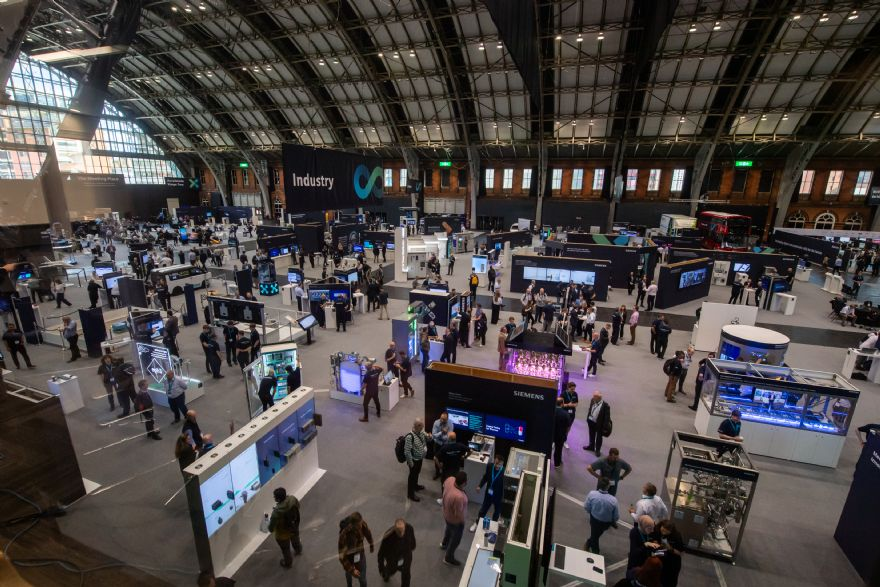
Siemens will bring its Transform event back to Manchester Central on 15 and 16 July, with industrial AI, digital twins, simulation, electrification, automation, cybersecurity, and smart grid technologies forming the core of the programme.
The two-day event will include live demonstrations, technical sessions, stage discussions, hackathons, and training for industrial and infrastructure organisations across the UK and Ireland. Siemens is placing the programme around the convergence of physical and digital systems, with emphasis on how factories, energy networks, buildings, and transport infrastructure can use connected engineering tools more effectively.
That convergence is becoming a practical engineering issue as manufacturers face rising energy demand, skills shortages, cyber risk, supply chain disruption, and pressure to improve productivity without weakening resilience. Digital transformation has moved beyond isolated pilots and dashboards, with more companies now trying to connect design, production, maintenance, site energy, and management systems into usable industrial workflows.
Digital twins and simulation will be central to the event because they give engineers a way to test decisions before they reach the shop floor. A useful digital twin is not simply a visual model of a machine or factory line; it supports commissioning, layout changes, process optimisation, maintenance planning, and energy modelling. When it carries accurate data from the real system, it can reduce rework and shorten the gap between design intent and operational performance.
Industrial AI is following a similar route into bounded engineering tasks. The strongest applications are emerging in automation design, diagnostics, quality inspection, production scheduling, and energy management, where outputs can be checked against defined requirements. Siemens has already extended AI into automation workflows through its Eigen Engineering Agent, which is being developed for electrical design integration, PLC work, HMI creation, and project generation.
Electrification gives the event a wider industrial dimension. Factories, logistics centres, data centres, public buildings, and transport sites are becoming more power-intensive as automation, EV charging, heat electrification, robotics, storage, and digital infrastructure expand. Electrical systems are no longer only a facilities concern. They now shape production capacity, resilience, operating cost, and decarbonisation planning.
Automation and energy management are therefore becoming harder to separate. A production site investing in robotics or high-speed equipment must understand load profiles, grid capacity, backup requirements, harmonics, and energy cost exposure. A building operator installing smarter control systems needs to manage comfort, power, security, maintenance, and data as connected functions. The older distinction between factory automation, electrical infrastructure, and building systems is losing usefulness.
Cybersecurity will sit alongside those technologies because connected systems increase both visibility and exposure. Industrial networks now link sensors, controllers, drives, safety systems, remote access tools, cloud platforms, and business applications. Each connection can improve performance, but each also requires ownership, segmentation, monitoring, and update discipline. Modernisation that leaves critical systems exposed simply moves the bottleneck from productivity to risk.
Skills will be another major part of the programme. Digital and electrified systems require technicians, engineers, operators, and managers who can specify, integrate, maintain, and improve them. Technology can reduce repetitive work, but it does not remove the need for industrial competence. Poorly understood automation or AI can create fresh sources of downtime, while well-integrated tools give experienced teams more capacity to solve higher-value problems.
Transform will give UK industrial companies a concentrated view of how Siemens is joining automation, software, power infrastructure, and industrial data. The most valuable demonstrations will be those that show measurable gains in uptime, commissioning speed, energy performance, safety, or maintainability. Industrial transformation is now less about adopting digital tools and more about building systems that remain useful under cost pressure, skills constraint, and operational uncertainty.