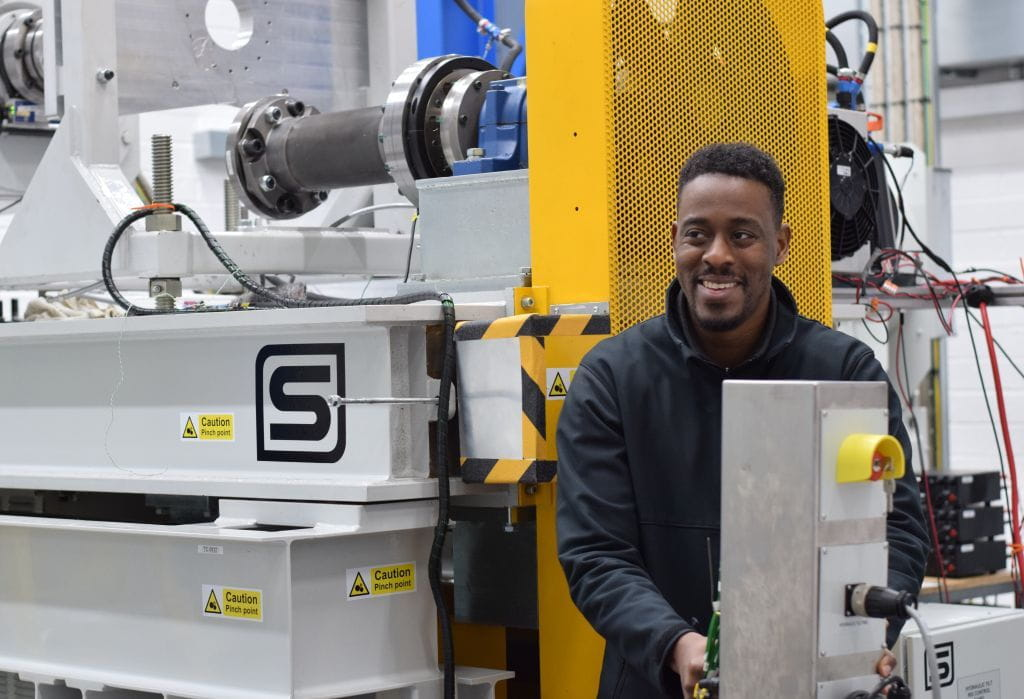
Gewefa UK is bringing Kemmler Präzisionswerkzeuge’s KSG600 shrink fit unit to the UK and Irish markets under its sole agency agreement with the Southern German tooling specialist.
The KSG600 combines inductive heating and air cooling in a single workstation for high-precision toolholding. It is designed for carbide and high speed steel tools from 3 mm to 32 mm in diameter and up to 490 mm long, targeting production environments that need repeatable clamping, controlled tool changes, and reduced setup variation.
Shrink fit technology uses controlled heating to expand the toolholder bore, allowing the cutting tool to be inserted before the holder cools and clamps around it. The method is valued for rigidity, concentricity, balance, and tool life, particularly in high-speed and high-precision machining. Its performance depends heavily on thermal control, since overheating can damage holders and cutting tools while inconsistent heating and cooling can reduce repeatability.
Kemmler’s system uses a single-touch operating concept with three preprogrammed energy efficient cycles. Through WLAN or Ethernet connectivity, users can access real-time status information, configure parameters, and monitor the system remotely, aligning tool preparation with more digitally networked production environments.
The KSG600 includes SafeControl technology, which monitors the inductive heating process in real time. Once the shrink fit holder reaches the required temperature, the system automatically stops heating and starts controlled cooling. Typical cooling time is two to three minutes, with built-in sensors and software regulating input power between 7 kW and 16 kW according to holder mass and geometry.
The unit supports SK, BT, CAT 40 and 50, HSK 63 and 100, and Capto C6 interfaces. Stop rod sets, cooling tubes with depth adjustment, adapter rings, and interchangeable ferrite discs support repeatable shrink depth and magnetic field shielding during induction heating. An additional cooling box can store and air cool up to five holders, helping reduce toolroom bottlenecks where preparation and cooling time interrupt machine utilisation.
Toolholding sits directly in the machining capability chain. Runout, clamping stability, vibration, thermal behaviour, and setup variation all influence surface finish, dimensional accuracy, tool life, spindle load, and scrap. As production teams push towards less attended machining, those variables become harder to manage through operator intervention alone.
More tightly engineered production hardware is appearing across the wider manufacturing environment. Motion components built for vacuum, temperature, and aggressive environments show how standard mechanical systems are being redesigned around process risk. Toolholding is subject to the same pressure, especially where a weak holder, inconsistent setup, or uncontrolled heating process can compromise a high-value part.
Digital monitoring changes how toolrooms manage repeatability. Heating cycles, holder types, temperature control, cooling times, and operator actions can be standardised more easily when the process is instrumented and connected. That supports job shops running mixed parts and manufacturers in aerospace, medical, automotive, and mould and die work, where process evidence and dimensional stability carry commercial value.
Gewefa UK already supplies toolholding and allied equipment across metal, composite, and wood machining industries. The Kemmler agency extends its portfolio into the tool preparation stage, which is becoming more important as manufacturers focus on fewer setups, tighter tolerances, and lower process variation.
The KSG600 launch reflects a broader move to treat every interface between tool, holder, spindle, and operator as part of the controlled manufacturing process. In high-value machining, productivity depends less on isolated equipment performance and more on whether the entire process can be repeated without drift.