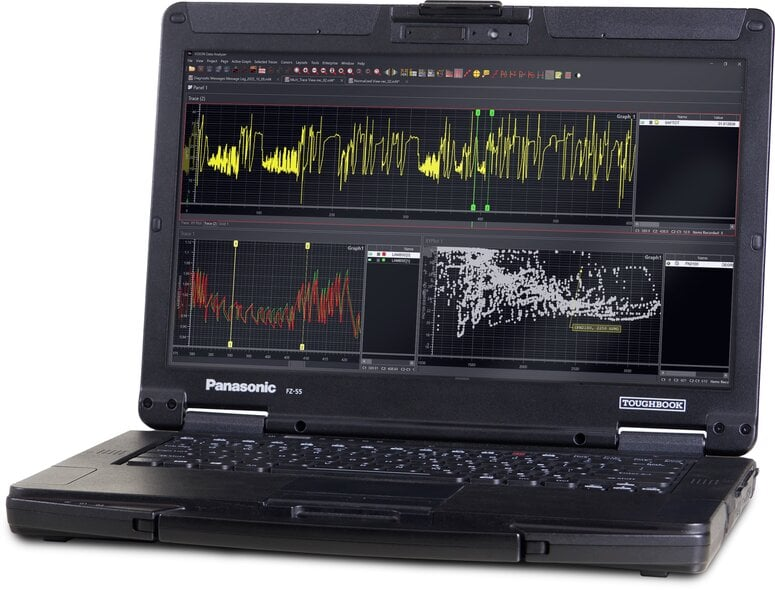
Accurate Technologies Inc. has released VISION Data Analyzer 4.1, an updated software platform for processing and analysing MDF4 measurement data across automotive, EV, hybrid, aerospace, off-highway, and industrial test applications.
The update adds workspace, visualisation, and network protocol capabilities for engineers working with large recorded data files from vehicle and machinery testing. The platform is designed to help calibration, validation, and test teams inspect recorded signals, bus traffic, GPS information, graphs, and dashboard views within one analysis environment.
VISION Data Analyzer 4.1 introduces a modular, dockable workspace that allows pages and tabs to be distributed across multiple monitors. Engineers can view data grids, GPS maps, graphs, and dashboards simultaneously, while a synchronised chain cursor links navigation across open windows in real time.
The software also adds a dashboard page with configurable circular and linear gauges, supporting post-test debriefs and live review sessions. Visualisation tools can help teams move quickly from raw recorded data to a shared understanding of system behaviour, fault conditions, or test results.
The main technical addition is native support for displaying Controller Area Network and Local Interconnect Network messages directly from recorded MDF4 files. Engineers can inspect raw CAN and LIN bus traffic alongside measured sensor signals in one application, using message filtering and time slider synchronisation.
MDF4 is a standard measurement data format widely used in automotive and industrial testing because it can handle high-frequency signals, large file sizes, compression, metadata, and complex test information. CAN is used for higher-speed vehicle and machinery communication, while LIN is commonly used for lower-speed body electronics and distributed functions. Combining those traces with sensor data reduces the need to move between separate tools.
The update is also designed to connect with VISION Enterprise, an optional module scheduled for release later in 2026. That platform is intended to support centralised MDF4 file storage and advanced metadata search for distributed engineering teams.
The release reflects a wider change in engineering validation. Vehicles, machines, and industrial systems are producing more data as electronics, software, sensors, connectivity, and control functions increase. Test teams now have to understand interactions between embedded systems, network messages, calibration parameters, physical signals, operating conditions, and customer use cases.
Automotive development shows the pressure clearly. Electrified platforms, software-defined vehicle architectures, advanced driver assistance, battery management, and connected functions have multiplied the amount of test data that engineering teams need to manage. At the same time, production uncertainty and cost pressure are forcing manufacturers and suppliers to shorten development loops without losing validation depth.
Electric drive development illustrates the level of engineering complexity involved. Programmes such as large-scale axial flux motor production require close coordination between design, calibration, validation, power electronics, thermal behaviour, and manufacturing readiness. Test and analysis platforms must keep pace with that complexity if engineering teams are to identify issues early enough to act.
Industrial equipment faces similar demands. Off-highway machinery, aerospace systems, automated equipment, and electrified industrial vehicles are becoming more software controlled and sensor rich. Field testing generates large datasets that must be interpreted quickly enough to support design changes, durability work, compliance evidence, and customer issue resolution.
Metadata is becoming a central part of that work. As test volumes grow, engineering teams need to find the correct file, vehicle configuration, software version, sensor channel, ambient condition, or event sequence without relying on manual naming conventions. Centralised storage and searchable metadata can reduce wasted engineering time, provided teams maintain consistent test discipline.
Data analysis tools also shape collaboration. A calibration engineer, software engineer, mechanical engineer, test driver, and programme manager may all need to interpret the same test run from different perspectives. Dashboards, synchronised cursors, maps, graphs, and bus traces can align discussion around evidence rather than recollection.
Data volume alone does not improve engineering decisions. Test teams need tools that preserve context, reduce friction, and allow anomalies to be traced across physical signals and network behaviour. VISION Data Analyzer 4.1 is aimed at that practical gap, bringing MDF4, CAN, LIN, dashboard, and visual review workflows into a more integrated environment.
As products become more connected and software dependent, validation data becomes an industrial asset. Companies able to capture, search, interpret, and act on that data quickly will be better placed to shorten development cycles and avoid late-stage engineering surprises.