BrightHeart has received CE marking for its B-Right AI Platform, enabling commercialisation of its prenatal ultrasound technology across the European Union.
The company will make its European debut at the Fetal Medicine Foundation World Congress in Vienna, running from 28 June to 2 July 2026. The approval follows earlier FDA clearances, an €11m Series A funding round, and launch activity through GE HealthCare’s Voluson Solution Store.
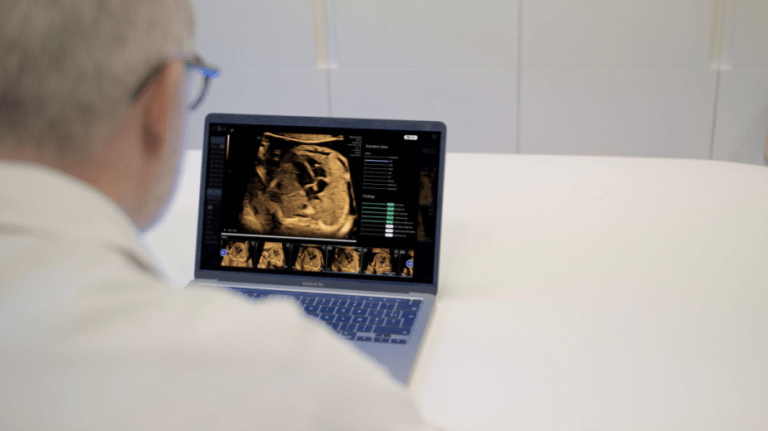
BrightHeart’s platform supports prenatal ultrasound examinations through live acquisition guidance and advanced morphological evaluation of critical fetal organs. The system is intended to reduce procedural variation, support protocol adherence, and provide structured analysis during one of the most technically demanding areas of diagnostic imaging.
Fetal ultrasound depends heavily on operator skill, scan conditions, fetal position, imaging quality, and access to specialist expertise. BrightHeart is targeting that variability by guiding sonographers during acquisition and applying AI analysis to assessment, beginning with cardiac screening and extending towards brain analysis and broader prenatal workflow support.
The company has cited peer-reviewed clinical evidence including a standalone validation study of 877 examinations against an expert cardiologist reference standard. In that study, the software identified findings associated with severe defects with 98.7% sensitivity and 97.7% specificity among conclusive exams, with results returned in 98.7% of cases.
CE marking is a key regulatory threshold for AI-enabled medical software, but commercial adoption still depends on clinical workflow, data governance, support, training, and post-market performance monitoring. A tool used in prenatal screening has to assist clinicians without slowing examination rooms or increasing uncertainty during time-sensitive appointments.
AI-enabled medical devices are moving through European regulatory routes across several clinical areas. DermaSensor’s AI-powered skin cancer assessment device and Cardiawave’s ultrasound therapy platform rollout both show how medical technology companies are now pairing approval with controlled deployment into clinical settings.
AI medical devices are rarely software-only in operational terms. They depend on imaging hardware, clinical workflows, cybersecurity, data integration, user interface design, software lifecycle management, quality systems, and technical support. Even when the product runs as software, it has to behave as part of a regulated medical system.
Ultrasound equipment manufacturers and imaging technology suppliers are increasingly working in that combined space. The value of a scanner is shaped not only by image quality, but by how effectively the system supports consistent acquisition, reduces variation, and helps clinicians identify relevant features. AI guidance and analysis tools are becoming part of that broader imaging workflow.
That shift changes the manufacturing and lifecycle burden. AI-enabled medical products require controlled software updates, version management, clinical performance monitoring, documentation, cybersecurity controls, and regulatory evidence. Updates cannot follow consumer software habits; they must preserve safety, performance, and compliance while adapting to new data and clinical use.
Healthcare systems are under pressure to improve access to specialist diagnostics while managing staffing constraints and rising demand. Prenatal ultrasound departments face limited appointment windows, variable scan conditions, and high consequences when abnormalities are missed. Any AI tool introduced into that environment has to work within established clinical practice rather than create a parallel process.
The Vienna launch gives BrightHeart access to a specialist fetal medicine community that will understand both the promise and the limitations of AI support. Clinical confidence will depend on evidence, usability, training, integration, and the ability to perform reliably across different centres, operators, equipment settings, and patient populations.
BrightHeart’s CE mark therefore opens the commercial route into Europe, but the harder assessment will take place in clinical use. The platform now has to show that it can support consistent prenatal imaging at scale while fitting into the regulated, time-constrained, and evidence-led environment of modern diagnostic care.