
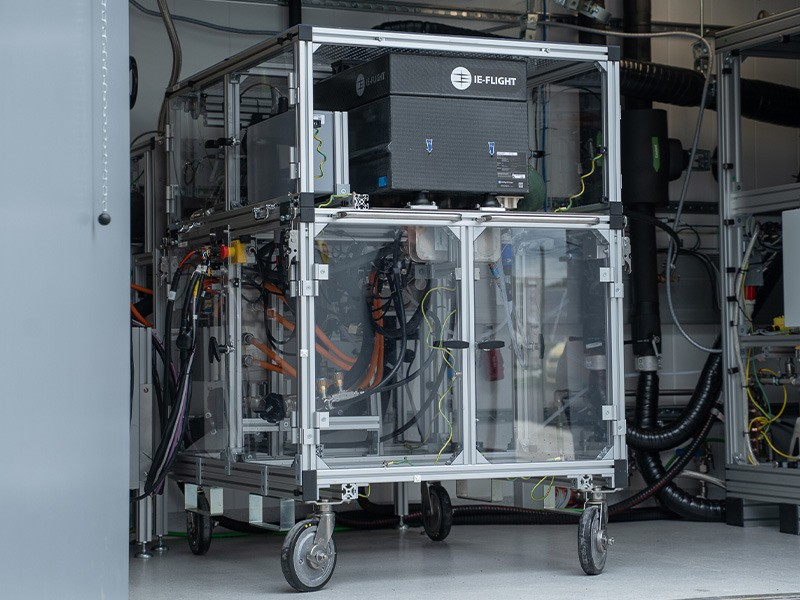
Intelligent Energy has completed work on H2GEAR, the UK hydrogen electric aircraft propulsion programme, and is applying the resulting technology to commercial fuel cell systems for zero-emission aircraft.
The £54m programme, formally known as Hydrogen Electric Aircraft Propulsion System, was led by GKN Aerospace with support from the Aerospace Technology Institute, the Department for Business and Trade, and Innovate UK. It brought together industrial and academic partners to develop scalable hydrogen electric propulsion technologies for future aircraft.
Intelligent Energy’s work has supported advances in power density, drag reduction, and dynamic response, all of which are central to making hydrogen fuel cells viable in aviation applications. Aircraft propulsion places severe demands on weight, packaging, thermal management, and response time, leaving little tolerance for systems that work only in controlled test environments.
The company is now feeding the H2GEAR development into Project HEIGHTS, a £17m ATI-backed programme launched in 2025. HEIGHTS is developing IE-FLIGHT 300, a modular hydrogen fuel cell platform designed for eVTOL aircraft and next-generation sub-regional aircraft.
That target market sits between battery electric demonstrators and larger aircraft where full propulsion system integration becomes more complex. Batteries remain suitable for some short-range and low-power applications, but aviation exposes limits around range, mass, charging time, and duty cycle. Hydrogen fuel cells offer a different route, provided the storage, balance of plant, thermal system, controls, and certification case can be engineered into a practical aircraft architecture.
Intelligent Energy has also developed a 1.3MW aviation fuel cell test facility in Northamptonshire. Testing at that scale is a critical part of the transition from programme research to aircraft-ready systems, since propulsion equipment must be assessed at power levels that reflect operational requirements rather than laboratory conditions.
Qualification will depend on how the complete system behaves under vibration, load cycling, thermal variation, fault conditions, and maintenance requirements. Stack performance is only one part of the problem. Balance of plant design, power electronics, hydrogen handling, safety systems, cooling, software validation, and serviceability all have to work as part of one certified propulsion system.
The development arrives as the UK aerospace supply chain is being pushed towards new propulsion systems, autonomous technologies, advanced materials, and digital engineering. Platforms for advanced engineering and defence capability have become more visible as government and industry seek stronger routes from research activity into industrial production, testing, and supply chain participation.
Hydrogen aviation also depends on infrastructure beyond the aircraft. Production, liquefaction or compression, airport storage, refuelling, safety procedures, maintenance regimes, and operational economics will all shape adoption. A fuel cell powertrain may provide a lower-emission propulsion route, but operators still need a system that can be refuelled, maintained, and scheduled without adding unsustainable complexity.
The focus on eVTOL and sub-regional aircraft gives the technology a practical early market. These platforms have smaller power requirements than large commercial aircraft, shorter routes, and more controlled operating models. They can help prove propulsion architecture, hydrogen handling, certification evidence, and maintenance practice before larger applications are attempted.
The industrial opportunity reaches well beyond fuel cell stack production. Hydrogen aircraft systems require materials engineering, precision manufacturing, thermal management, test systems, control electronics, sensors, safety valves, tanks, software, and aerospace-grade quality management. Each area creates supply chain demand, although participation will depend on meeting strict performance and certification requirements.
H2GEAR’s completion gives Intelligent Energy a stronger technical base for commercial hydrogen aviation work. The demanding phase now sits in production readiness, certification evidence, and supply chain execution, where research gains must be translated into systems that can operate reliably in aircraft over repeated duty cycles.


