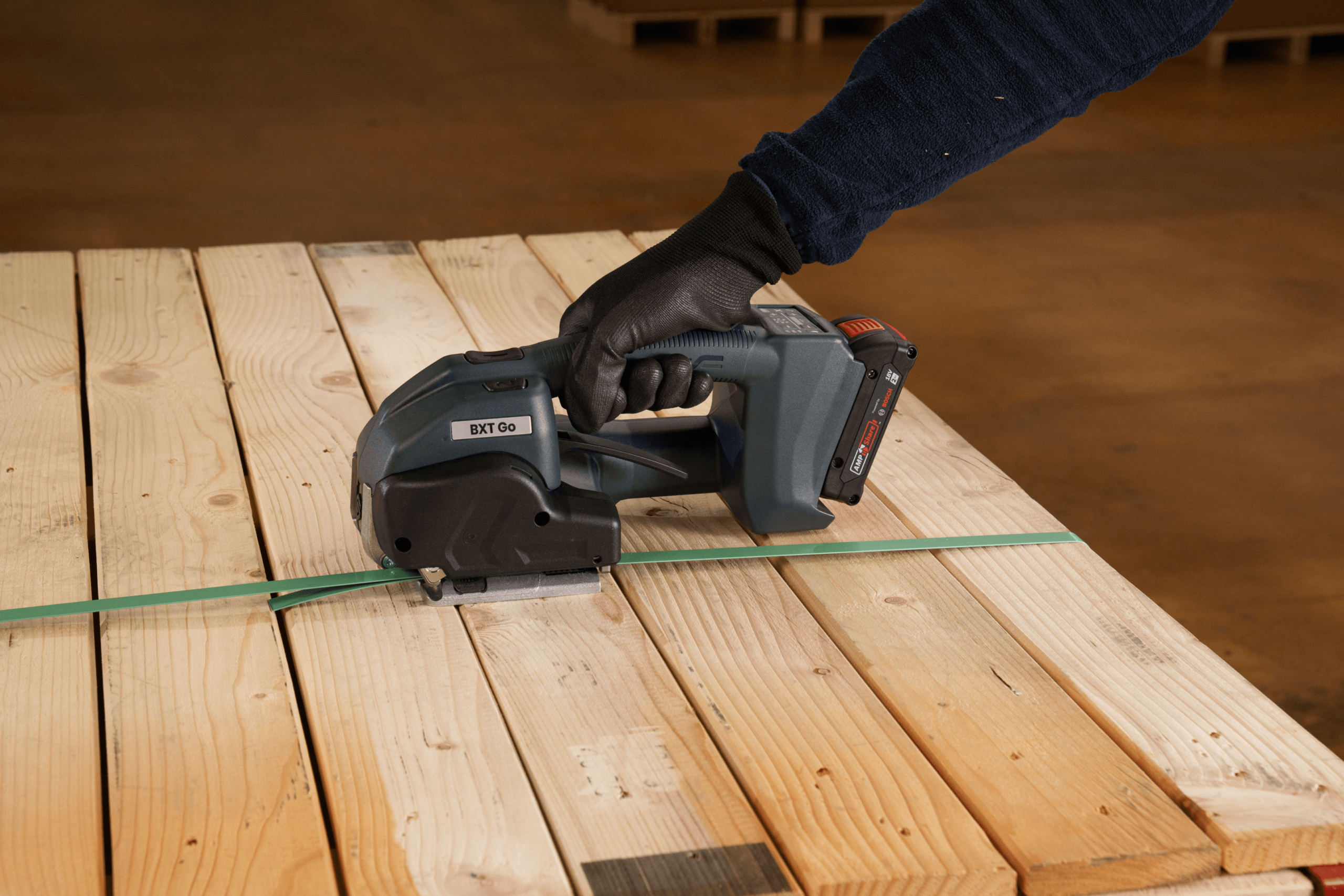
Signode has launched the BXT Go battery-powered hand tool for plastic strapping, offering a mid-level option for everyday manufacturing, warehousing, logistics, and distribution applications.
The tool has been engineered in Switzerland and is designed to support PET and PP strapping in 1/2-inch and 5/8-inch sizes. It includes automatic, semi-automatic, and manual operating modes, giving users flexibility across routine packaging, palletising, bundling, unitising, and distribution tasks.
The BXT Go weighs 8.05 pounds including the battery and uses an 18V Bosch lithium-ion battery system that can charge to 80% capacity in approximately 24 minutes. Signode has emphasised weight balance and operator comfort, positioning the tool for daily use where repetitive handling and strapping work can contribute to fatigue.
Nicole Ostryzniuk, Vice President of Global Tools at Signode, said: “The BXT Go strapping tool was developed to meet customers’ mid-level strapping applications, complementing the BXT4 strapping tool, which is designed for a broad range of applications, including heavy-duty, high-tension use. Its features and lightweight design make it a practical and reliable handheld option for professionals seeking a balance between cost and productivity.”
Battery strapping tools occupy a practical part of the packaging and logistics equipment market. They are less visible than fully automated lines, but they shape daily productivity in factories, warehouses, and dispatch areas where goods need to be secured quickly and consistently. Manual tools can be adequate at low volumes, while higher throughput places pressure on operator effort, strap tension consistency, battery life, and downtime between charges.
Packaging operations are being reassessed for labour efficiency and manual handling. Automated packing equipment for quarrying operations has shown how industrial packaging is moving towards repeatability and lower labour dependency in harsh environments. The BXT Go addresses a smaller-scale part of the same problem by reducing fatigue and improving consistency where handheld equipment remains the right fit.
Not every operation can justify fixed automation. Mixed loads, variable pallet sizes, distributed packing points, and lower volume production often still require mobile tools. In those settings, ergonomic design, battery performance, and consistent strap tension can have a measurable effect on productivity. A tool that is too heavy, slow to recharge, or unreliable under daily use introduces delays even when the wider packing process is well designed.
The use of PET and PP strapping gives the tool relevance across a broad range of loads. PET is commonly used where higher strength and load stability are required, while PP remains widely used for lighter and medium-duty applications. Supporting both materials allows operations to use one tool across different packaging requirements, provided strap size and tension needs sit within the tool’s capability.
Signode has also highlighted sustainability considerations, including metal and plastic components made from recycled and recyclable materials that are easily replaceable. In industrial packaging equipment, sustainability is strongest when linked to product life, maintenance, replaceable parts, and material efficiency rather than broad claims. A tool that lasts longer and can be serviced can reduce replacement frequency and support lower lifecycle impact.
Ostryzniuk added: “As manufacturing, warehousing, and distribution operations continue to evaluate ways to support their sustainability objectives, there is growing demand for tools and equipment designed with product longevity and material considerations in mind. The BXT Go strapping tool is ideal for customers looking for a long-term, mid-level strapping solution.”
The BXT Go targets a practical middle ground. It is not intended to replace high tension or fully automated systems, but to give everyday operations a more productive handheld option. Warehouses and factories trying to reduce strain, control costs, and maintain packing reliability often need exactly that balance.