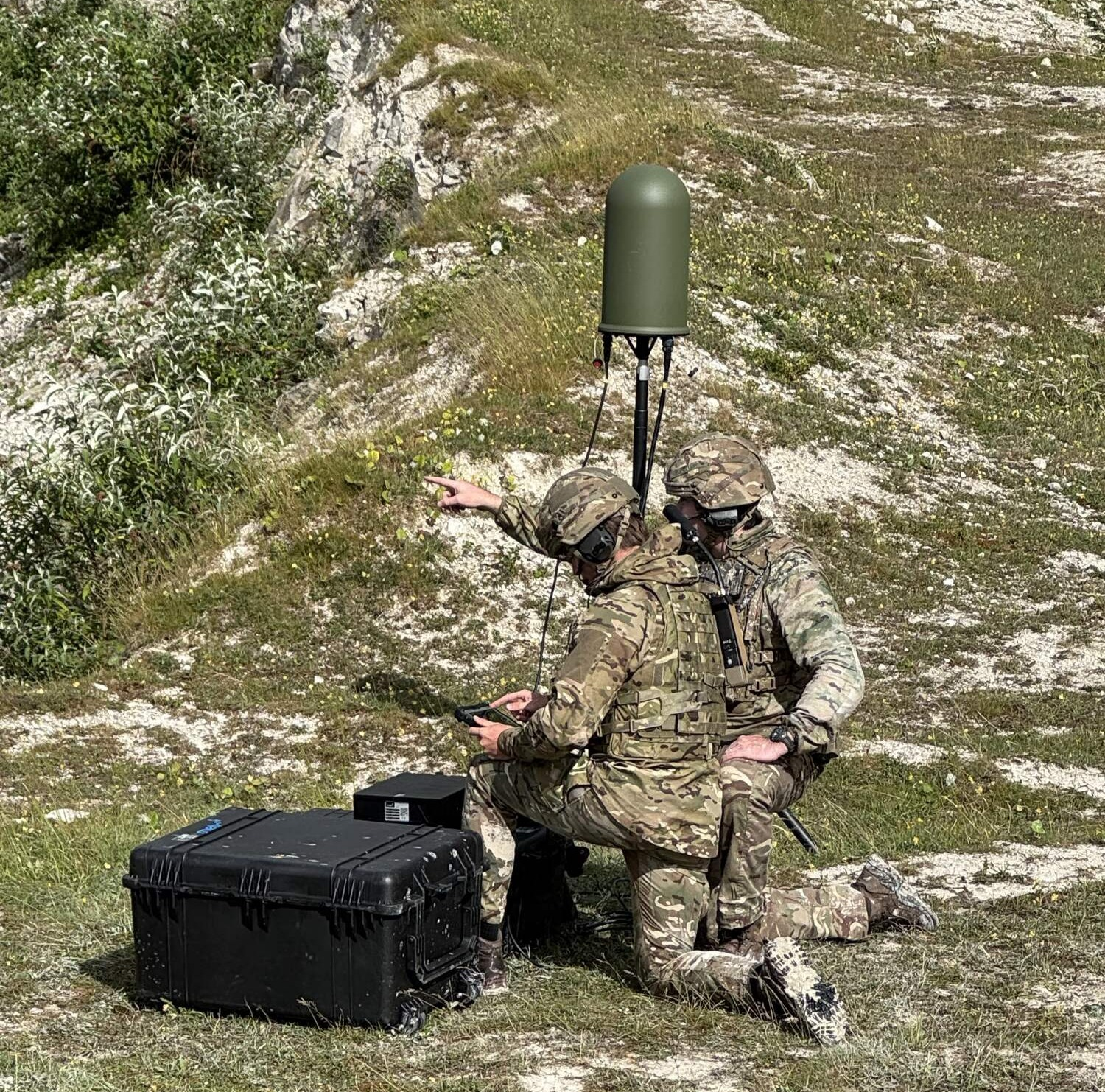
Metis has been selected by Kongsberg to supply Skyperion Lightweight passive RF sensors for Poland’s SAN counter-uncrewed air system programme, strengthening UK involvement in one of Europe’s fastest-developing defence technology markets.
The Lincoln-based company specialises in radio-frequency sensing and drone detection technology. Its Skyperion Lightweight system is designed to detect and locate RF emissions associated with drones and their control links, giving operators a passive method of identifying threats without transmitting signals of their own.
The order is connected to a Polish counter-UAS programme worth more than £30 million and places Metis technology inside a wider air-defence architecture led by Kongsberg. The sensors can be vehicle-mounted, deployed for static protection, or integrated into maritime and other operational environments, giving the system flexibility across land, base-protection, and infrastructure-security roles.
Ben Hewitt, Chief Commercial Officer at Metis, said: “Securing this contract with Kongsberg is a major achievement for Metis and reinforces the confidence placed in our technology by other leading defence partners. The SAN cUAS programme represents an important step forward in strengthening counter-drone capability in Poland and across the region.”
European defence planners are placing greater weight on layered counter-drone systems as small uncrewed aircraft become cheaper, more numerous, and more adaptable. Detection now carries as much urgency as defeat, because operators need enough time to distinguish genuine threats from clutter, classify the target, and choose a response that does not waste expensive effectors.
Passive RF sensing is gaining ground because it can identify drone activity without creating its own detectable emissions. That is valuable in contested environments, where electronic signatures can expose the defender, and in static protection roles where persistent monitoring is required. RF sensors can sit alongside radar, electro-optics, acoustic systems, and electronic-warfare tools in a layered architecture.
The integration work behind counter-UAS capability is becoming increasingly complex. Sensors, command software, vehicles, effectors, communications links, and operator interfaces all need to behave as one system. If detection data cannot be fused and acted upon quickly, individual sensor performance is of limited value.
That requirement is reshaping defence electronics. Suppliers are being asked to deliver compact hardware, low-power operation, ruggedised designs, secure data handling, and rapid integration into larger architectures. The same pressure is visible in the shift towards larger autonomy test and scale infrastructure, including the new DroneTEX facility in Swindon.
The Metis order also gives a smaller UK specialist a stronger export pathway. Defence electronics companies often grow by proving a focused technology inside multinational systems, where larger primes provide the platform, procurement route, support structure, or command architecture. That can take specialist British engineering into programmes that would otherwise be difficult to reach directly.
Poland’s investment reflects the wider security shift across eastern Europe. Air defence, surveillance, counter-drone capability, and electronic warfare are all receiving renewed funding as countries respond to a more hostile regional environment. Systems that can be deployed quickly, integrated with existing command structures, and scaled across multiple units or sites are likely to remain in demand.
Counter-drone technologies will also influence civil and critical infrastructure markets. Ports, airports, prisons, energy sites, defence estates, and major industrial facilities are assessing drone risk, even where military-grade responses are not appropriate. The underlying technologies — passive RF sensing, data fusion, classification algorithms, and resilient communications — will shape those markets as they mature.
Kongsberg’s selection gives Metis a stronger role in that transition. The company’s task now is to show that specialised UK RF technology can operate reliably inside European defence systems where speed, accuracy, and integration discipline determine whether detection becomes usable protection.