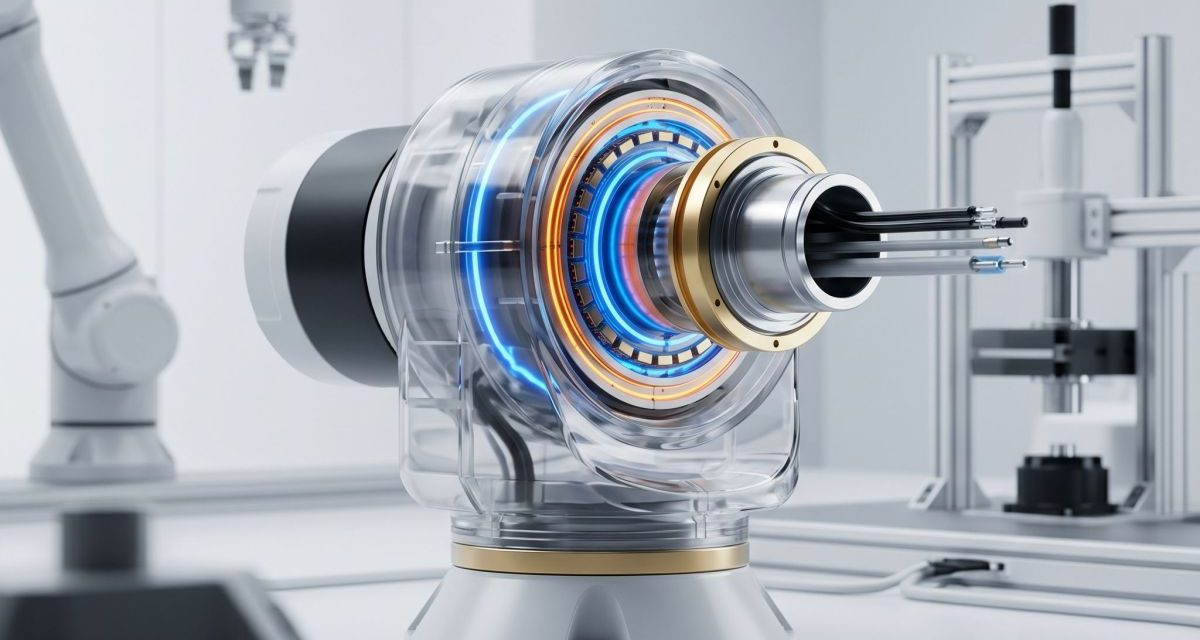
RLS has expanded its magnetic encoder portfolio with AksIM-4 Dual Concentric, an ultra-thin absolute encoder designed to provide motor-side and joint-side position feedback from one coplanar package.
The technology is being made available through Astute Group and has been shown at Hardware Pioneers Max 2026 at ExCeL London. Target applications include robotic arms, humanoid platforms, collaborative robots, surgical systems, precision automation, and other motion-control systems where joint space is becoming increasingly constrained.
Robotic joints commonly require separate feedback systems for motor rotation and final output position after a gearbox or reducer. That arrangement adds cabling, mounting features, components, and assembly work. AksIM-4 Dual Concentric places both feedback systems on one flat-ring structure, allowing both measurements to be captured within the same footprint.
The architecture retains the through-bore layout used across the AksIM family. Designers can route power cables, data harnesses, pneumatic lines, cooling circuits, or vision-system wiring through the centre of a joint without blocking position feedback. A component-level change can therefore influence the wider mechanical layout of a robot arm, joint module, or compact motion assembly.
RLS’s magnetic encoder technology provides absolute position measurement without optical discs or batteries. Existing AksIM architectures support high-resolution operation and immediate position availability after power-up, reducing the need for homing routines. The magnetic approach also improves tolerance to dust, oil, moisture, and vibration, which are common constraints in industrial and medical automation environments.
Robotics engineering is moving towards smaller, more integrated, and more sensor-rich platforms. Humanoid and collaborative robots need high joint density without sacrificing maintainability, while surgical and laboratory systems need compact motion assemblies that remain accurate inside tightly controlled envelopes. Every cable, sensor, connector, and mounting feature competes for space inside the joint.
Encoder selection affects more than motion feedback. Additional sensors create more procurement lines, assembly steps, wiring routes, failure modes, and service requirements. Combining motor and joint feedback into one package can reduce design friction where the joint envelope is already crowded by motors, reducers, brakes, bearings, connectors, structural components, and protective housings.
The wider automation sector is also moving towards more integrated mechatronic modules. Robot cells, machine tools, packaging systems, inspection equipment, and autonomous platforms increasingly rely on sensing hardware embedded deep inside the mechanism. As robotic systems move into more specialised industrial tasks, including automated aircraft cabin marking on final assembly lines, component reliability and compact integration become central to deployment.
Position feedback sits at the heart of that shift. Robots need to know where each axis is, while higher-performance systems also need confidence that commanded and actual positions match under load, after gear reduction, and across changing duty cycles. Measuring motor position alone can miss backlash, compliance, or downstream movement. Measuring output position improves control fidelity, but traditionally adds hardware and packaging complexity.
Industrial electronics suppliers are being pushed to provide longer availability, rugged operation, and higher integration while OEMs reduce assembly time and simplify their supply chains. Cutting encoder count can help manufacturers rationalise inventory, especially where a common design platform is used across several joint sizes or robot variants. Fewer components can also support lighter joints, easier assembly, and simpler field maintenance.
The benefits may not be visible at the robot user interface, but they can shape machine cost, uptime, and serviceability. In smaller robotic systems, small reductions in mass, wiring, and packaging complexity can affect reach, payload, torque, reliability, and ease of integration. A compact dual-feedback encoder therefore addresses one of the less glamorous constraints that often determine whether advanced automation becomes production-ready.
AksIM-4 Dual Concentric enters a market where software, AI, and control systems attract most attention, while the mechanical and sensing hardware still sets the limits of what can be built. Smaller, safer, more capable robots will depend on components that allow designers to increase function without increasing complexity. RLS’s new encoder is aimed directly at that constraint.