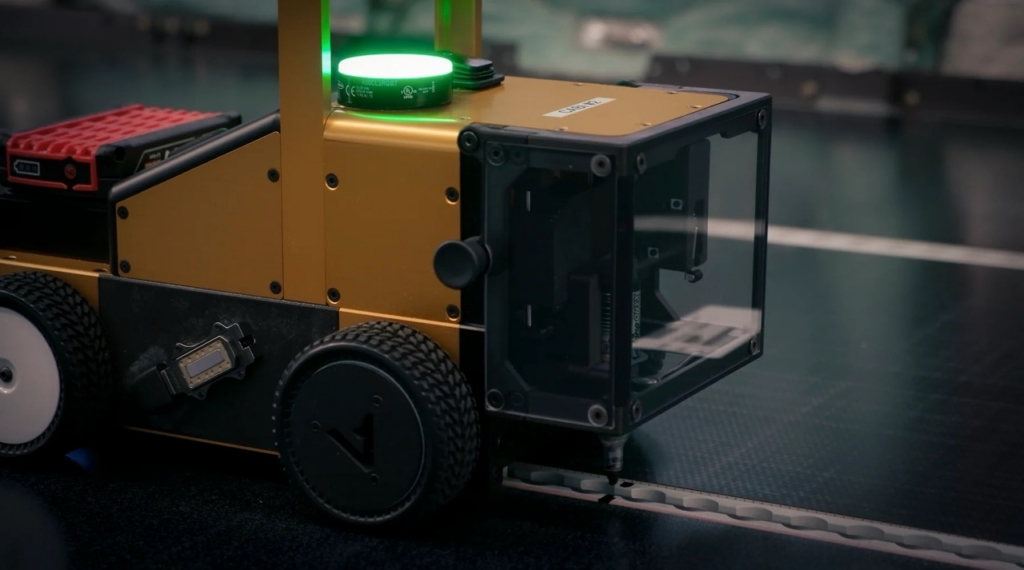
Airbus has developed CabinMarker, a compact robot designed to speed up aircraft seat installation and reduce a repetitive manual task during final assembly.
The four-kilogram robot automates the positioning marks used during aircraft seat installation, a job traditionally carried out manually by operators working along seat tracks inside the cabin. Airbus says the robot can reduce the marking process from around 150 minutes to about 30 minutes, cutting task time by roughly 80%.
The first units are expected to be delivered to the Jean-Luc Lagardère A321 final assembly line in Toulouse in late 2026. Developed by Airbus Robotics, the system is being positioned as a practical tool for production ramp-up, ergonomics, and quality improvement rather than as a broad automation demonstrator.
Seat installation is demanding because it takes place inside a constrained cabin environment. Operators bend, kneel, crawl, and work close to the floor while marking positions accurately along seat tracks. Even small errors can affect downstream installation work, create rework, or disrupt final assembly flow.
CabinMarker is designed to move through the cabin, locate reference points, and mark seat positions with repeatability. Automating the operation reduces physical strain and creates a more consistent link between digital design data and the physical aircraft. In cabin installation, seats, monuments, wiring, fittings, safety requirements, and customer-specific layouts all have to align.
The system is being introduced on the A321XLR line, where long-range narrowbody operations are creating new cabin-layout requirements for airlines. As aircraft interiors become more varied and manufacturers work through delivery backlogs, final assembly tools that reduce repetitive work and protect accuracy become more valuable.
Aerospace automation often struggles when standard factory robots meet the realities of large, variable, highly regulated products. Aircraft are not uniform boxes moving past fixed automation cells. They involve complex geometries, tight working spaces, thousands of parts, customer-specific configurations, and procedures that must remain repeatable and validated.
CabinMarker reflects a more targeted approach. Rather than trying to automate an entire assembly stage, Airbus has focused on a defined bottleneck where time, ergonomics, and accuracy are closely connected. Incremental automation can produce measurable gains without requiring a complete redesign of the production system.
Manufacturers across aerospace are pursuing similar routes through robotics, digital work instructions, automated inspection, metrology, and data-driven quality systems. The aim is not to remove skilled assemblers from aircraft production, but to reduce the burden of repetitive, awkward, or error-prone tasks so that experienced workers can focus on higher-value operations.
Capacity investment is also spreading through the European aerospace supply chain. Collins Aerospace’s expanded landing gear production in Poland shows how manufacturing networks are being strengthened as programmes prepare for sustained demand. Higher capacity has to be matched by production systems that can scale without undermining quality or workforce resilience.
Final assembly is particularly exposed to this pressure. Supply shortages, late configuration changes, missing parts, and manual rework can disrupt flow even when major structures arrive on time. A robotic tool that saves two hours on a repeated cabin task can become significant when multiplied across rate increases, customer variants, and constrained labour availability.
Ergonomics is also a production issue, not a welfare afterthought. Aerospace manufacturing depends on skilled people whose experience is difficult to replace quickly. Reducing physically demanding tasks helps protect that workforce, improves consistency, and makes production roles more sustainable over long shifts and high-rate environments.
Digital continuity adds another layer. Aircraft interiors are designed digitally, but final installation still depends on the accurate transfer of design intent into the cabin. A robot that carries digital data into the physical marking process reduces the gap between engineering data and shopfloor execution.
Airbus will still need to prove the system through deployment, operator acceptance, maintenance routines, and integration with existing production procedures. Automation in aircraft assembly is valuable only when it is reliable enough to become part of normal production rather than another exception to manage.
CabinMarker is a small machine aimed at a specific assembly problem, but the industrial logic is strong. Aerospace productivity gains often come from removing bottlenecks that are repeated thousands of times. In an industry under pressure on rate, quality, and labour availability, targeted robotics can carry more weight than its size suggests.