Hexagon has expanded the automation capability of its Leica Absolute Tracker ATS800 with AI-based feature recognition for large-scale quality inspection in aerospace, shipbuilding, wind turbine manufacturing, and other high-mix industrial environments.
The new capability, called FeatureDetect, uses the ATS800’s onboard camera to automatically locate circular features such as bolt holes and mating points. Precision inspection routines are often driven by CAD data, but operators still need to identify and align physical features before measurement begins. Automating that step reduces preparation time and improves repeatability across shifts, locations, and operators.
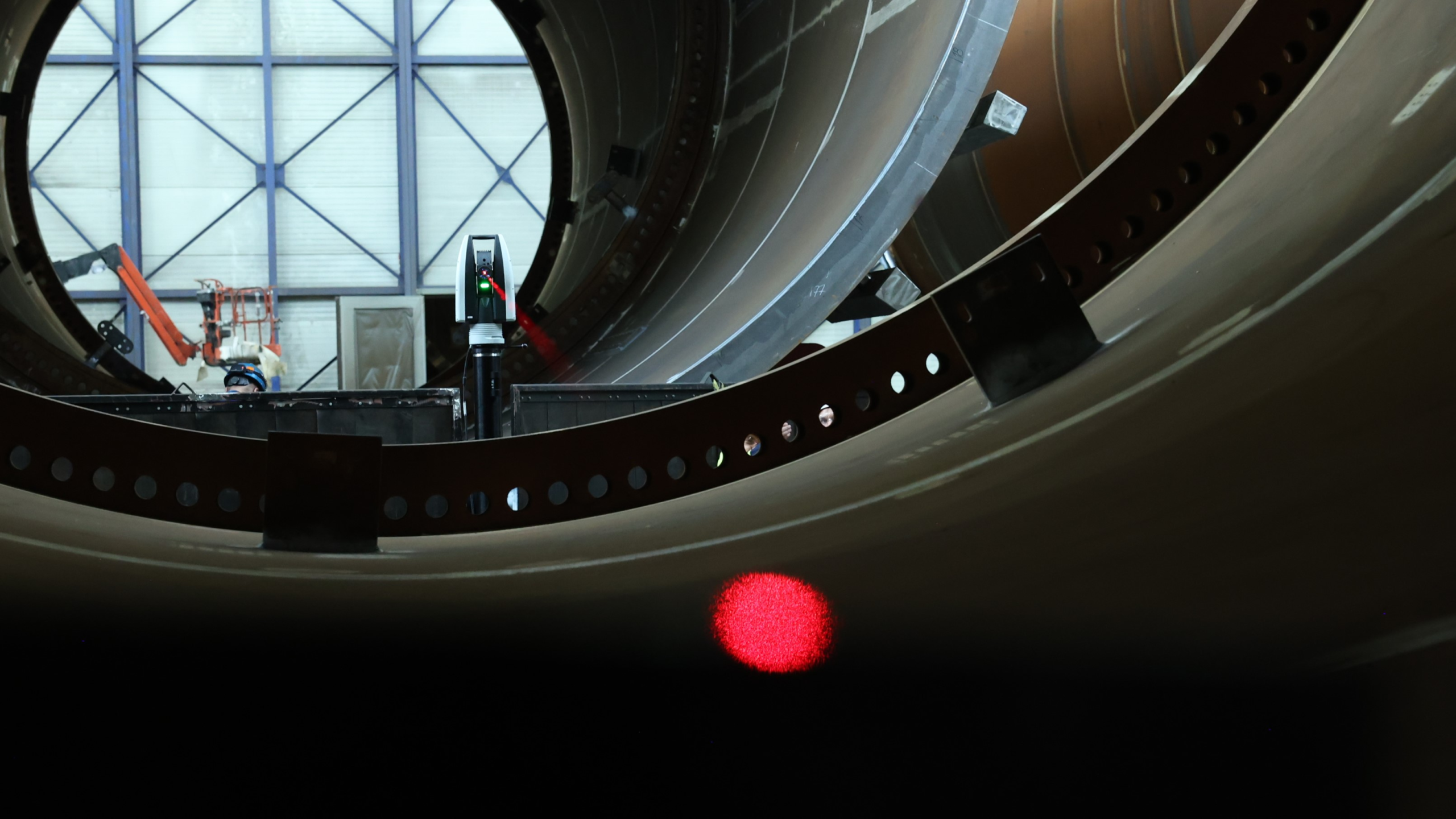
The ATS800 was launched in 2025 as a direct-scanning laser tracker capable of high-resolution measurement from up to 40m away. It can measure large structures without requiring workers to access every feature manually with probes, reflectors, cherry pickers, or temporary staging.
Aircraft assembly, shipbuilding, and large renewable energy structures all depend on inspection processes that can be difficult to automate using conventional measurement equipment. Critical features may be high, enclosed, obstructed, or spread across large geometries, while production teams still need reliable data on flush, gap, hole position, mating surfaces, and structural alignment.
Hexagon says the system can reduce inspection of aircraft, wind turbine, and other large-part features from multiple days to hours. The tracker is portable, battery-powered, and can be mounted on a tripod, rack, rail, or autonomous mobile robot. With PowerLock reflector tracking, it can establish a positional reference within a wider coordinate system, supporting both fixed and mobile automated inspection workflows.
GKN Aerospace’s Dutch operations are among the first users to evaluate the ATS800. Roy Helmos, Tool Service Manager at Fokker Aerostructures, said: “This tracker will help automate measurement and increase efficiency. During the proof of concept, we already identified opportunities to make the process even faster working with Hexagon and our integration partner, ARGON.”
ARGON has integrated Hexagon direct-scanning tracker technology into a forklift-based measurement station, allowing semi-automated inspection of large and hard-to-access components directly on the shop floor. The approach avoids the cost and complexity of a full robotic cell while reducing dependence on operator skill for repetitive measurement tasks.
Geert Creemers, Founder & Managing Partner at ARGON, said: “We are only scratching the surface of what’s possible with this direct scanning technology. It brings precision and speed to domains where manual measurement was the norm. We call it ‘automation without robots’. In most cases, we achieve efficiency gains of five to ten times, combined with significantly improved, operator-independent data quality.”
Hexagon is also positioning the ATS800 for unattended and remote inspection. Built-in Wi-Fi supports remote operation, while FeatureDetect and PowerLock allow the tracker to locate targets, establish its position, and begin measurement in a new area. Mounted on an autonomous mobile robot, the system can access underside fuselage areas, flanges, and other difficult geometries during production or overnight shifts.
More information is available on the Leica Absolute Tracker ATS800 product page.