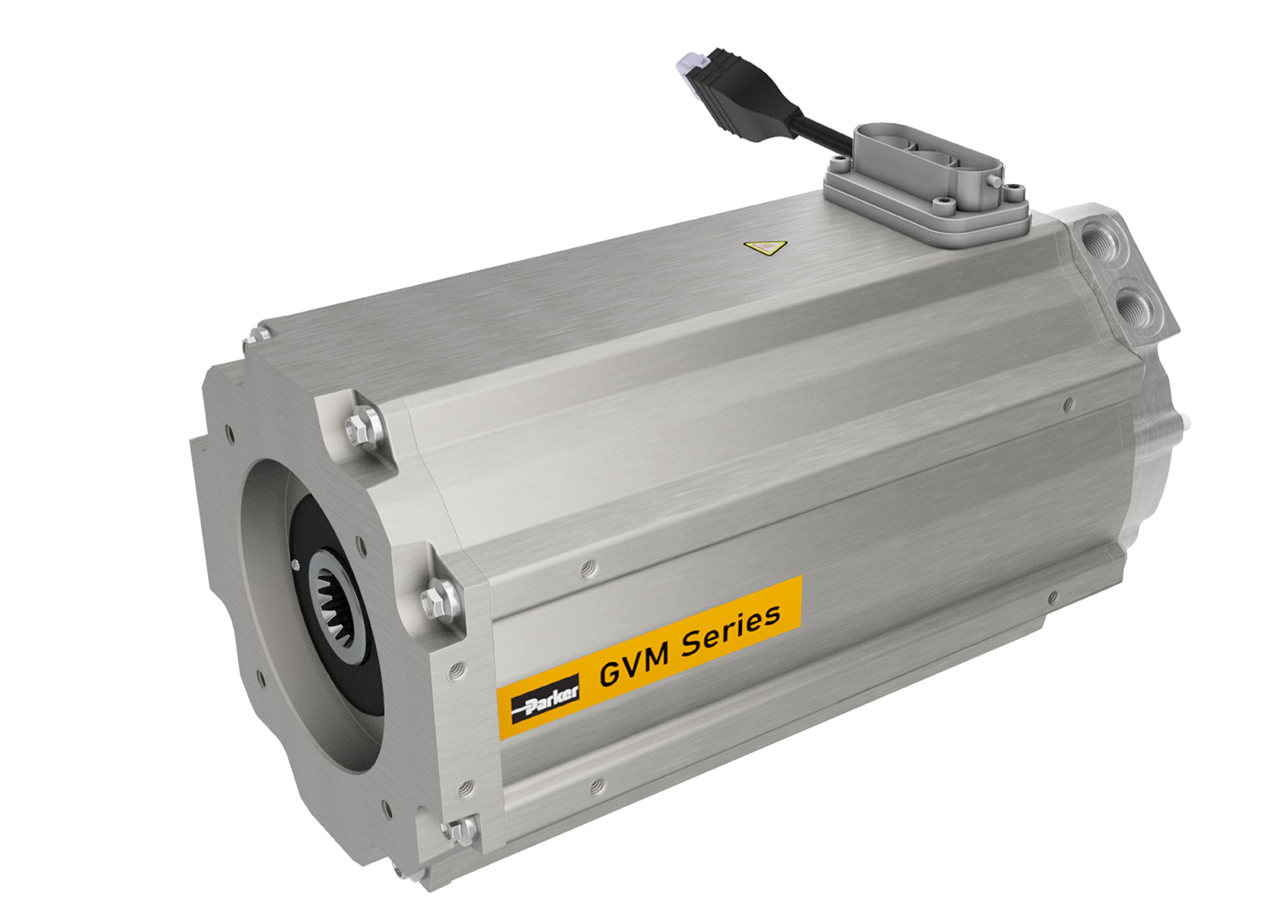
Parker Hannifin has launched the second-generation version of its GVM210 Global Vehicle Motor, introducing a series of updates intended to simplify installation, strengthen safety, and improve durability across electrified on- and off-highway platforms. The GVM210 Gen 2 is aimed at OEMs and integrators working in material handling, construction, mining, agricultural, utility, and specialist vehicle applications.
The revised motor builds on Parker’s existing GVM210 platform, but shifts the emphasis toward integration and operational robustness rather than headline performance alone. As vehicle manufacturers move from pilot electrification projects into broader platform roll-outs, the focus has increasingly moved to packaging, serviceability, thermal protection, and compatibility with different inverter and control strategies.
To support that, Parker has introduced new pigtail connector options in 12-pin and 16-pin configurations. The 16-pin version enables the use of two PT1000 temperature sensors on a separate mode, allowing full motor thermal protection with three-phase control even when torque is requested at low speed. The change is intended to give OEMs more flexibility in aligning feedback and protection functions with the control architecture used in different vehicle platforms.
The company has also added support for high-voltage interlock loop functionality through the power connector option. If either the power connector or low-level connector is disconnected, the power supply cuts off automatically. That brings the motor into line with the safety expectations increasingly built into electrified vehicle systems, particularly where machines are operating in demanding environments and may require regular service access.
For electro-hydraulic pump systems, Parker has introduced an optional O-ring on the prepared motor flange to improve sealing between the motor and pump. The update is designed to strengthen resistance to leaks and contamination in harsh operating conditions, including environments where dust, grease exposure, and repeated mechanical stress can affect reliability over time.
Bruno Jouffrey, market manager mobile, Electric Motion & Pneumatic Division at Parker Hannifin, said: “The GVM210 Gen 2 is designed to carry forward the performance customers rely on from the Gen 1 series while making the motor easier to install across a wider range of vehicle architectures. We have also improved connectivity, for easier and faster integration, in addition to safety improvements.”
The launch reflects the direction of travel across off-highway electrification, where suppliers are increasingly being judged on how quickly their components can be integrated into production vehicle programmes and how well they perform under real duty cycles once deployed. More information on the platform is available via Parker’s GVM motor range page.