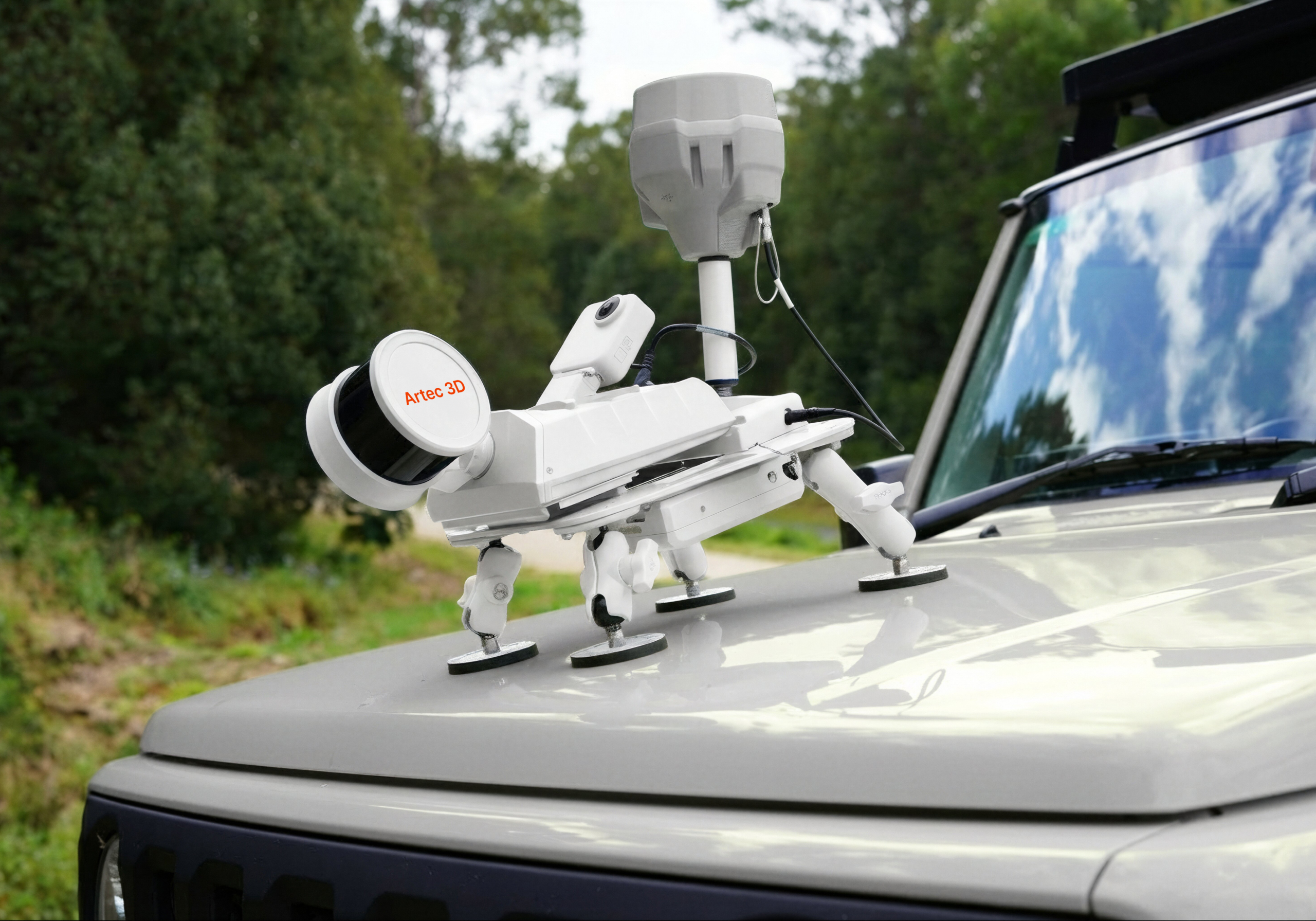
Artec 3D has launched Artec Jet, a new mobile LiDAR system built around SLAM-based positioning and aimed at large-area capture in environments where conventional mapping workflows can struggle. The Luxembourg company said the system can be deployed by hand, on vehicles, or onboard drones, giving it a route into industrial surveying, site documentation, and digital twin creation across construction, mining, oil and gas, civil infrastructure, and complex plant environments.
The product broadens Artec’s portfolio beyond its established handheld and long-range scanning lines, pushing the company further into site-scale capture where positional tracking, deployment flexibility, and speed matter as much as raw point density. Artec said Jet can deliver accuracy of ±10 mm indoors and underground, detect changes as small as 5 mm, and improve global accuracy further through RTK accessories for GNSS-assisted georeferencing. A companion app provides real-time feedback and on-site verification, while an optional video camera setup adds colour capture for projects where visual context is required alongside geometry.
The hardware has been designed around multiple field configurations rather than a single fixed workflow. Artec lists seven deployment modes, spanning handheld, backpack, drone, vehicle mount, protective cage, telescopic pole, and robotic integration, which gives engineering teams a single platform for survey work that might otherwise require several devices. That is likely to appeal in sectors where access conditions change quickly between open sites, enclosed structures, underground voids, and confined industrial spaces.
One of the more significant elements is autonomous aerial use. Artec said Jet can operate onboard a drone without manual control, using SLAM and AI-based navigation to plan flight paths, maintain positioning, and avoid obstacles including fine wire hazards while continuing to collect mapping data. For tunnel inspections, unstable structures, or spaces that are inaccessible or unsafe for personnel, that shifts the conversation from remote capture as a specialist option to remote capture as a standard operating mode.
The launch also introduces Artec Twins, a new software platform for processing and visualising large-scale 3D data. Artec said the software is designed to process, merge, georeference, inspect, and export major scan datasets in formats including LAS, LAZ, PLY, DXF, and E57, linking Jet into a wider workflow for BIM, as-built documentation, change detection, and condition assessment. In a statement accompanying the launch, Art Yukhin, president and CEO of Artec 3D, said: “Our mission has always been to make 3D scanning as fast, accurate, and intuitive as possible.” The company is scheduled to show the system with partner Data Design at Manufacturing World Nagoya on April 8–10, where visitors can see a hands-on demonstration.