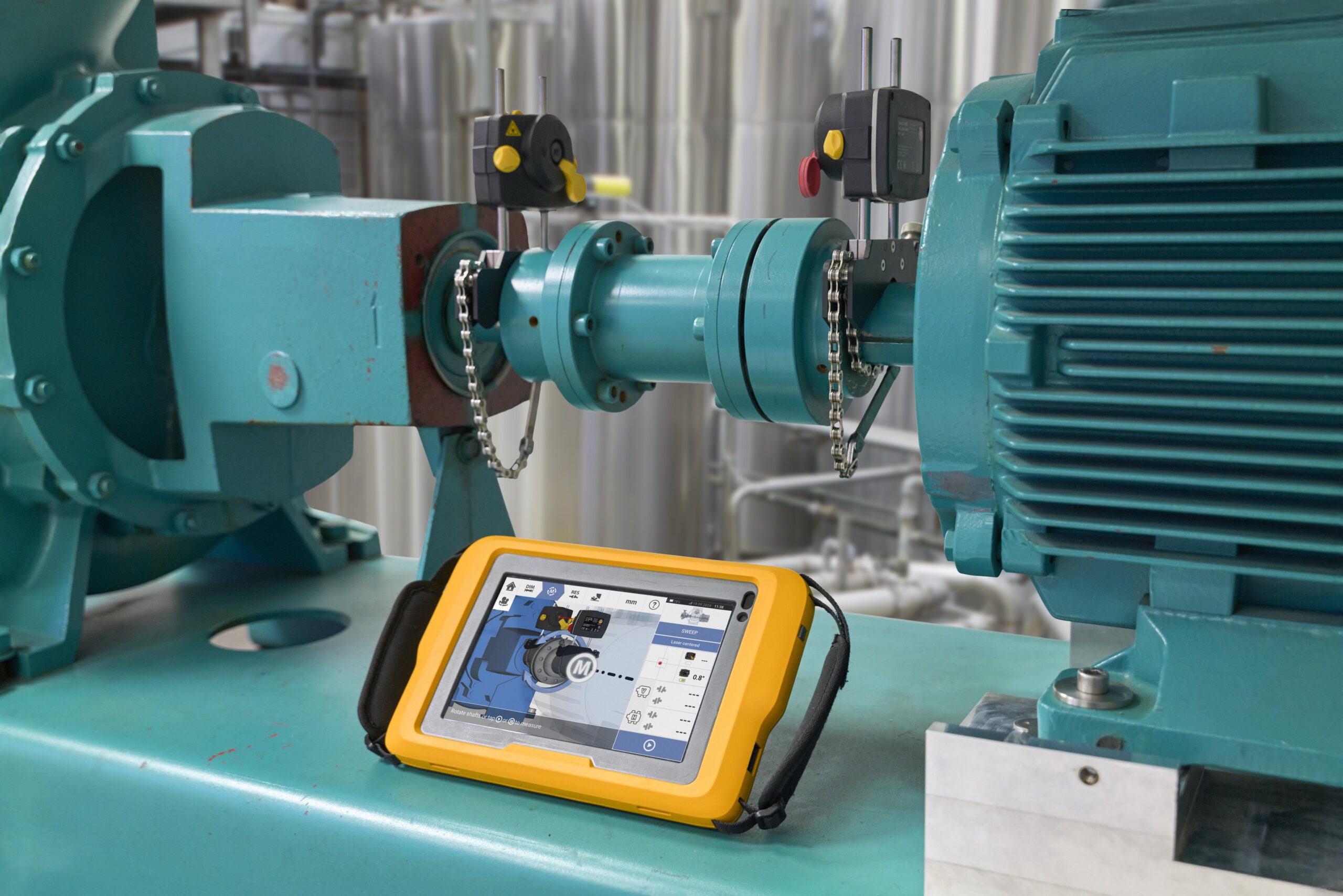
Fluke Corporation has launched RotAlign Core and RotAlign Elite, a two-tier laser shaft alignment range designed to simplify product selection while pushing more reporting, diagnostics, and ROI tracking into the alignment workflow itself. The release brings the RotAlign line onto a single-laser, dual-detector platform intended to reduce setup time on standard plant assets while still scaling into more complex machinery.
RotAlign Core is aimed at routine alignment work on motors, pumps, and fans, while RotAlign Elite moves up to more demanding train configurations, extended couplings, and higher-precision jobs, including cardan-shaft applications. Fluke’s alignment business says the portfolio is designed around a modular tablet platform, allowing users to add sensors and software capability over time rather than replace the whole system as requirements change.
The feature set shows how alignment tools are being asked to do more than measure offset and angular error. Both systems add customisable reporting, direct email sharing, and an onboard ROI calculator, while the Elite version introduces measurement video replay so technicians can remove bad data points without repeating a rotation. “Manufacturers today aren’t short on data, they’re short on insight and provable returns,” said Vineet Thuvara, Chief Product Officer at Fluke Corporation.
That pitch lands in a market where maintenance teams are being squeezed from two sides. Unplanned downtime remains costly, but the people expected to prevent it are often covering more assets with less time, and experienced alignment specialists are not easily replaced once they leave the plant. Tools that shorten repeat measurements, document the job clearly, and capture decision-making inside the workflow are becoming as important as raw measurement accuracy.
Fluke is also leaning on the operational case for single-laser alignment. By avoiding rough pre-alignment and measuring across two detector planes, the system is intended to keep jobs moving in tight spaces and on machines that cannot always be rotated freely. For plants trying to standardise maintenance practice across sites, the more significant development may be the platform approach itself: a simpler entry point at the Core level, an upgrade path to Elite, and a clearer route from everyday alignment to deeper condition-led maintenance.