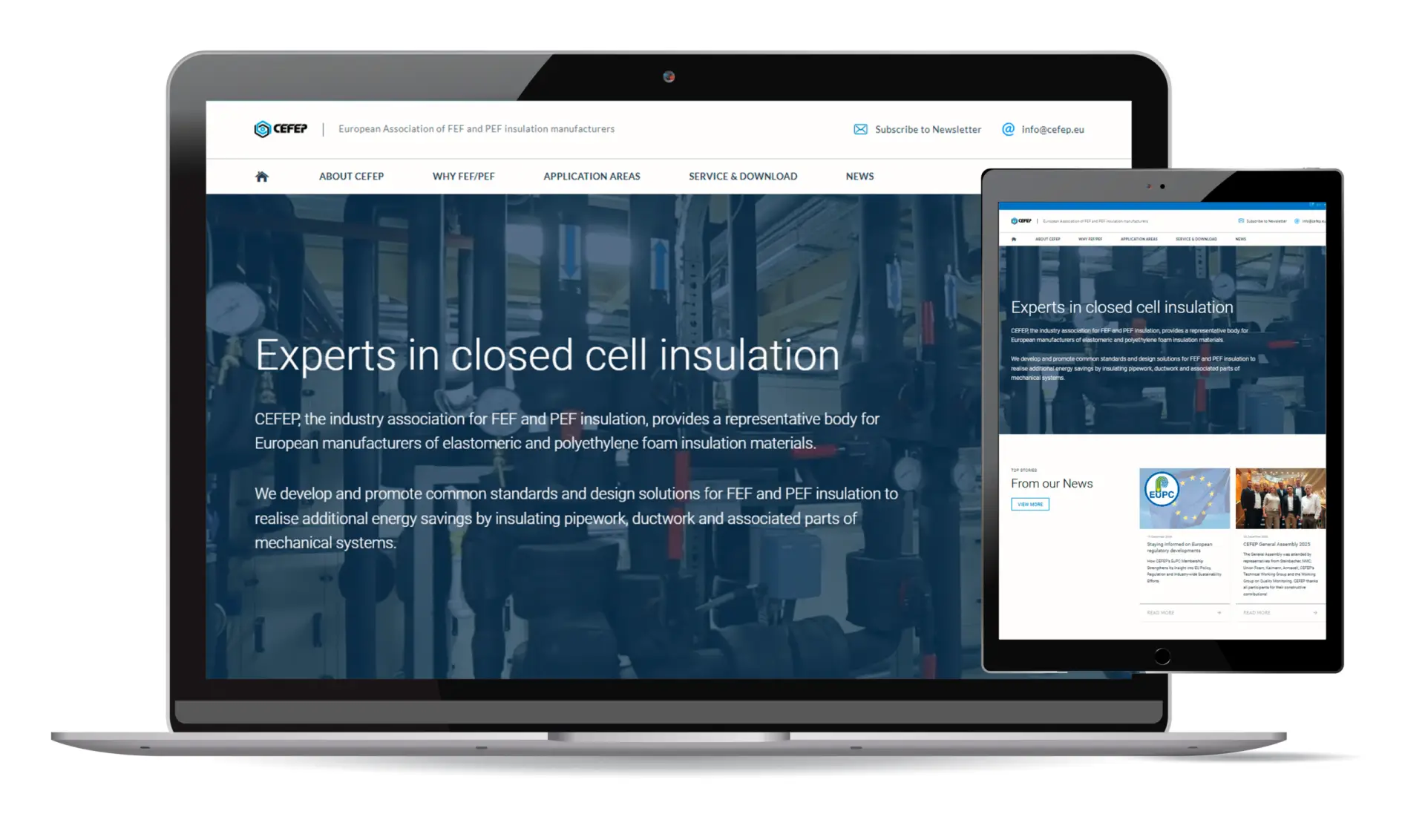
CEFEP has stepped up its digital communications around technical insulation with a website positioned as a central reference point for flexible elastomeric foam and polyethylene foam materials in Europe. The platform brings together information on application areas, technical guidance, association activity, and communication channels including LinkedIn and its e-mail newsletter.
On the face of it, a trade association website refresh is a modest development. In practice, the move lands in a market where mechanical building services are under much closer scrutiny for lifetime efficiency, condensation control, corrosion risk, and regulatory compliance. CEFEP represents manufacturers including Armacell, Kaimann, NMC, Steinbacher, and Union Foam, and its core argument is that closed-cell insulation is one of the less glamorous but more durable levers available for improving the performance of pipework, ducting, and other technical building systems.
The association has spent recent years pushing a more technical case for FEF and PEF materials, linking them to lower energy losses, moisture resistance, and longer-term system stability. That is not a trivial point in HVAC and building services work, where poor detailing around valves, fittings, and other discontinuities can quietly erode performance. CEFEP has previously argued that retrofitting uninsulated components in pipe systems can cut energy losses by more than 20%, which helps explain why it wants its guidance and position papers easier to find and easier to use.
Elke Rieß, chair of CEFEP, said the new platform had been designed as a central digital reference point for flexible technical insulation in Europe, improving access to shared expertise and guidance. The broader task now is to turn that information into specification behaviour, especially in a construction market that is still better at talking about fabric efficiency than consistently addressing the performance of the systems running inside it.
For designers, installers, and manufacturers, the interesting question is whether technical insulation can win a firmer place in decarbonisation and compliance conversations that usually gravitate elsewhere. CEFEP is clearly trying to make that case more systematically online.