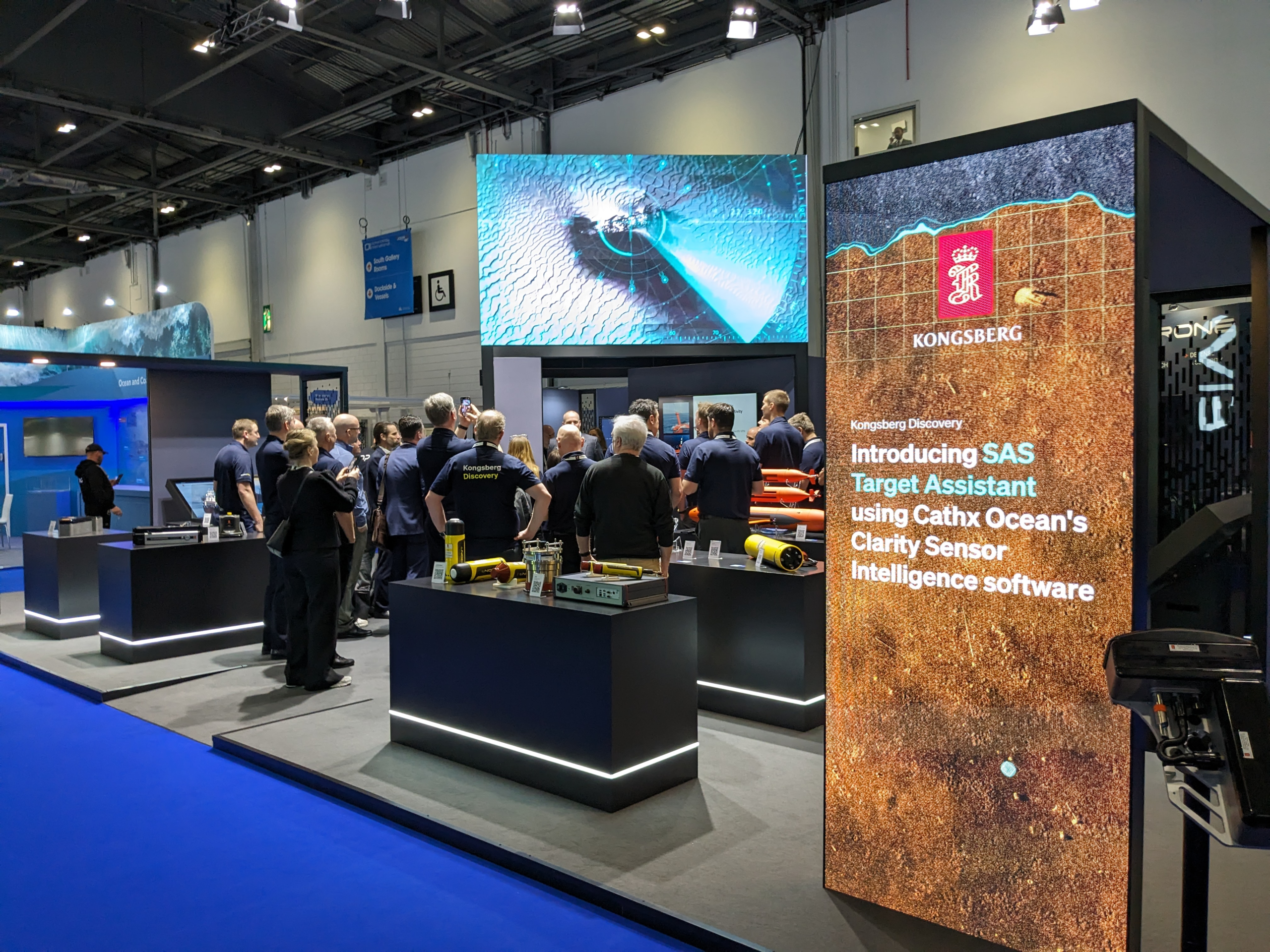
Kongsberg Discovery will use Oceanology International (OI) in London to unveil two new products — one in sonar and one in inertial technology — as it leans into rising demand for ocean mapping, navigation resilience, and critical infrastructure monitoring. The launches are scheduled for OI’s 10–12 March run at ExCeL London, with Kongsberg also signalling further announcements spanning ocean science, defence, and energy.
The company has not disclosed product names or specifications ahead of the show, but it is positioning the launches as part of a broader update cycle across software and hardware. Kongsberg Discovery will also put existing systems in front of survey and offshore operators via daily riverside demonstrations, using Fugro’s Academy Training Vessel as a working platform rather than a static stand prop.
On-water demonstrations are set to feature the EM 2042 multibeam echosounder, the Seapath 385 GNSS-aided inertial navigation system, and a CP300 ADCP transducer, with the package aimed squarely at hydrography and water-column measurement workflows where time-on-task and data confidence dictate cost.
Protection, however, is the not-so-subtle second theme. Kongsberg Discovery will run live feeds at its stand from the Oslofjord Critical Maritime Infrastructure (CMI) Protection Test Bed in Horten, Norway, which the wider KONGSBERG Group launched in summer 2025 as a venue for joint trials and demonstrations with public authorities, researchers, and industry. The facility is framed around operationally realistic testing for threats to subsea pipelines, power cables, energy installations, and ports.
That pitch lands in a market that has spent the past three years rediscovering the obvious: seabed infrastructure is hard to guard, easy to disrupt, and now politically fashionable to worry about. The Nord Stream explosions in September 2022 became a reference point for policymakers and operators alike, and European security analysis since then has repeatedly flagged the vulnerability of undersea assets and the need to improve surveillance, repair capability, and coordination.
Henning Langlete, Director Marketing and Communication at Kongsberg Discovery, said: “OI is a ‘must attend’, operating as a global meeting place for industry, academia and a wide range of ocean stakeholders. It’s where the latest knowledge and innovations are revealed, showcased and shared – so it’s the ideal platform to unveil technology that we believe can offer users transformational benefits.
“We also have partnerships to highlight and updates to existing solutions in line with increased market demand. We invite anyone with an interest in exploring, developing, understanding and protecting our ocean space to pay us a visit to discover more.”
The company says the Oslofjord link-up will let visitors watch “real-time missions” and see how its portfolio — including HUGIN autonomous underwater vehicles, subsea sensors, analytics, and situational awareness tooling — is intended to be deployed in mixed scenarios rather than single-product demos.
“We’re really excited to offer live feeds linking the OI exhibition hall to the waters of the Oslo Fjord,” Langlete added. “This will allow visitors to immerse themselves in real-time missions, seeing for themselves how advanced technology can illuminate the secrets beneath the sea’s surface – building not only awareness and preparedness, but also true understanding.”
Kongsberg Discovery will exhibit at stand D600.