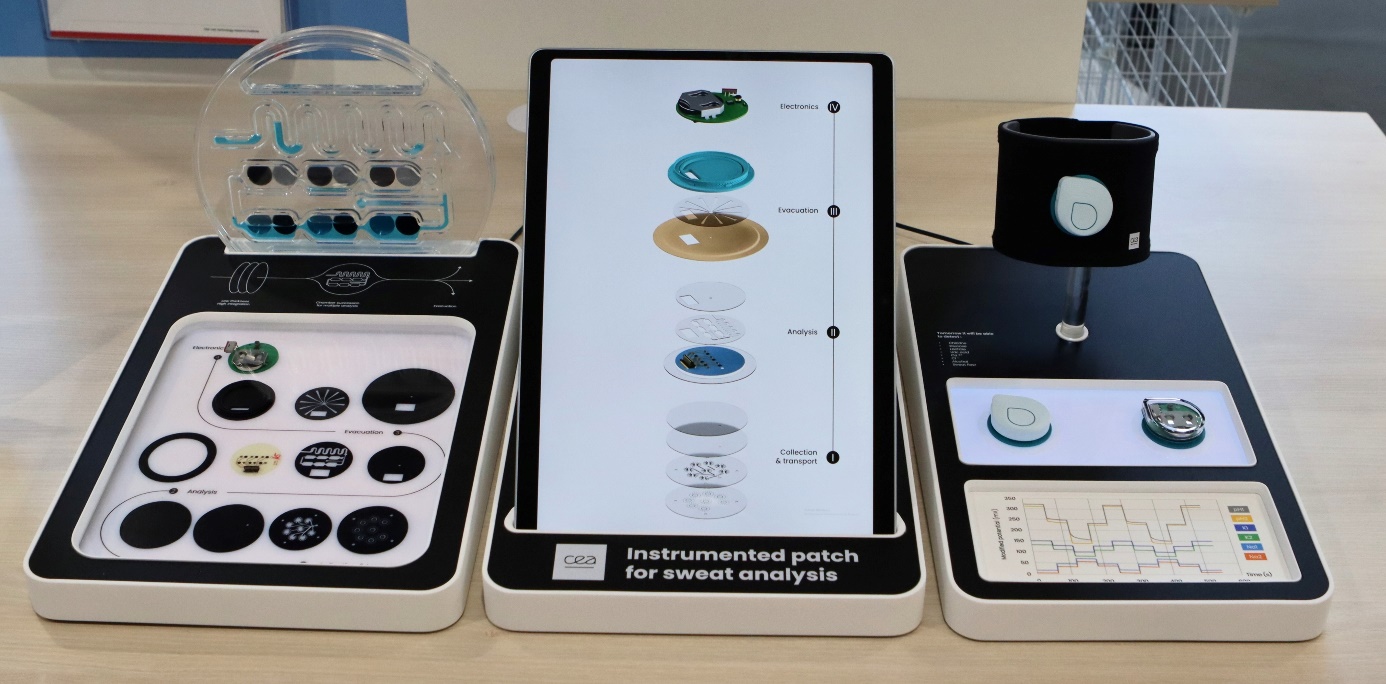
CEA-Leti has collaborated with STMicroelectronics on a wearable “Sweat Patch” prototype designed to analyse sweat continuously in real time, with the first version measuring pH, sodium, and potassium. The device is built around an adhesive sweat-collection layer, an integrated microfluidic circuit feeding measurement chambers, and an evaporation layer for drainage, all fabricated on flexible substrates intended to conform to the skin.
The electronics stack includes ST’s high-precision analog front-end R&D prototype project for solid-state electrochemical sensors, paired with CEA-Leti’s sensing platform. The stated goal is practical, continuous biochemical monitoring that is stable enough to move beyond intermittent readings, and robust enough for harsher environments where hydration status and thermal load are operational issues rather than lifestyle metrics.
Nadège Nief, Deputy Head Micro-Technologies for Biology and Healthcare Division at CEA-Leti, said: “In this novel system, all the sweat produced is efficiently collected and transported through microfluidic pathways to measurement chambers, each equipped with an electrochemical sensor, and then into the drainage system for disposal. While earlier generations of analysis rely on only intermittent readings, Sweat Patch ensures a continuous, stable biochemical signal that allows a dramatic improvement in analysis.”
CEA-Leti said the prototype is approximately 3 cm in diameter and under 1 cm thick, developed under its “human-use-compliant by design” framework, with medical-grade, non-toxic, biocompatible materials. That’s the necessary hygiene factor for any device that expects to sit on skin for extended periods, particularly if the longer-term ambition is occupational monitoring rather than short, voluntary sports use.
ST frames the enabling element as a compact, high-precision potentiostat capable of controlling and reading the electrochemical sensors with high accuracy. Enrico Alessi, R&D Manager of System Architectures in the Central R&D of Analog, Power & Discretes, MEMS and Sensors Group at STMicroelectronics, said: “The Sweat Patch goes beyond traditional monitoring solutions, delivering meaningful, personalized data that can drive smarter decisions across diverse environments… In industrial settings, continuous sweat analysis can serve as an early detector of heat stress and electrolyte imbalances, helping to safeguard worker health.”
The work sits in the broader push towards “contextual sensing”, where biochemical data is fused with motion and activity information, then used to trigger alerts, interventions, or operational decisions. CEA-Leti and ST said the next steps include industrialising sensors for additional biomarkers, plus connectivity and data-security improvements to support scalable deployments.