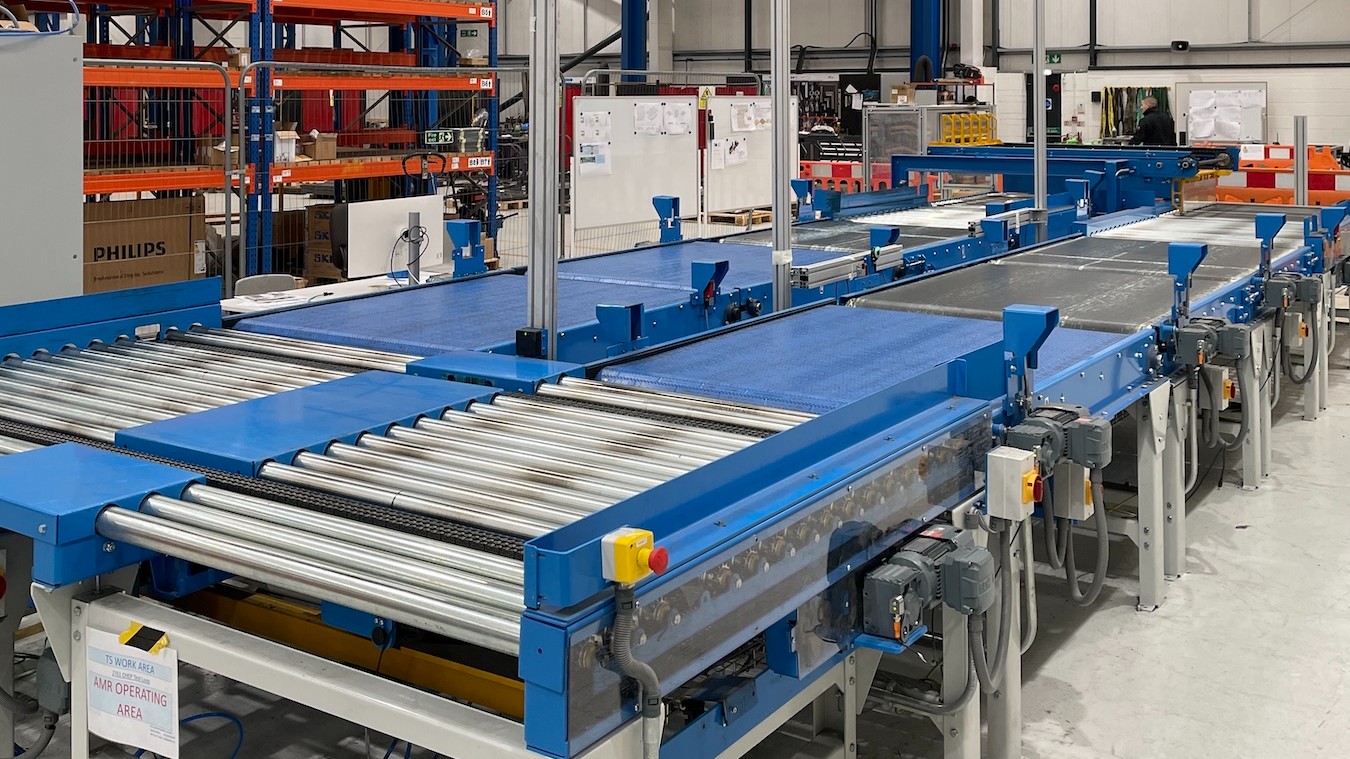
Materials handling specialist Tracoinsa has implemented a conveyor evaluation system that leans heavily on sensors and software from ifm electronic, aiming to generate hard data on how different conveyor types perform over extended operation. The rig brings together short sections of roller, chain, belt, and other conveyors arranged as two parallel closed-loop tracks.
At one end of the system, a pneumatically operated cross-transfer moves products between the tracks, while at the other end a chain-driven pusher handles transfers in the opposite direction. Products placed onto the loop circulate indefinitely until removed, allowing Tracoinsa’s engineers to monitor wear, fatigue, and operating behaviour over many hours or days, rather than relying on brief test runs or anecdotal field feedback.
Each conveyor drive is equipped with an ifm VVB306 three-axis vibration sensor, devices designed for condition-based analysis of imbalance and rolling element bearing damage. In this application, velocity measurements are used as an indicator of drive fatigue, while acceleration data provides insight into friction and impact events. The sensors’ integrated temperature measurement gives a further data point on drive health over time.
The pneumatic cylinders on the cross transfer are instrumented with ifm PQC812 pressure sensors, providing continuous monitoring of system pressure and highlighting leaks or compressor issues. All sensor data is carried over IO-Link, simplifying field wiring and enabling full access to the devices’ diagnostic values, not just threshold-based switching.
An IO-Link master aggregates the data to a laptop running ifm’s moneo software, which offers dedicated machine health monitoring functionality. The software is used to analyse live and historical data, present key indicators in dashboard form, and store datasets for further investigation when required. In practice, this translates into a live view of each conveyor section’s behaviour, with the ability to correlate vibration, temperature, and pressure anomalies with specific operating conditions.
According to Tracoinsa, the system is already feeding directly into design decisions and maintenance recommendations for customers, giving the company a more quantitative basis for specifying conveyor technologies and maintenance strategies. It also brings the often vague notion of “performance under harsh conditions” down to measurable parameters that can be discussed with clients.
“The ifm sensors are very easy to work with,” said James Baker, Project Engineer for Tracoinsa. “They’re robust devices that are simple to configure and they deliver accurate and dependable results. IO-Link greatly simplifies field wiring, and the ifm moneo software is both versatile and easy to use. We had one day of training from ifm, and after that we were able to quickly develop dashboards, using drag-and-drop techniques, which exactly match our requirements and show the important results clearly.”
As condition monitoring and predictive maintenance tools continue to move from high-value machinery into broader intralogistics applications, Tracoinsa’s evaluation loop shows how relatively modest investments in sensing and analytics can generate practical, data-driven insight — and potentially differentiate integrators in a crowded conveyor market.