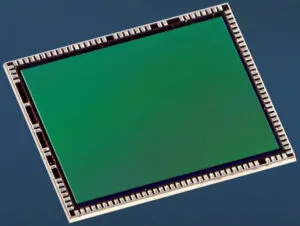
ST Microelectronics has unveiled its latest series of image sensors, integrating advanced 3D stacking technology. These sensors, featuring both global and rolling shutter modes, offer enhanced imaging performance by allowing users to optimise image capture. Alexandre Balmefrezol, ST’s imaging general manager, stated, “Global and rolling shutter modes allow customers to optimise image capture, ensuring motion-artifact-free video capture [global shutter] and low-noise, high-detail imaging [rolling shutter] at the same time. This architecture is unique on market today.”
The sensors are back-side illuminated, with each pixel measuring 2.25µm, and employ capacitive deep trench isolation. Available sensor sizes include a 7.29mm (1/2.5in) sensor, offered as a 5.76 x 4.46mm die or within a 10.3 x 8.9mm BGA package, boasting a claimed array-to-die area ratio of 73%.
ST’s product range includes monochrome and RGB-IR variants. The RGB-IR version features on-chip RGB-IR separation and is capable of switching between multiple imaging modes, such as 5Mpixel RGB-NIR 4×4, 5Mpixel RGB Bayer, 1.27Mpixel near-IR sub-sampling, and 5MP near-IR up-scale, all with independent exposure times. These sensors are poised to serve diverse applications, including robotic vision, biometric identification, traffic management, inventory management, and automated check-out systems.
Samples are currently available, with mass production slated for February 2026. For further details, refer to ST’s product page for the VD1943. In a related development, earlier this year, the 3.2Gpixel image sensor of the Vera Rubin Observatory commenced operations in Chile.