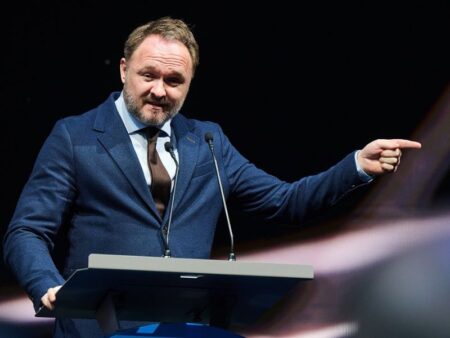

Dan Jørgensen
Electrification will lead to system collapse unless flexibility is introduced, the EU energy commissioner Dan Jørgensen has warned, writes Vic Wyman in Brussels.
Yet, Linda-Maria Wadman, chief business development officer of Swedish grid management software firm Plexigrid, said that tweaks could be needed in regulations, which today lead high-voltage grid operators, for example, to invest in grids rather than in flexibility.
Both Jørgensen and Wadman were speaking in Brussels at the Flexcon conference, which tackled one of today’s most complex energy conundrums: how to flexibly match electricity demand to supply to optimise the use of grids and decentralised power sources while still holding down costs and decarbonising.
Listen:
Podcast: Flexibility is the quiet superpower of Europe’s energy transition
Read:
Why flexibility is ‘king’ for Central & South Eastern European power traders
At the conference organised by smart energy association smartEn, the focus was on how businesses could rethink their operations and manage energy more smartly, mainly by demand-side resources taking electricity when it is cheap and selling when prices are high.
Aggregators, for example, might want to combine the battery potential of lots of electric vehicles, taking control of when the vehicles are charged or are feeding the grid.
By reducing congestion in grids at all voltages, and providing better access to electricity markets for distributed resources, flexibility could produce indirect benefits of more than €300 billion/year for Europe’s economies by 2030, claimed a smartEn report in January 2025.
The report cited generation costs €4.6 billion lower and 15.5TWh of renewable energy not curtailed, or wasted because of grid congestion.
It also projected an annual 37.5 million tonnes reduction in greenhouse gas emissions, or more than required by the European Commission.
Flexibility as smart alternative
As electricity demand increases, in part as the world electrifies transport and other sectors, flexibility has emerged as a smarter alternative to just building more capacity.
The Dutch congestion management company Gopacs rejected the idea of building more power network: “Operators in the control room are sweating the assets.”
It added that the increase in renewables was producing a switch from selling electricity in day-ahead markets to intra-day markets.
Belgium’s transmission grid operator Elia, for example, will not have enough reserve capacity to supply the 6-7GW of flexibility that it expects to need by 2036 to keep the lights on, said James Matthys-Donnadieu, the company’s chief customers, markets and system officer.
That would include 3GW able to react within 15 minutes to demand changes and up to 0.5GW able to react within five minutes.
Balancing problems
Elia’s energy solutions product lead Alexandra Verbrugge told Flexcon that the growth of renewables, contributing to possible oversupply of electricity in Belgium and in neighbouring countries at the same time, was likely to result in frequent negative prices and system balancing problems.
Elia projected that Belgium’s current photovoltaic capacity of 11GW, with installations smaller than 10kVA accounting for two-thirds of that, would rise to 16.5GW by 2035.
“The more solar that we have the more uncertainty that we have on forecasting,” said Verbrugge. Elia will promote intra-day and even day-ahead markets to modulate pv output, she said. “Not every kWh produced has value.”
Elia will adopt soon both explicit bidding to the system operator, which Matthys-Donnadieur said works well when the system does not need to balance electricity consumption and production, and implicit reaction to price signals, through imbalance prices.
“It’s not either-or,” said Matthys-Donnadieu, pointing to reduced electricity bills, lower grid investment and more efficient system operation. In the long-term, consumers could typically save €170—530/year charging an electric car and €20—70/year on air conditioning, he claimed.
“That could be a really novel way of reducing costs for everybody,” the UK regulator Ofgem told Enlit Media.
Smart but not always clever
A new smartEn report, produced by the consultancy Compass Lexecon, concluded that operating large energy-intensive industrial processes to provide demand-side flexibility could cut energy costs and attract value from taking part in electricity markets, typically by load-shedding or providing manual frequency restoration reserve (mFRR) to help stabilise grid frequency.
Read:
Methodology for flexibility needs assessment in Europe proposed
Listen:
Projects Podcast: Unlocking flexibility and innovation for a decarbonised future
Flexibility would also provide power system benefits, such as reducing peak demand and avoiding investments, and societal benefits, such as environmental benefits, said Fabien Roques, head of European energy practice at Compass Lexecon.
He said that the opportunities to monetise flexible demand varied across EU countries, in four areas: wholesale markets; ancillary services, such as providing Frequency Containment Reserve (FCR); other system services, such as interoperability; and congestion management.
The report considered five sectors with direct connections to transmission grids: iron and steel; aluminium; cement; glass; and pulp and paper.
However, Roques said that only the latter had a good chance of earning enough to pay for switching to smart flexibility, or up to 95% of the cost, far more than cement (up to 30%), glass (up to 7%), iron and steel (4%) and aluminium (negligible).
In paper mills, smartEn/Compass identified the potential to replace fossil-fuelled steam production with electric boilers able to react immediately to grid or price signals. Fitting a steam accumulator along with a larger grid connection could provide more flexibility by exploiting lower electricity prices to create a buffer able to reduce peak demand, the report added.
Constraints to greater electrification and flexibility are often associated with the technical or economic need to run processes continuously rather than in spurts.
Adina Georgescu, the energy and climate change director of the non-ferrous metals trade association Eurometaux, cautioned that, although the annual consumption of about 7TWh of a typical medium-sized aluminium smelter suggested potential flexibility, metal production could be adversely affected.
And Jonas Verstraeten, co-founder of Belgian energy management firm Companion.energy, said that the biggest barrier in general to flexibility was that “it’s a hassle to be flexible”, adding that you need to give certainty to customers about the financial return.
“We have hit transition [to decarbonised energy]. We are on the way,” said Pete Noyce, senior lead in the regulations and markets team at the UK-based utility operating system company Kraken. But he doubted that success was certain: “If we are not delivering value for money we are not going to get a decarbonised grid.”
Regulatory hurdles
Variations in regulations between European countries affects flexibility. In Czechia, for example, independent aggregators have not been allowed access to the wholesale market, which has been open only to suppliers and large consumers.
In Poland, a 2023 law allows for independent aggregators, with a right to participate in electricity markets, but there is no framework that allows their access to the wholesale market.
Great Britain is seen by smartEn as one of Europe’s most advanced countries for flexibility, with access through explicit and implicit demand response to wholesale prices.
But the regulator Ofgem has been considering changes to ensure consumer protection and cyber security controls for organisations carrying out load control. In Britain, remote control of consumers’ energy smart devices is little regulated apart from under general consumer protection rules.
A priority for Ofgem is the licensing of new entities for supply flexibility, with first licences expected in mid-2026. It also expects to publish smart device standards within a couple of years and to address concern about interruptibility of supply.
Many factors could stifle flexibility in Europe. For example, the Belgium-based Eniris can take smart control of batteries, pv and vehicle charging stations via the cloud and locally, said co-founder Bart Verheecke.
But he claimed that although using cloud-based energy management systems using application programming interfaces (APIs) was simple, many API interfaces were unreliable, with frequent announced maintenance, often contained bugs and inaccurate information and produced unexpected charges. “Prices are not transparent and need to be negotiation on a per-customer basis,” he said.