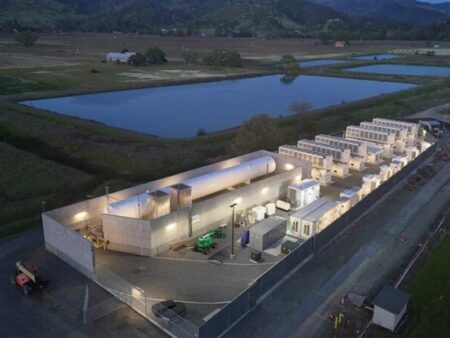

Calistoga Resiliency Center. Image courtesy PG&E
Energy storage major Energy Vault and Californian utility PG&E have launched what they say is a unique microgrid platform, combining advanced hydrogen fuel cells with lithium-ion batteries for power resilience in the face of wildfires.
According to the companies, the ‘first-of-a-kind’ platform in the US has been developed to ensure Calistoga’s power resiliency during Public Safety Power Shutoffs (PSPS) and creates a blueprint for future installations across California and the USA.
With the announcement, the Calistoga Resiliency Center (CRC) has been successfully completed and has gone into commercial operation. The project provides a unique, fully sustainable solution to address power resiliency amidst the growing challenges of wildfire risk in California.
Serving approximately 1,600 PG&E customers in and around downtown Calistoga, the CRC represents a step forward in addressing the need for PSPS due to wildfires and extreme weather events. The 293MWh microgrid system enables the isolated Calistoga community microgrid to maintain power during these necessary safety shutoffs, delivering at least 48 hours of continuous energy supply with a peak power output of 8.5MW during PSPS events.
The system is orchestrated by Energy Vault’s VaultOS Energy Management System, enabling black-start, grid forming and coordinated performance orchestration across all subsystems while communicating with PG&E’s Distribution Control Center.
Have you read:
Dedicated wildfire supercomputers to power AI forecasting
Artificial neural network tool to detect wildfire-sparking powerline faults
Commenting in a release was Craig Horne, senior vice president, Advanced Energy Solutions at Energy Vault: “This project is a major milestone in our mission to deliver sustainable, resilient energy solutions to communities most vulnerable to climate-driven grid disruptions.
“The Calistoga Resiliency Center exemplifies the power of innovation and partnership, and it marks a significant step forward in the execution of our ‘Own & Operate’ strategy, which enables us to deliver long-term value through recurring revenue and community impact.”
When operating in island mode, the CRC utilises hydrogen fuel cells for electricity generation, providing essential power to the community. After supporting black-start and grid forming requirements of the microgrid, Energy Vault’s B-VAULT DC battery technology works in concert with the fuel cells, ensuring instantaneous response and maintaining grid stability throughout operation.
The use of liquid hydrogen extends run time through delivery and transfer into the onsite storage tank without interrupting power supply to the City of Calistoga while also reducing the cost of resiliency services.
The CRC serves as a model for Energy Vault’s future utility-scale hybrid microgrid system deployments as a zero-emission solution to address PSPS events. According to the company, the tech is ready to be deployed across California and other regions prone to wildfires as well as locations where improved grid-resiliency is needed.
Said Mike Delaney, vice president, Utility Partnerships and Innovation, PG&E: “PG&E is committed to continually delivering innovations that enhance electric system safety and reliability while driving costs down for our customers.”
“The Calistoga Resiliency Center is another step toward fulfilling that commitment. It is the right solution for PG&E, for Calistoga, and for the planet.”
The announcement comes on the heels of the recent completion of the Cross Trails BESS, the first project to be placed in service under Energy Vault’s growing portfolio of ‘Owned & Operated’ projects.
This zero-emission system aligns with California’s Renewable Portfolio Standard (RPS) while meeting PG&E’s multi-day, long-duration energy storage requirements.