Packaging is often the very first touchpoint a consumer has with a beverage, and as such it plays a vital role in shaping perception, preference, and purchasing decisions. To stay relevant, packaging must constantly evolve to reflect changing consumer tastes, rising environmental expectations, and tighter retailer requirements. This means producers are constantly rethinking how beverages are presented, bundled, and shipped – prompting a wave of innovation across materials, formats, and production processes that will ensure that not only does a product look good, but arrives at its destination without any damage.
For example, smaller multipacks, slimline cans, lightweight bottles, cardboard clips and mixed-format packs are increasingly replacing heavier, shrink-wrapped formats. These new solutions are more eco-friendly and shelf-efficient, but they can also introduce new operational headaches on the production line – especially when it comes to conveying and packaging.
According to Sander Boers, Strategic Account Manager – Beverage at Regal Rexnord, what were once seen as packaging challenges are now opportunities for innovation and optimization.
“Changes in packaging formats naturally influence how products move through the line, from handling and alignment to maintaining consistent speeds,” he explains. “But with the right technologies and design approach, it’s entirely possible to adapt quickly and keep lines running smoothly, even as formats evolve.”
With over 90 years of experience supporting beverage production lines around the world, Regal Rexnord is well placed to respond. Drawing on its extensive product portfolio – which includes trusted names like Rexnord™, System Plast™, Sealmaster™, and ModSort™ – the company is helping beverage producers navigate this packaging transition with smart, stable, and sustainable conveying solutions built to meet the challenges of today and tomorrow.
Shifting formats, shifting demands
One of the most noticeable changes in recent years is the shift toward smaller, less uniform packaging units. Where once a supermarket shelf might have been filled with 24-packs of identical cans, today you’re just as likely to find four- or six-packs, mix-and-match bundles, or slim cans joined together by a minimalist paperboard carrier.
These shifts can create real challenges for line stability.
“We’re seeing a much wider range of packaging formats, and many of them are inherently less stable,” Boers explains. “Sleek or slim cans, for example, have a smaller footprint than traditional ones. That means less contact with the conveyor surface and a higher risk of tipping. This is especially true during dry running or when moving across conveyor gaps.”
At the heart of many of these stability issues is the space between conveyor segments — known as the dead plate.
“Smaller products struggle more with large transfer gaps,” says Boers. “It’s not just about tipping, but also preventing jams, reducing misalignment, and maintaining throughput.”
To address this, Regal Rexnord has introduced new belts such as the 1533 Series LBP (Low Back Pressure) MatTop™ Chain, a 15mm pitch modular belt featuring integrated rollers directly within the belt surface. This innovation allows for tighter transfers without dead plates, enabling smooth motion even for narrow or unstable packs.
Meanwhile, the Rexnord 1540 Curve System with tangential belt operation ensures a consistent very small transfer zone across the entire belt width – something not all curve systems can guarantee.
“With many more traditional designs, the transfer gap can widen significantly near the belt edges,” Boers says. “Ours stays uniform, which is critical for line layout flexibility and pack integrity.”
For Regal Rexnord, these developments are part of a broader shift toward smaller pitch and more densely engineered modular belts. These small adjustments play a key role in helping producers maintain line performance despite any reduced packaging stability caused by modern designs.
Dry-running that delivers
Sustainability is another key driver behind packaging changes, and not just in the materials themselves. Many beverage plants are transitioning to dry-running conveyor systems, minimizing the use of water- and soap-based lubrication to reduce environmental impact, simplify wastewater treatment, and improve workplace hygiene and safety by keeping production floors clean and dry.
Dry-running, however, places greater demands on conveying components. With no lubricants to reduce friction or ease product flow, chains must offer low-friction surfaces, high wear resistance, and easy cleanability.
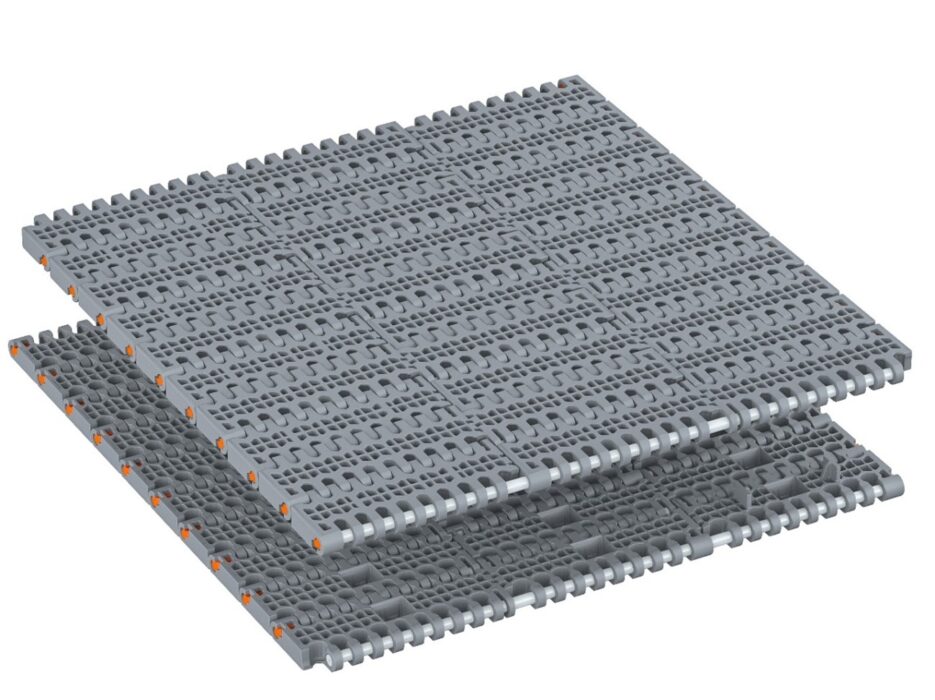
The Rexnord™ 1100 Series FlushTop™ MatTop™ Chain was designed with these demands in mind. Purpose-built for dry-run applications, the 1100 Series combines a flat, smooth conveying surface with an open-hinge design that enables efficient cleaning. Its universal geometry supports PET, glass, and aluminum cans with equal reliability, eliminating the need for multiple chain types on a single line.
“With older systems, you might have needed different chains for each product type, plus backups in different materials or widths,” says Boers. “Now, with the 1100 Series, many customers are consolidating to a single chain type, cutting down on inventory, simplifying changeovers, and improving sustainability.”
Supporting sustainability at every level
From energy-efficient low-friction materials to simplified standardization strategies, Regal Rexnord’s packaging solutions help reduce cost and environmental impact at every stage. Run-Dry designs help limit water and chemical use. Meanwhile, innovations like the new small transfer curve system and LBP belts with embedded rollers reduce product waste caused by tipping or instability.
The company is also investing in long-term system sustainability by extending product lifespans and simplifying maintenance. For example, the 1100 Series’ cleanable open hinge reduces downtime during sanitation, while belts with smaller pitches – such as the 1533 series belt – reduce the need for complex transfer components, minimizing failure points.
“It’s all about futureproofing,” says Boers. “Packaging is going to keep evolving. Our goal is to provide systems that are flexible, efficient, and ready to adapt, so drinks manufacturers don’t have to overhaul everything every time the market shifts.”

Image 2: The Rexnord® 1100 Series FlushTop™ MatTop™ Chain combines a flat, smooth conveying surface with an open-hinge design that enables efficient cleaning.