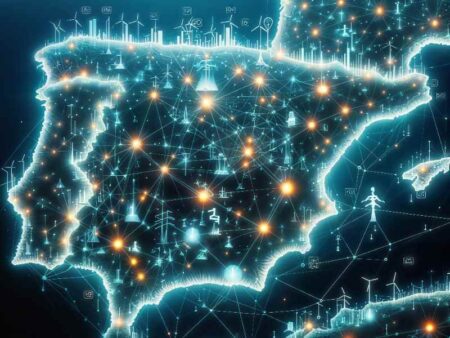

Spain’s electric network illuminated. Image courtesy 123rf
Drawing on the current findings of MITECO and REE reports, PSC senior strategic advisory consultants Carlos Ferrandon-Cervantes and Abraham Alvarez-Bustos unpack the causes of the blackout that have been identified thus far, as well as solutions from a control room perspective that could prevent similar events from occurring in the future.
A major power blackout at the end of April saw Spain, Portugal, and even parts of southern France lose their electricity supply after a grid collapse. For most of the Iberian Peninsula, the outage lasted about 10 hours, but was also far longer in some areas, reaching almost a full day. The consequences were severe, with communications and transportation systems hamstrung, a state of emergency declared across much of Spain, and thousands of police deployed.
An unprecedented event for the region and one of the worst outages in European history, the Spanish grid operator Red Eléctrica de España (REE) reports that just before the outage, grid-connected generation amounted to about 32GW, including 25GW of demand in Spain alone, 2.6GW of exports to Portugal, 0.87GW exported to France and 0.78GW of exports to Morocco. A further 3GW was being used to charge pumped storage hydropower reservoirs. REE notes that in 2024, wind power led national generation with a 23.2% share, followed by nuclear energy at 20%, solar photovoltaic at 17%, combined cycle gas at 13.6%, and hydroelectric at 13.3% .
As is evident, Spain is a leader in the adoption of RES, a power system which is by no means small, with peak demand ranging from approximately 17,847MW in the minimum demand, to 38,272MW in the high season (in winter) during the year 2024. Notably, it is in the beginning of spring and part of the summer months that the mix of generation has a greater share derived from RESs.
More on the outage in Iberia:
Iberia blackout caused by ‘overvoltage’ and ‘chain reaction’ says Spain
How the Iberia blackout has accelerated resilience financing
The state of the previous grid – The recent past, for context
The Ministry for the Ecological Transition and Demographic Challenge (MITECO in Spanish) of the Spanish Government released a report describing the series of events that occurred prior to the blackout on the 28th of April.
They refer to voltage fluctuations in the past year, highlighting the cases of 31st January, 19th March, and 22nd and 24th of April, being the last two days closest to the blackout on the 28th of April. The oscillations’ issue was also present in 2024, according to the report, the order of magnitude of these oscillations was like the ones seen on the 28th of April 2025.
In the same report, it is also mentioned that the synchronisation of more electrical networks to the Continental European grid, such as from Ukraine and Moldavia in 2022, and the full synchronisation of the Baltic countries (Estonia, Latvia, Lithuania) in February 2025, has added another layer of complexity and change to one of the largest interconnected power systems in the world, as the Continental European one is.
The REE report states that the conditions were within normal ranges during the early morning of the 28th of April, until the natural increase of the demand, around 6 to 7am. On the other hand, the MITECO report highlights that from 6am, interarea oscillations were detected in the Spanish grid. On the same line, voltage fluctuations were also present throughout the morning.
These are, in fact, deemed “extraordinary” by many agents of the system during that day, according to the report. Unfortunately, many sections of the reports are redacted; however, the following events were identified that morning:
- Potential voltage variations were detected at 9:10am in a power plant in Cáceres. It is inferred that 400kV is the voltage in question, and it can also be deduced from the report that this power plant tripped. It is unclear at what time, as many parts of the paragraph are redacted.
- Hydro generation tripped, around 10:40am, though details such as location, size or other identifiers of the source of this generation are redacted.
- By 11:10am, the disconnection of more than one transformer in the Zaragoza province occurred. The identified 400kV substations were Terrer and Rueda de Jalón. This can be deduced from the REE report, with these transformers being connected at the 55kV voltage level.
Moments before the blackout, at 12:30pm, the generation mix was: 82% RES, 10% nuclear (4 reactors synchronised, two of them fully loaded), 3% gas (6 power stations synchronised), 1% coal, and 4% cogeneration and waste.
The event unfolding – Oscillation issues and voltage control, a compounded effect
MITECO’s report describes that the day before, during the commitment stage of the day-ahead market, the System Operator (SO) had identified that there would be solutions required to tackle possible technical constraints that may arise during the day.
The specific technical reasons for unit commitments can vary, however, to perform the voltage control activities, synchronous machines within the Spanish grid are relied upon, according to current regulations, such as the Operation Procedure 7.4. In this case 3 nuclear power plants and 7 combined cycles were responsible, and they are distributed geographically per pre-defined zones in the Spanish grid.
Likewise, other measures were taken, such as renewable energy curtailment, between 9:55am and 11:51am, to manage overloading conditions before N-1 contingency events. This occurred in Toledo and Ciudad Real on the Spanish grid.
It can be inferred that since RES operate under power factor control mode, by reducing the active power output, reactive power support was also reduced, to keep the power factor proportion. In the Spanish grid, and according to the current regulatory framework of del Royal Decree 413/2014, RESs perform such “static” voltage control in function of their power factor. All in all, with this measure, another degree of freedom was reduced for the control room operator in real-time for voltage control purposes.
Essentially, from 6am to the moment of the first-generation outage around 12:32pm (without considering the first hydro generation trip at 10:40am), was a compounded effect. The SO, in order to manage the observed oscillations in the system, implemented measures to improve its damping. Such measures were connecting more than 400kV transmission lines, meshing the grid and achieving a more robust stance, from the oscillation’s issue perspective.
Overall, measures taken by the SO could only support the voltage control and oscillation issues to a degree. After every available measure (discreet controls in essence) was exhausted, at approximately 12:26pm, the SO ordered more conventional generation to initiate in the South Zone of the Spanish grid, which was expected within an hour and a half. This did not materialise as the blackout occurred before that.
What followed at 12:32pm was the beginning of a cascading effect that occurred on the 28th of April in the Iberian Peninsula. The first mismatch in generation was due to distributed generation, amounting to 525MW, of which 317MW belonged to generation below the 1MW threshold. This was deducted from the abnormal uptick of demand observed in the grid. Next, the transmission level connected generation started to trip. In this identified sequence of events by REE’s report, 8 tripping events from different RESs occurred, followed by the tripping of a Combined Cycle power plant in Valencia, the load shedding scheme applied on PHS due to underfrequency conditions, and finally the tripping of a nuclear power plant.
The way forward and lessons learned from a control room perspective
REE’s report highlights the importance of improving the regulatory compliance of power stations, namely the dynamic nature of voltage control from synchronous generation, and also the static control that is performed by RESs in the Spanish grid. Special note is made in the report of the forced oscillation phenomena that occurred with the large Badajoz power plant, they did not materialise due to the blackout occurrence.
On the regulatory side, Operational Procedure 7.4 has recently been updated and now requires RESs to remain connected and absorb or supply reactive power during transients, even if the voltage levels are outside normal operational boundaries. This is an extremely valuable step to ensure the operations of the Spanish grid remain more secure in future, and it was remarkable how quickly this measure was implemented.
In the long run, low-carbon generation must provide a control and capability baseline comparable to that of conventional generators to manage system contingencies effectively. Recent events in Spain have renewed interest in understanding the scale of potential blackouts, accelerating related investment programmes.
Encouragingly, initial regulatory measures have already been implemented. Without such coordinated action, there is a risk that rapid growth in renewable generation could outpace the development of corresponding stability measures, leaving the system vulnerable. Addressing these challenges must therefore go hand in hand with planning for the future.
About the authors

Carlos Ferrandon-Cervantes: senior consultant II, strategic advisory, PSC
Dr Ferrandon-Cervantes is an electrical engineering consultant with 10 years of research experience, and 7 years of industry work experience, from the distribution level to the transmission system operator.

Abraham Alvarez-Bustos: senior consultant II, strategic Advisory, PSC
Alvarez-Bustos is a power systems researcher and analyst with 8 years of research and industry experience. His principal research interests lie in developing models, methodology and software aimed at power systems computational analysis, optimisation, reliability, stability and decision strategy.