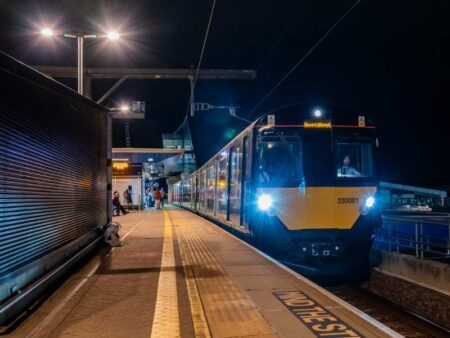

The train’s journey ran from Reading-London Paddington-Oxford-London Paddington-Reading
© Great Western Railway
A Great Western Railway (GWR) battery-electric train in the UK has set a new world distance record of 200 miles (322km), the furthest distance travelled by a train of its kind on a single charge.
The previous record of 139 miles (224km) was achieved by Stadler Deutschland in Berlin in 2021.
The trip, which was taken to commemorate Railway 200 celebrations, started at the Reading Train Care Depot and travelled to Paddington twice, as well as Oxford.
The event was recorded and verified by officials from the Rail Performance Society, who were on board to witness the record’s completion.
Commenting in a release was Rail Performance Society vice chair, Nigel Smedley: “We can confirm that, subject to final checks, the Great Western Railway Class 230 train travelled 200 miles on a return journey from Reading Train Care Depot without charging its batteries from any external energy source.”
Said GWR engineering director, Dr Simon Green: “Today’s record attempt has been a bit of fun, but it also underlines a serious point: investment in battery technology is essential as we look to replace our ageing diesel fleet.
“Overhead lines will remain the first choice to power electric trains, but where that isn’t possible or desirable, battery technology like this offers a reliable and efficient alternative to bridge the gap.
“As part of our future rolling stock plans we’ll need battery trains to routinely cover over 60 miles between charges – and today’s achievement provides clear evidence that this is a viable and exciting solution for the future of our railway.”
Network Rail operations director, Simon Gillibrand, was among those at Reading Train Care Depot to welcome the record-breaking battery train. Said Gillibrand: “We’d like to congratulate GWR on setting this world record – reaching 200 miles during the Railway 200 celebrations is not just a symbolic achievement, but an important breakthrough that highlights the potential of battery-powered trains.
“Rail is already the greenest form of public transport and today’s record-breaking journey shows what an important role new technologies will play in our commitment to a low-emission railway, with a goal of reaching net-zero by 2050.”
Have you read:
California utility launches ‘replicable model’ for electrifying school bus fleets
Joint venture to provide electric air taxi service in Japan
Battery train viability testing
The train used for the trip was a Class 230, number 230001, previously used for GWR’s trial of fast-charge technology on the Greenford branch line.
The earlier trial tested the capability and viability of fast-charge battery technology in a real-world environment. Using a converted London Underground train as a testbed, GWR put batteries and the systems that charge them through their paces for a year on the five-mile return trip between West Ealing and Greenford in London’s western suburbs. This is a line usually served by diesel units.
In May, GWR released a white paper outlining the findings of the trial, finding that the infrastructure needed to charge them is cheaper than full electrification.
According to the company in the white paper, a key downside to electric trains is getting the electricity to the train.
Namely, overhead line equipment, which comprises masts and wires to deliver current to trains, comes with high up-front capital costs and long construction times. Once installed, the system of masts and wires is good for decades of work but when budgets become constrained, it’s harder to justify the initial outlay, particularly on quieter lines.
To test whether batteries could unlock electric rail services without the wait for full electrification, GWR’s trial comprised two elements.
The first was a bank of batteries sitting by the lineside and connected to a simple distribution network operator (DNO) electrical supply on one side and, on the other, to a set of charging rails placed on the track. The second was an electric train equipped with batteries and retractable shoes that connect with the charging rails.
The shoes and rails allowed the lineside batteries to rapidly charge the train batteries in a matter of minutes, says GWR in their white paper, allowing the train to continue its journey.
For the trial, a fast-charge team took batteries housed in small shipping containers – normally used as emergency power sources in hospitals – and installed them by the side of the line at West Ealing.
On the tracks alongside, GWR installed two sets of charging rails. According to the company, the installation was quick, simple and with easy access, requiring no special tools and permission from only a small number of stakeholders.
The operator’s current fleet is expected to exceed serviceable use some time over the next 7-10 years, with GWR now planning to further utilise battery trains in the future.