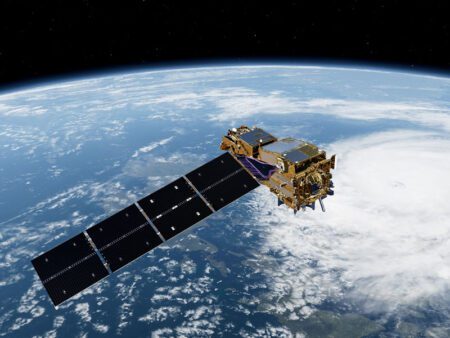

Image: ESA/ATG medialab
The Metop Second Generation A1 (Metop-SGA1) satellite has been launched from Europe’s Spaceport in French Guyana and should soon start transmitting high-resolution weather data.
The first satellite in EUMETSAT’s Polar System Second Generation (EPS-SG) programme, Metop-SGA1, in a polar orbit around 800km above the Earth’s surface, should continue the Metop series of satellites’ role as Europe’s most important source of meteorological observations for forecasts up to 10 days ahead.
In particular, with the improved short and medium-term weather models, there should be earlier warnings of extreme weather events that can improve preparedness by for example grid operators for managing energy supply.
Phil Evans, EUMETSAT Director-General, said that extreme weather has cost Europe hundreds of billions of euros and tens of thousands of lives over the past 40 years.
Have you read?
How power systems can boost resilience to extreme weather
Europe Energy Briefs: Weather and climate and how they impact the energy system
“The launch of Metop-SGA1 is a major step forward in giving national weather services in our member states sharper tools to save lives, protect property, and build resilience against the climate crisis.”
He added that the impacts will be felt even beyond that and across the Atlantic, as Metop-SGA1 is Europe’s first contribution to the Joint Polar Satellite System with the US National Oceanographic and Atmospheric Administration (NOAA) – an ongoing polar orbiting environmental satellite programme gathering global atmospheric, terrestrial and oceanic data.
Unlike the first European weather satellites, which were in a geostationary orbit essentially remaining fixed above the equator, the polar orbiting satellites travel north to south as the Earth rotates beneath them enabling them to secure a global coverage.
Under the EPS-SG programme, Metop-SGA1 is due to be accompanied by a complementary satellite, Metop-SGB1, in 2026. These will then be followed by a further two consecutive pairs of Metop-SG satellites over the next two decades.
These will loop the Earth 14 times daily at an altitude of 823-848km. With their vast increase in the quantity and frequency of data, they will take advanced weather forecasting well into the 2040s.
Metop-SGA1 instruments
Metop-SGA1 carries a suite of six state-of-the-art atmospheric sounding and imaging instruments designed to deliver optical, infrared and microwave data for weather forecasting, storm prediction and climate monitoring as well as a wide range of other services and applications.
These include a new generation infrared atmospheric sounding interferometer to provide radiance spectra measurements of temperature, humidity, clouds, greenhouse gases, aerosols and trace gases in the Earth’s atmosphere; a visual and infrared imager to provide observations of the Earth’s outgoing radiation; a microwave sounder to deliver geolocated atmospheric temperature and water vapour sounding data as well as observations of cloud, snow and sea ice; a radio occultation sounder to provide atmospheric temperature and humidity measurements; and a multi-viewing, multi-channel, multi-polarisation imager to enhance the monitoring of aerosols and cloud properties.
Metop-SGA1 also carries the EU’s Copernicus Sentinel-5 mission, which will supply detailed data on atmospheric composition and trace gases that affect air quality.
Currently, more than 95% of the data used in numerical weather prediction comes from satellites, and this share is expected to grow as the Metop-SG satellites enter service.
They also are expected to provide important data for nowcasting – up to six hours ahead – particularly in northern latitudes where geostationary satellite data is sparser.