
Image: Hitachi
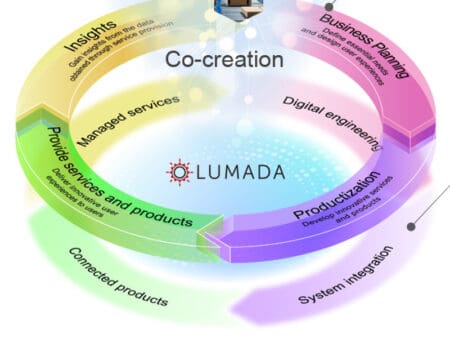
Hitachi has entered into a three-year partnership with Microsoft to embed its generative AI solutions into the Lumada framework and expand its use to the energy sector.
Hitachi intends to embed the Microsoft cloud, Azure Open AI Service, Dynamics 365, Copilot for Microsoft 365 and GitHub Copilot into the Lumada solutions.
In addition, the two companies intend to promote joint projects to address pressing business needs such as bolstering cloud services, enhancing security and mitigating the environmental footprint of data centres, which have become an increasing area of focus with the growing use of generative AI.
Keiji Kojima, President and CEO of Hitachi, says the company has been driving transformation by applying AI across the group to improve productivity and will invest 300 billion yen ($2.1 billion) in generative AI in the 2024 financial year.
Have you read?
How predictive AI is helping smooth the path to net zero
Artificial intelligence as an ally of the energy transition
“Hitachi and Microsoft have already been working on a variety of co-creation projects including the development of next-generation digital solutions for the manufacturing and logistics fields,” he comments.
“Under this new agreement, we are excited to further accelerate social innovation by expanding our efforts to social infrastructure areas such as energy and mobility and by applying generative AI to improve the productivity of frontline workers, which will become even more important in the future.”
As part of the agreement, Hitachi and Microsoft intend to improve access to and strengthen digital solutions for asset performance management, energy trading and risk management.
Hitachi Energy’s Enterprise Software Solutions technology and its partnership with Microsoft is thus considered as a key to optimising the energy network, from generation through transmission and distribution and ultimately in delivering reliable and sustainable energy to customers, a statement says.
As part of the initiative, Hitachi has already started to use Microsoft’s generative AI for its JP1 integrated operations management cloud service software, aimed to accelerate response times to address failures and enable improved operational efficiencies for IT departments, financial and public institutions.
Increased computing power and cloud infrastructure are both critical to scaling these applications.
Hitachi also intends to train more than 50,000 ‘genAI professionals’ on advanced AI skills, incorporating training provided by Microsoft into its own training.
Hitachi reports that generative AI is able to properly generate application source code 70-90% of the time.
The company also reports the development of a generative AI-based predictive maintenance solution for overhead lines on railways, which could presumably be adapted to the power sector.