
Tata Steel UK has marked further progress on its electric arc furnace project at Port Talbot, with work advancing across the main steelmaking and downstream processing elements of the South Wales transformation programme.
The project is centred on a new 3.2 million tonne electric arc furnace, which will replace blast furnace-based production at the site and form the core of Tata Steel’s lower carbon steelmaking route in the UK. Alongside the furnace itself, the company’s programme includes a new EAF meltshop, upgrades to the hot mill and casters, and development of a new pickle line.
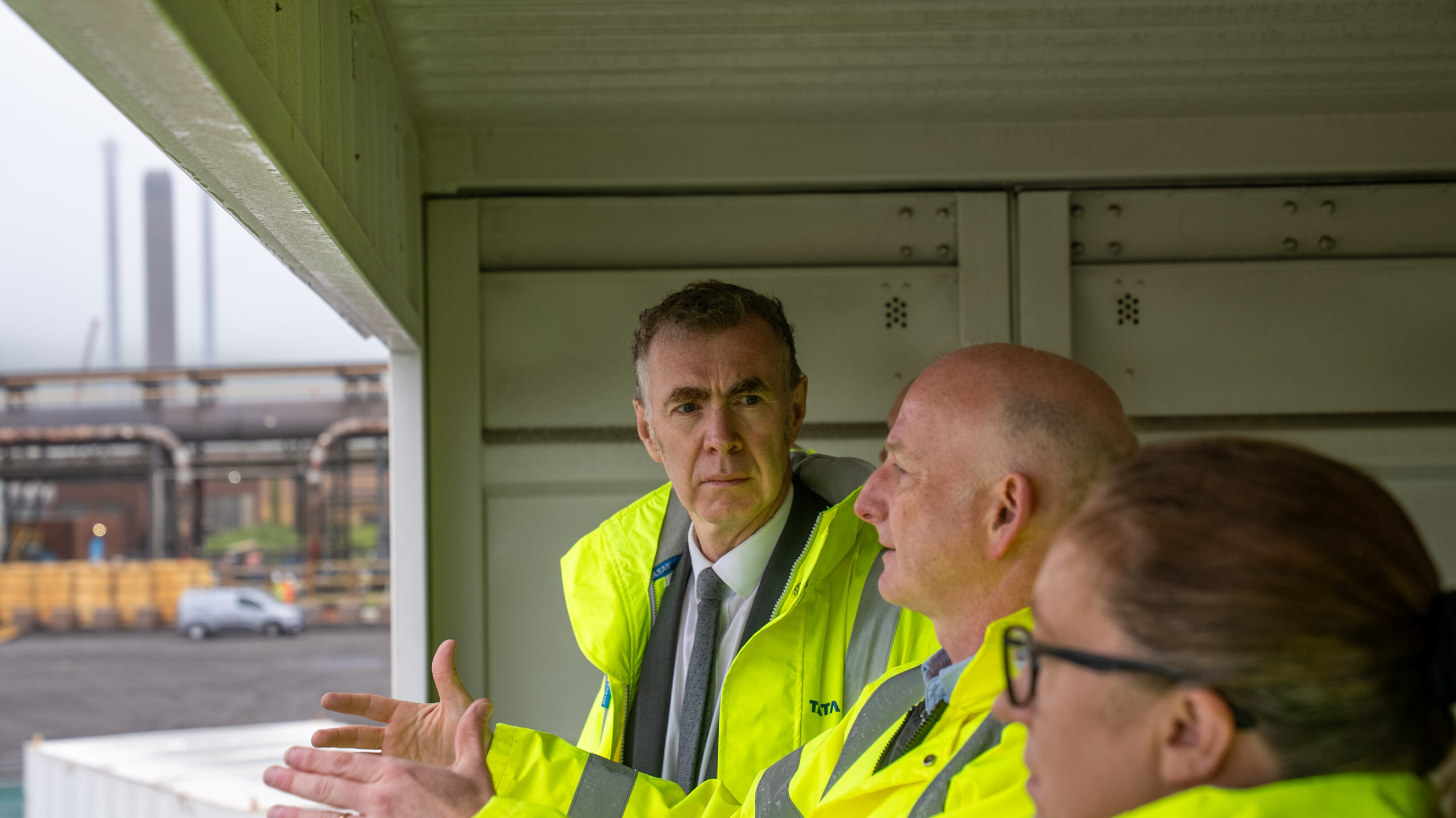
Welsh Government Minister for Enterprise, Connectivity, and Energy Adam Price MS visited the site as Project Invictus continued to move from planning into visible construction activity. The visit underlined the scale of the works now under way at one of Britain’s most important heavy industrial locations, where the transition from blast furnace production to electric arc steelmaking is reshaping the site’s operations, workforce requirements, energy profile, and material flows.
At Port Talbot, the move to EAF production changes much more than the furnace technology. Scrap steel will become the primary feedstock, placing greater emphasis on scrap quality, sorting, handling, chemistry control, and domestic material availability. The transition also alters the site’s relationship with power infrastructure, as electricity supply becomes a defining factor in operating cost, production stability, and long-term competitiveness.
The downstream investment is equally important. Steel customers require repeatable grades, consistent mechanical properties, surface quality, traceability, and delivery reliability, particularly in sectors where material qualification is demanding. The hot mill, caster, and pickle line upgrades therefore sit at the heart of whether the new production route can support higher value industrial markets rather than simply replacing lost tonnage.
Port Talbot’s shift reflects a wider reordering of steelmaking economics. Blast furnace production carries heavy carbon exposure, while electric arc furnace production depends on scrap availability, low carbon power, and effective integration with downstream processing. The technology route is established, but the industrial challenge sits in execution: securing the right material inputs, controlling energy costs, maintaining product quality, and supporting customers through qualification and transition.
The UK already generates substantial volumes of scrap steel, although much of it has historically been exported. A larger domestic EAF base gives the country a stronger reason to retain and upgrade that material, provided collection, sorting, and processing systems can deliver scrap streams suitable for higher specification applications. Without that supporting infrastructure, the value of domestic scrap will remain limited by quality variation and inconsistent availability.
The project is also closely tied to the UK’s energy system. Electric arc furnaces can reduce emissions from steelmaking, but they require large volumes of reliable, competitively priced electricity. Network capacity, power market arrangements, and energy price exposure will all influence the long-term economics of the site. Steel decarbonisation is therefore inseparable from grid planning and industrial energy policy.
The wider metals sector is already under pressure from cost, demand, and investment constraints, with recent sector evidence pointing to persistent competitiveness concerns. Port Talbot’s programme shows that major transition investment is still possible, although it also illustrates how dependent that transition has become on policy stability, infrastructure, and technically disciplined delivery.
Large industrial conversions are rarely clean breaks from the past. They depend on inherited assets, experienced workers, established customers, and supply chains that have to adapt while production expectations remain high. Port Talbot’s next phase will test whether the UK can convert legacy steelmaking capacity into a lower carbon production base without losing the capability, product range, and industrial confidence that made the site strategically valuable in the first place.
