
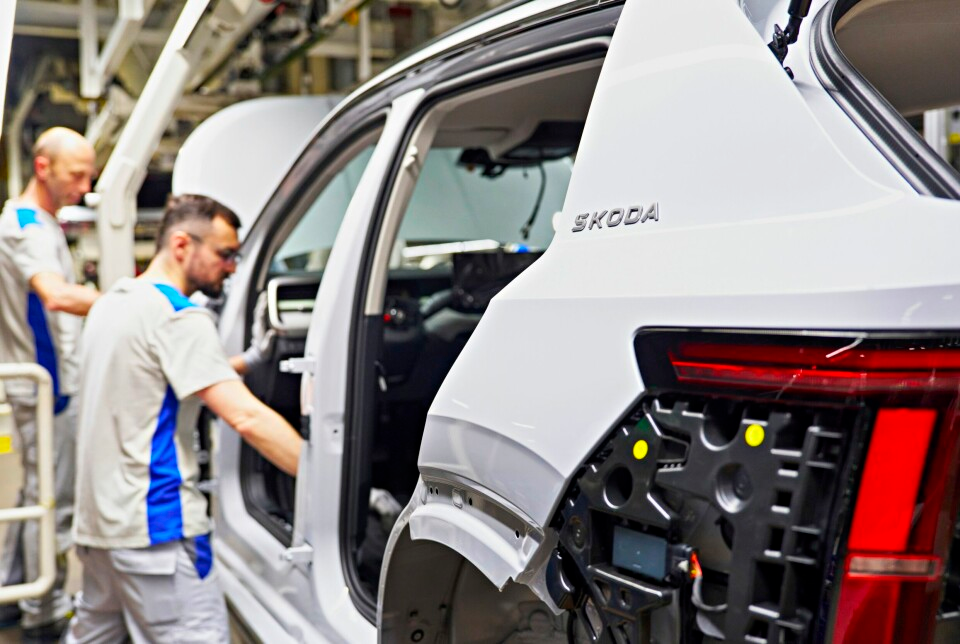
Škoda Auto has started series production of the all-electric Epiq at Volkswagen Navarra in Pamplona, making the model the Czech brand’s first vehicle manufactured in Spain.
The Epiq is Škoda’s new all-electric entry model and forms part of the Electric Urban Car Family being developed within Volkswagen Brand Group Core. Production at Pamplona places the car inside a wider Spanish manufacturing strategy that will see electric models from CUPRA, Volkswagen, and Škoda produced at plants in Spain.
Volkswagen Navarra was founded in 1965 and became part of the Volkswagen Group in 1984. The plant has produced more than 10 million vehicles over its lifetime and employs almost 5,000 people. Current output includes the Volkswagen Taigo and T-Cross, with more than 1,400 cars produced per day.
The start of Epiq production gives the plant a more central role in the group’s electric strategy. Navarra has historically been associated with combustion-engine Volkswagen models, but it is now moving into mixed production of internal combustion and battery-electric vehicles. The all-electric Volkswagen ID. Cross is expected to follow on the same line, creating a multimodel and multipowertrain manufacturing environment.
That flexibility is central to the industrial shift taking place across European automotive production. Carmakers are investing heavily in electric vehicles while demand remains uneven by market, price point, incentive regime, charging infrastructure, and customer segment. A plant able to produce combustion-engine and electric models on the same line gives the group more scope to adjust volumes as the market develops.
Spain is becoming increasingly important to that strategy. Volkswagen Group’s affordable electric vehicle plans are linked to Spanish assembly and battery ecosystem investment, with Pamplona and Martorell playing complementary roles. The decision reflects Spain’s established automotive base, supplier network, export infrastructure, and access to skilled production labour.
Affordable EV production raises a tougher set of manufacturing constraints than premium electrification. Lower vehicle prices leave less room to absorb battery-cost volatility, tariffs, logistics disruption, or underutilised plant capacity. Manufacturers have to reduce cost while retaining safety, digital functionality, range, reliability, and brand expectations.
That pressure is visible across Europe. Carmakers have been pressing Brussels for more time on EV tariffs, with rules-of-origin requirements due to tighten and regional battery supply chains still developing. Final assembly can be retooled, but competitiveness increasingly depends on battery cells, power electronics, thermal systems, semiconductors, software, and charging performance.
Volkswagen Brand Group Core is designed to extract synergies across Volkswagen, Škoda, SEAT/CUPRA, and Volkswagen Commercial Vehicles. The Epiq’s production in Pamplona shows that approach moving onto the factory floor. Shared architectures spread development and industrialisation costs, while flexible lines give the group more room to adjust production between brands and models.
The workforce transition is equally important. Mixed ICE and EV production requires training around high-voltage systems, battery handling, software-defined diagnostics, electronic architectures, and new safety procedures. Production employees must support legacy powertrains and electric platforms at the same time, often within plants originally configured around combustion-engine output.
Europe’s established automotive base is still trying to hold competitiveness through that transition. German manufacturers are already losing ground in parts of the shift, with electrification, software investment, China exposure, and tariff uncertainty testing industrial structures that were built around different assumptions.
Škoda’s Epiq start is therefore more than a new model entering production. It shows how European manufacturers are moving towards lower-cost EVs, mixed production systems, and tighter cross-brand cooperation because demand, regulation, and competition are changing faster than traditional vehicle cycles. The plants that can handle powertrain overlap, cost pressure, and uncertain volumes will carry more strategic weight as the EV transition becomes a manufacturing contest as much as a product race.
