
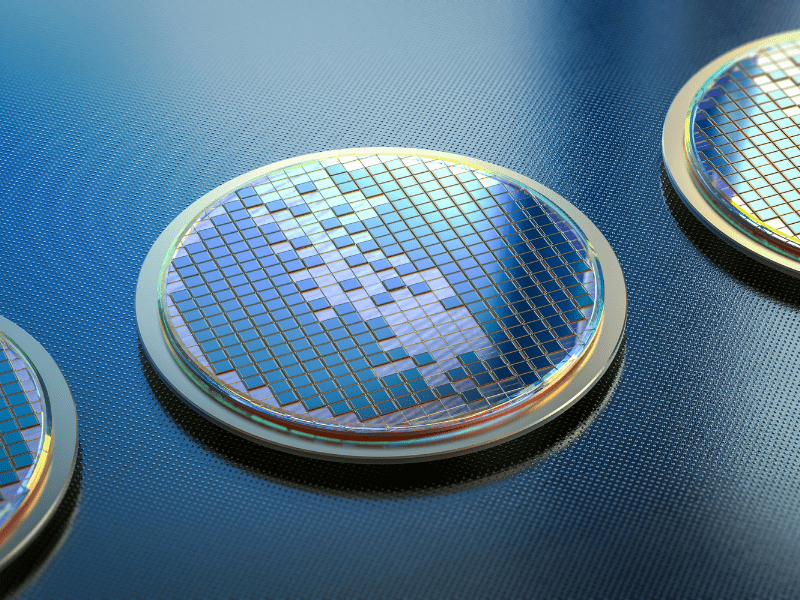
ROHM Semiconductor has selected AIXTRON’s G10-GaN deposition system to establish in-house gallium nitride epitaxy at its Hamamatsu plant in Japan.
The system is being ramped for volume production of 8-inch GaN epitaxial wafers for 650V and 100V power device platforms. The move deepens ROHM’s control over a critical manufacturing step for power semiconductors used in AI data centre infrastructure, electric vehicle powertrains, server power supplies, onboard chargers, DC-DC converters, and voltage regulation modules for accelerator-based computing.
ROHM has built its GaN position through the EcoGaN product family, including 650V GaN HEMTs for server power supplies and EV applications. Its 100V product line is aimed at voltage regulation modules used in AI accelerators and GPU-based computing platforms, where power density, efficiency, and thermal performance are becoming decisive design constraints.
The production partnership shifts ROHM further away from reliance on external foundry manufacturing for 650V GaN devices and toward greater vertical integration. By bringing epitaxy in-house, the company gains closer control over wafer quality, device performance, process scheduling, and production responsiveness. In compound semiconductors, epitaxial growth has a direct effect on breakdown voltage, on-resistance, thermal stability, and yield.
The work at Hamamatsu follows ROHM’s earlier effort to bring GaN process technology into the site through a technology transfer agreement with TSMC. That programme set out a route toward an end-to-end in-group GaN production system by 2027, strengthening the company’s ability to align materials, process technology, and device development within a more controlled manufacturing structure.
AIXTRON’s G10-GaN platform is designed for high-volume GaN-on-silicon epitaxy, where uniformity, throughput, and process control determine whether device performance can be reproduced at scale. The economics of GaN power devices depend not only on transistor performance, but on wafer size, yield, equipment productivity, defect control, and the ability to qualify processes for demanding industrial and automotive applications.
Demand is being pulled by two powerful end markets. AI infrastructure is pushing data centre power systems toward higher density, greater efficiency, and more sophisticated power conversion, while EV platforms continue to demand smaller, lighter, and more efficient conversion stages across onboard chargers, DC-DC converters, and auxiliary systems.
GaN is well suited to parts of that transition because it can switch faster and reduce losses in appropriate converter topologies. Higher switching frequencies can shrink magnetic components and improve power density, although they also intensify design challenges around electromagnetic interference, gate drive, layout, thermal management, packaging, and system qualification. The semiconductor device is only one part of the industrialisation problem.
Manufacturing integration sharpens the link between device performance and customer requirement. When more of the epitaxy and device process sits under internal control, materials, device structures, and production windows can be tuned with a closer feedback loop. Power electronics customers increasingly need supply predictability as well as performance gains, particularly where components are destined for data centres, vehicles, and grid-connected equipment.
The wider compound semiconductor market is also becoming more strategically important. GaN, silicon carbide, advanced packaging, and substrate engineering are being drawn into investment decisions around energy efficiency, AI power, electrification, and supply-chain resilience. Materials work such as Atomera’s RF GaN-on-silicon development shows how semiconductor engineering is pushing beyond conventional silicon scaling, while ROHM’s own SiC MOSFET adoption in AI server backup power illustrates the same pressure for more efficient power conversion around high-density compute.
ROHM’s AIXTRON partnership is therefore both a capacity move and a manufacturing-control move. The power semiconductor market is moving quickly, but device claims alone will not determine the strongest suppliers. Manufacturing consistency, qualification capability, and reliable supply will shape which technologies make the transition from demonstration to industrial deployment.
