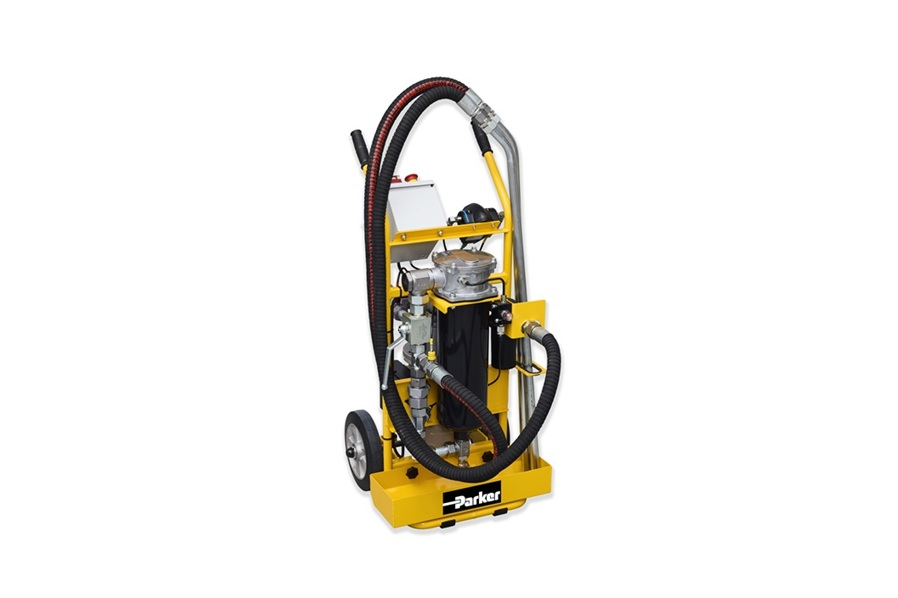
Parker Hannifin has launched the GLFTrolley, a portable filtration system designed to remove free water and particulate contaminants from hydraulic and lubrication fluids used across demanding industrial applications.
The mobile unit is intended to improve fluid cleanliness before filling, transferring, or servicing hydraulic systems. It can be moved between equipment, tanks, drums, and maintenance areas, giving engineers a practical way to clean fluids at the point of use rather than relying only on fixed filtration systems or scheduled oil changes.
Hydraulic fluid contamination remains one of the most persistent causes of industrial reliability problems. Water, particles, degraded oil, and poor handling practices can accelerate wear in pumps, valves, actuators, servo systems, and seals. Failures often appear as poor control, internal leakage, rising temperatures, reduced efficiency, and unplanned downtime.
The GLFTrolley is aimed at sectors where hydraulic systems operate under harsh duty cycles, including gas, marine, mining, forestry, and in-plant applications. In these environments, equipment is often exposed to moisture, dust, temperature variation, and continuous mechanical stress, making contamination control a central part of asset protection.
Portable filtration can be particularly useful where equipment is distributed across a plant, vessel, quarry, or remote site. A moveable unit allows maintenance teams to intervene where the problem is, rather than moving fluid or equipment back to a central service area. That can reduce handling risk and make preventive action more likely to happen before contamination becomes a failure.
Fluid cleanliness is also becoming more important as companies try to extend asset life. Replacement machinery is expensive, component lead times can be uncertain, and shutdown windows are often hard to secure. Protecting existing hydraulic systems through better maintenance gives operators a direct route to controlling cost without waiting for major capital investment.
Similar reliability themes are visible across heavy-duty industrial equipment. High-efficiency motors and drives for quarrying, recycling, construction, and bulk handling are being brought to Hillhead as part of a wider push to improve equipment performance in demanding operating environments. Parker’s filtration launch sits in the same practical engineering space: incremental improvements that protect uptime and reduce avoidable wear.
Water removal deserves particular attention in hydraulic and lubrication systems. Free water can reduce lubricity, promote corrosion, damage additive packages, and accelerate fatigue. Where drums are stored outdoors, equipment operates in marine conditions, or temperature swings create condensation, water contamination can develop quickly.
Cleaner fluid can also support energy performance. Worn components, internal leakage, sticking valves, and degraded oil force hydraulic systems to work harder to deliver the same motion or pressure. Filtration will not correct poor system design or chronic overload, but it can reduce the damage that gradually erodes efficiency.
The launch reflects a broader move towards condition-based maintenance. Fluid analysis, vibration monitoring, temperature data, pressure readings, and digital service records are all being used to identify failure risks earlier. Portable filtration gives maintenance teams a way to act on that information without waiting for a scheduled overhaul.
Reliability often improves through disciplined handling of small risks. A relatively modest improvement in fluid cleanliness can protect expensive components, avoid production interruptions, and reduce maintenance escalation. Parker’s GLFTrolley is built around that logic, bringing filtration closer to the equipment and giving operators another tool to prevent avoidable hydraulic failures from reaching the production schedule.