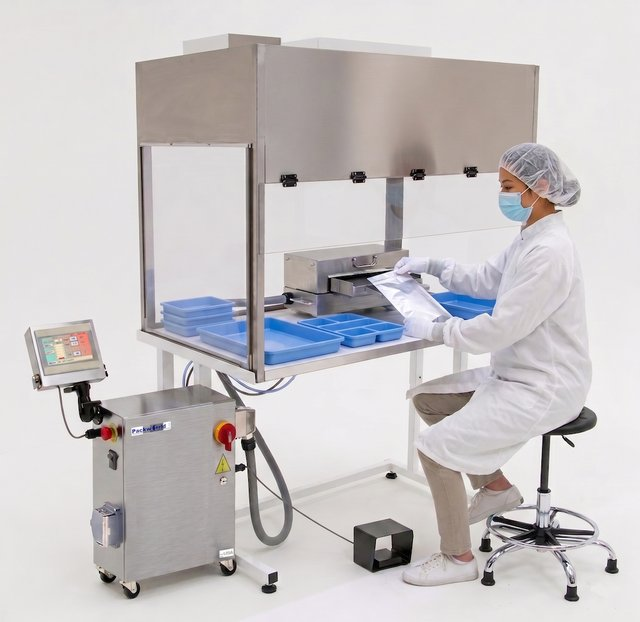
PackworldUSA has introduced the PW4214, a compact remote impulse heat sealing system designed for controlled environments where workspace, aseptic technique, and seal repeatability are critical.
The system is intended for use in biological safety cabinets, laminar flow hoods, tissue banking, regenerative medicine workflows, and laboratory environments where operators need to seal flexible sterile barrier systems inside confined spaces. The design keeps the low-profile sealing head inside the critical clean zone while placing the control module and touch screen interface outside the workspace.
That separation addresses a practical constraint in clean and controlled environments. Biosafety cabinets and laminar flow hoods provide limited working space, yet operators often need to manipulate specimens, packaging, tools, and documentation while maintaining aseptic technique. Large equipment inside the work area can restrict access, increase handling difficulty, and complicate cleaning.
The PW4214 uses a lightweight remote sealing head that can be integrated into existing containment equipment and fixtures. By reducing the equipment footprint inside the workstation, the system is designed to improve operator access and manoeuvrability while supporting repeatable seals on flexible packaging used for biological and medical materials.
Impulse heat sealing is a small but important process in pharmaceutical, medical, laboratory, and tissue handling workflows. A seal failure can compromise sterility, containment, transport integrity, or product traceability. High-value or sensitive biological materials require a sealing process that is controlled, documented, and repeatable rather than treated as a minor packaging step.
PackworldUSA’s wider equipment line uses TOSS technology and PIREG impulse temperature control, with the company focusing its systems on validatable and consistent sealing. The PW4214 applies that approach to applications where equipment must support controlled workflows while occupying as little clean zone volume as possible.
Cleanroom and laboratory equipment design is increasingly shaped by human factors as well as technical specification. Operators working inside cabinets often deal with restricted reach, gloves, visibility constraints, contamination control procedures, and delicate biological materials. Equipment that reduces obstruction can improve process consistency by allowing materials to be handled with fewer awkward movements.
The system also connects with wider changes in pharmaceutical and medical manufacturing, where traceability, validation, and process evidence are moving deeper into routine operations. Sealing equipment used for regulated products may need to support documentation, controlled recipes, calibration, access control, and data integrity requirements. PackworldUSA indicates that its touch screen line can support 21 CFR Part 11 compliance, a key consideration for electronic records and signatures in regulated environments.
Traceability requirements have already increased pressure on coding, labelling, and inspection processes, including printable label systems designed for more durable industrial identification. Sealing sits within the same control chain. A pack, pouch, label, code, batch record, and process parameter all contribute to whether a regulated product can be released, traced, stored, transported, and investigated if required.
The PW4214 is particularly relevant to tissue banking and regenerative medicine because those workflows often involve scarce, valuable, and biologically sensitive materials. Operators may need to maintain sterility while working within constrained hoods and cabinets, and the packaging process must avoid unnecessary disruption to the work area. Separating the sealing head from the main controls moves bulk and interface elements outside the clean zone.
Regenerative medicine and advanced therapy manufacturing are creating demand for equipment that can scale from laboratory processes toward more repeatable production. Many workflows have developed in research settings, but commercialisation requires tighter controls around materials, equipment, records, and operator variation. Small process tools can become critical once production has to satisfy quality system expectations.
Equipment suppliers must balance compact design with validation needs. A smaller sealing head cannot compromise temperature control, pressure consistency, seal width, material compatibility, cleanability, or serviceability. In regulated environments, a space-saving design is only useful if it preserves process evidence and performs consistently across batches and operators.
The introduction reflects a wider trend toward modular and remote equipment configurations. Instead of forcing all controls, power, interfaces, and mechanical elements into the clean zone, suppliers are separating functions so that only the necessary process head enters the controlled space. That can reduce clutter, simplify cleaning, and make it easier to integrate equipment into existing cabinets.
Sealing is not usually the most visible part of pharmaceutical or medical technology production, but it is one of the barriers that protects product integrity. PackworldUSA’s PW4214 targets that barrier at the point where cleanroom space, operator movement, and validated packaging meet.