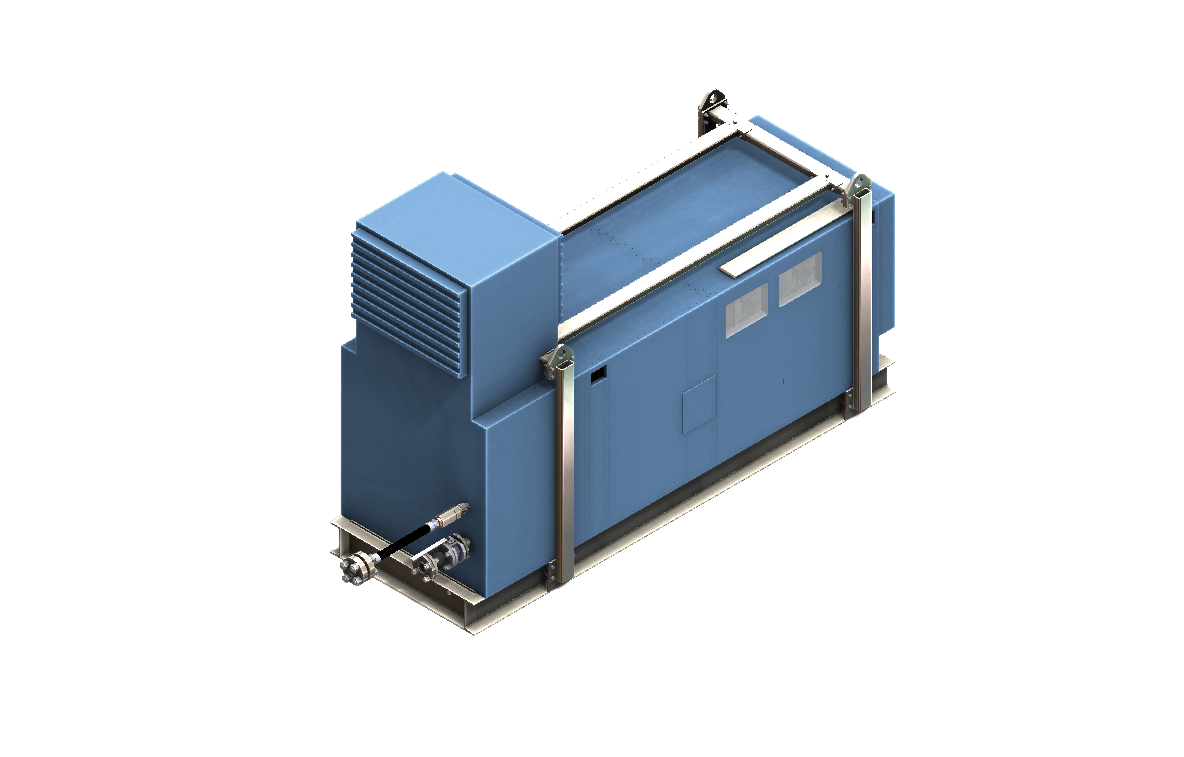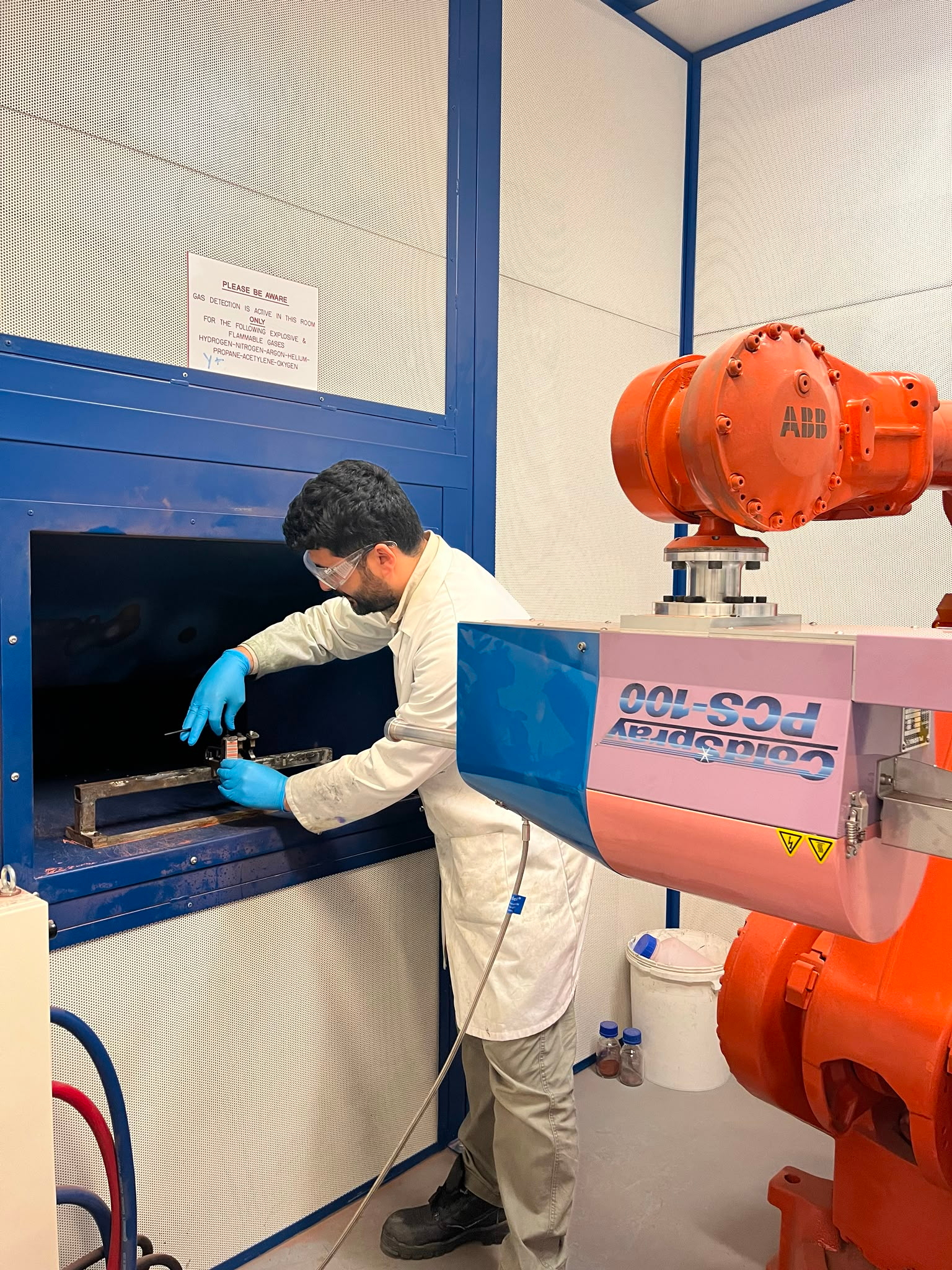
The University of Nottingham has launched the UK’s highest-pressure cold spray additive manufacturing facility, creating a national capability for advanced metal repair, remanufacturing, coatings, and additive manufacturing research.
The facility is housed within the Centre of Excellence in Coatings and Surface Engineering and will support collaboration with industry and research partners across advanced manufacturing, clean energy technologies, and high-value engineering sectors. Aerospace, defence, fusion, and nuclear are expected to be among the main application areas.
Cold spray is an additive manufacturing and surface engineering process that accelerates fine metal powders at very high speed onto a substrate. Unlike conventional welding or many thermal spray processes, the feedstock does not melt during deposition. Solid-state bonding occurs as particles impact the surface, deform, and build a dense metallic layer.
Avoiding melting can reduce heat-affected zones, thermal distortion, oxidation, phase changes, and residual stress. In high-value components made from demanding alloys, the ability to add or restore material without exposing the part to high thermal loads can open repair routes that would otherwise be technically difficult, slow, or uneconomic.
The project has been supported through Research and Innovation and the Faculty of Engineering at the University of Nottingham, alongside PlasmaGiken, Rolls-Royce, BAE Systems, and the Engineering and Physical Sciences Research Council. The partner group reflects the sectors where cold spray has a clear industrial role: components are expensive, qualification demands are high, and replacement can carry long lead times.
Professor Tanvir Hussain, professor of coatings and surface engineering at the University of Nottingham, said: “After three years of proposal development and industrial collaboration, we are proud to commission the UK’s highest-pressure cold-spray additive manufacturing facility. This is not simply a new piece of equipment added to the UK cold spray landscape, but it represents a national capability that will support advanced manufacturing research and industrial innovation for years to come for the UK for all engineers and technologists.”
The facility is expected to support new techniques, applications, and industrial validation. Potential use cases include restoration of worn or damaged metal parts, protective coatings, dimensional recovery, material build-up, and development of repair processes for components exposed to harsh mechanical, thermal, or corrosive environments.
Repair and remanufacturing are becoming more strategically valuable across high-end engineering. Aerospace, defence, and energy operators are under pressure to extend asset life, reduce waste, protect supply chains, and keep critical equipment in service for longer. Component value is not limited to material and machining time; qualification, documentation, certification, lead time, and downtime can all dominate the business case.
Cold spray can also support more resource-efficient production without depending on broad sustainability claims. Restoring a high-value part rather than scrapping it can reduce material demand and machining effort, especially where components are made from nickel alloys, titanium alloys, copper, aluminium, or other materials linked to expensive feedstocks and complex supply chains.
Industrial adoption will depend on much more than proving that material can be deposited. Process control, feedstock characterisation, bond strength, microstructure, porosity, residual stress, surface preparation, inspection, and qualification routes all need to be understood. Safety-critical sectors require repaired components to be treated as engineered products with documented performance, not as successful laboratory demonstrations.
A national facility can carry more value than a single machine purchase because cold spray sits at the intersection of materials science, process engineering, surface preparation, metrology, mechanical testing, and industrial qualification. Bringing those disciplines together in one hub gives manufacturers a stronger route from experimental deposition to validated process windows.
Advanced manufacturing is increasingly constrained by verification as much as production capability. Work on automated aerospace inspection bottlenecks has already shown how high-value engineering can be held back when inspection and assurance fail to keep pace with machining and fabrication. Cold spray repair will face the same discipline around inspection, traceability, and data-backed confidence.
The new Nottingham capability strengthens the UK’s position in a field that could support defence readiness, aerospace maintenance, clean energy infrastructure, nuclear component life extension, and future fusion engineering. These sectors need advanced manufacturing processes that perform under practical industrial constraints, where repeatability and evidence count as much as novelty.
The launch gives manufacturers and researchers a route to test cold spray at a level of pressure and capability not previously available nationally. The next stage will be proving which applications can move from research interest to qualified industrial use. In repair and remanufacturing, the strongest process is the one that can be repeated, measured, documented, and trusted on parts that are too valuable to discard and too critical to fail.