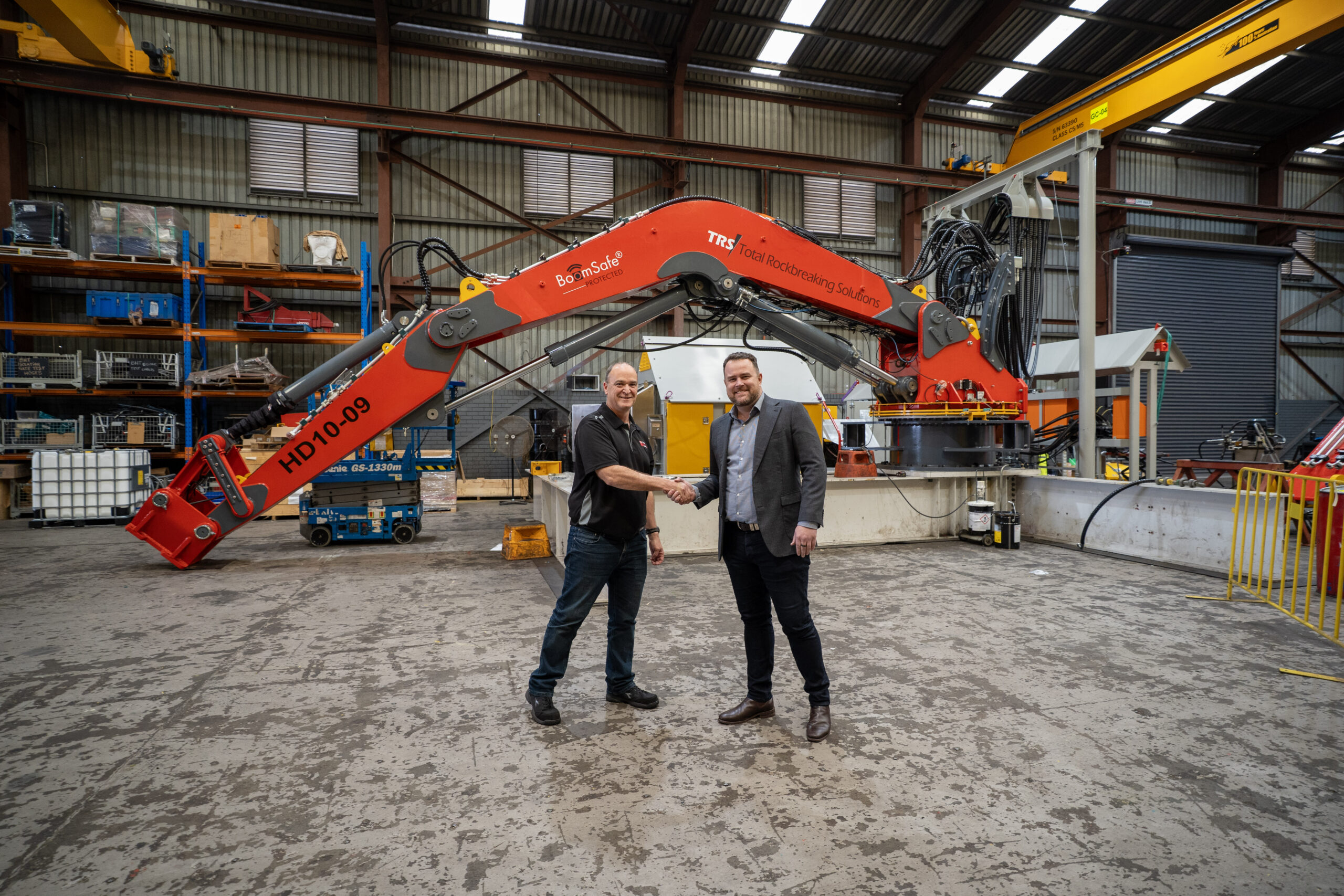
Finnish mining equipment manufacturer Normet has acquired Total Rockbreaking Solutions (TRS), a Western Australian engineering business specialising in rock breaking and hydraulic attachments, extending its equipment portfolio beyond its established underground mining and tunnelling operations.
The Perth-based company, founded in 2013, employs 40 people. Its engineering and equipment activities serve mining, quarrying, construction, demolition and recycling customers, with workshop and on-site technical services supporting the machinery it supplies.
TRS will retain its existing brand and team following the transaction. Normet has not disclosed the acquisition price.
The purchase brings engineering relationships with surface mining operators and engineering, procurement and construction management contractors into the Finnish group’s international network. Normet employs approximately 2,000 people across more than 30 countries and generated net sales of €471m during 2025.
Ed Santamaria, president and CEO of Normet, said: “Their knowledge of surface mining applications and close collaboration with customers and EPCM partners complements Normet’s capabilities exceptionally well.”
Normet intends to combine the Australian company’s application engineering resources with its own investment in automated rock breaking systems. Its existing underground equipment portfolio includes machinery for concrete spraying, rock reinforcement, breaking, scaling and materials transport.
Surface mining introduces a different set of constraints for rock breaking equipment, particularly where extracted material is delivered in large volumes to primary crushing facilities. The dimensions and physical characteristics of rock fragments can vary between successive loads, and material exceeding the crusher’s intake capacity must be reduced before it can progress through the plant.
Hydraulic breakers transfer repeated impacts into the rock through a tool driven by a hydraulically powered reciprocating mechanism. The selection of a breaker must account for the characteristics of the material, the available hydraulic flow and pressure, and the strength of the structure supporting the equipment.
An excavator-mounted breaker can be moved between different working areas. Fixed boom systems, by contrast, are commonly positioned around crushing and material handling installations where they must reach oversized rocks or obstructions within a defined operating envelope.
The geometry of the boom and its supporting structure consequently influences the range of material positions that can be reached. Engineers also need to establish whether the equipment can be installed without restricting access for maintenance or interfering with adjacent plant.
The repeated forces produced by a breaker are transmitted through the boom, its joints and the supporting structure. Hydraulic hoses, seals and mechanical connections are exposed to demanding operating conditions that can include dust, vibration and considerable changes in load.
Application engineering must therefore extend beyond matching the nominal size of a breaker to the material. The capacity of the hydraulic supply, the geometry of the installation and the required operating duty affect how the equipment will perform over its working life.
TRS’s workshop and field support resources give Normet additional capacity to maintain equipment operating within these environments. Local engineering teams can also contribute to the design of installations where existing crushers, conveyors or civil structures determine the space available for new machinery.
Normet has been developing automation through its Xrock business, which introduced the Xrock Autobreaker in December 2025. The system is designed to identify oversized rocks and undertake breaking operations autonomously, reducing the need for personnel to remain near the working area.
Automating such tasks involves a different perception problem from that encountered by robots handling manufactured parts of known geometry. The distribution and shape of rocks can change following each material delivery and each impact. A system must identify an appropriate target and adapt subsequent movements as the material fragments.
The breaker also needs to operate within the mechanical reach of its supporting boom and avoid contact with the surrounding equipment. Where rock breaking forms part of a crushing circuit, the operating sequence must be coordinated with the conditions at the crusher and the availability of downstream material handling capacity.
Santamaria said: “The combination also strengthens our ability to bring innovative technologies to the market and expand our presence in key mining regions globally.”
The acquisition gives Normet access to established Australian surface mining projects at both the engineering design and operating stages. Involving equipment specialists early in plant design can allow breaker geometry, hydraulic services and maintenance access to be considered before the surrounding infrastructure is installed.
No specific combined product launch or new customer deployment has been announced. The immediate expansion is in the group’s application expertise and service footprint, providing a wider range of mining installations in which its rock breaking and automation technologies can be engineered and supported.