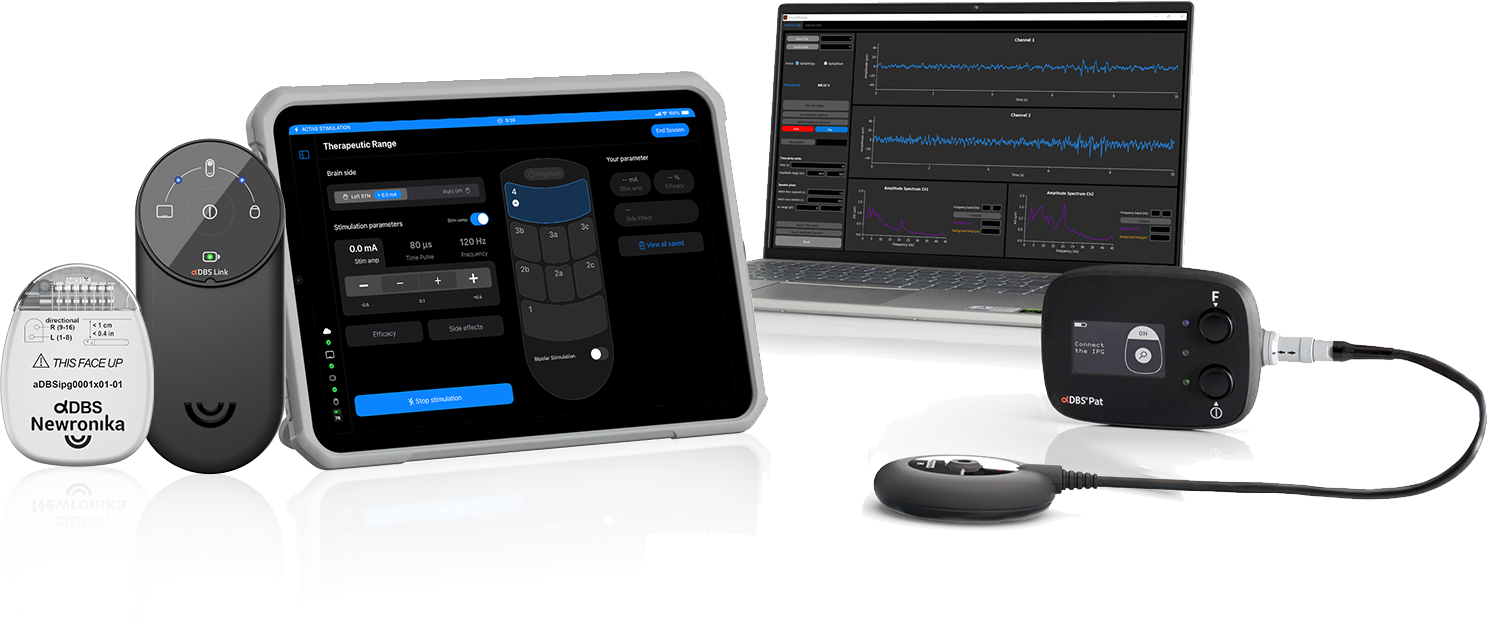
Newronika has received CE Mark certification for the latest commercial version of its αDBS adaptive deep brain stimulation system, clearing the technology for use across the European Economic Area.
The Milan-based company has integrated the implant with WebBioBank, a cloud platform that collects neuronal signals alongside clinical data. The resulting system combines implanted stimulation, physician programming, patient interaction, and longitudinal information within one connected therapeutic architecture.
Conventional deep brain stimulation normally delivers therapy according to programmed settings, even as symptoms and neurological activity change during the day. αDBS senses local field potentials in real time and adjusts stimulation within parameters established for the individual patient.
Newronika’s Adaptive Therapy Stim Engine interprets the measured signals and controls stimulation within a defined therapeutic range. The hardware includes an implantable pulse generator, leads, a physician interface, and a patient remote that can support data collection beyond scheduled clinical appointments.
Deep brain stimulation is an established treatment for selected patients with Parkinson’s disease and other movement disorders. Electrodes are placed within targeted areas of the brain and connected to an implanted generator, which delivers electrical pulses intended to alter abnormal neural activity.
Adaptive operation creates a more complex engineering requirement because the device must sense very small neural signals while delivering electrical stimulation in the same environment. Signal processing has to distinguish useful biomarkers from interference, movement, and stimulation artefacts before the control system changes therapy.
Closed-loop performance consequently depends on the integration of electrodes, analogue front ends, embedded software, algorithms, telemetry, batteries, packaging, and clinical programming. Each element must remain stable within an implanted environment over a prolonged service life.
WebBioBank adds a data infrastructure around the implant, collecting de-identified neuronal and clinical information from participating centres. Clinicians and researchers can examine therapy response over time, compare patterns across patients, and study how adaptive settings behave outside short clinic-based assessments.
Developed with support from the Italian Ministry of Education, the platform has already contributed to peer-reviewed work examining brain activity and stimulation mechanisms. Its inclusion in the commercial system moves that data environment closer to routine therapy and post-market evidence generation.
Connectivity also expands the device’s cybersecurity and data-governance requirements. Authentication, access rights, transmission security, software updates, audit records, and separation between clinical control and research analysis must remain effective throughout the product lifecycle.
European approval moves the programme from development into commercial manufacturing and clinical deployment. Repeatable production is required across implants, leads, programmers, patient devices, sterile supply, packaging, traceability, service, and post-market surveillance.
Implantable devices operate under strict process controls because small manufacturing variations can affect reliability and patient safety. Electronics, batteries, feedthroughs, housings, connectors, and specialist materials must be produced through documented routes that remain stable over long periods.
Newronika’s certification follows broader progress across European interventional technologies, including the global pivotal programme for the Topaz transcatheter heart valve. Both developments show how medical-device growth depends on clinical evidence, manufacturing readiness, regulatory execution, and sustained specialist supply.
The company is also conducting the ADVENT pivotal trial under a US Food and Drug Administration investigational-device exemption. The study spans the United States and Europe and is intended to support future American approval for conventional and adaptive stimulation in Parkinson’s disease.
Commercial adoption across Europe will depend on clinical outcomes, reimbursement, physician training, implanting-centre capacity, and compatibility with existing care pathways. Adaptive therapy may reduce some programming burden, although it also introduces additional data, software, and workflow requirements.
Long-term evidence will determine whether continuous sensing and responsive stimulation produce more consistent symptom control, reduce unwanted effects, or improve battery use. Those outcomes must be demonstrated across varied patient populations rather than through isolated technical performance.
The CE Mark gives Newronika a route into that next stage, where manufacturing scale, clinical support, software maintenance, and post-market data become as important as the original implant design. Its αDBS platform now moves from controlled development towards routine use within European neurological care.