JAKOB Antriebstechnik has expanded its standard stainless steel shaft coupling range for hygienic applications in the pharmaceutical, food, and medical technology sectors.
The company now offers several stainless steel couplings as standard product series, including KG-VA, KGH-VA, and MKG-VA metal bellows couplings; WD-VA and WDB spacer couplings; the EKM-VA elastomer coupling; and SKVA-N and SKVA-K safety couplings, including variants.
Stainless steel shaft couplings are used where corrosion resistance, cleanability, and hygienic design are essential. Smooth stainless surfaces reduce the risk of dirt and germ accumulation, while the material can tolerate aggressive cleaning regimes more effectively than many conventional coupling materials.
The range is aimed at mechanical transmission applications inside production environments with strict hygiene requirements. Pharmaceutical production, food processing, medical technology, biotechnology, cleanrooms, and chemical processing all place additional demands on components that would be treated as straightforward drive hardware in less controlled industries.
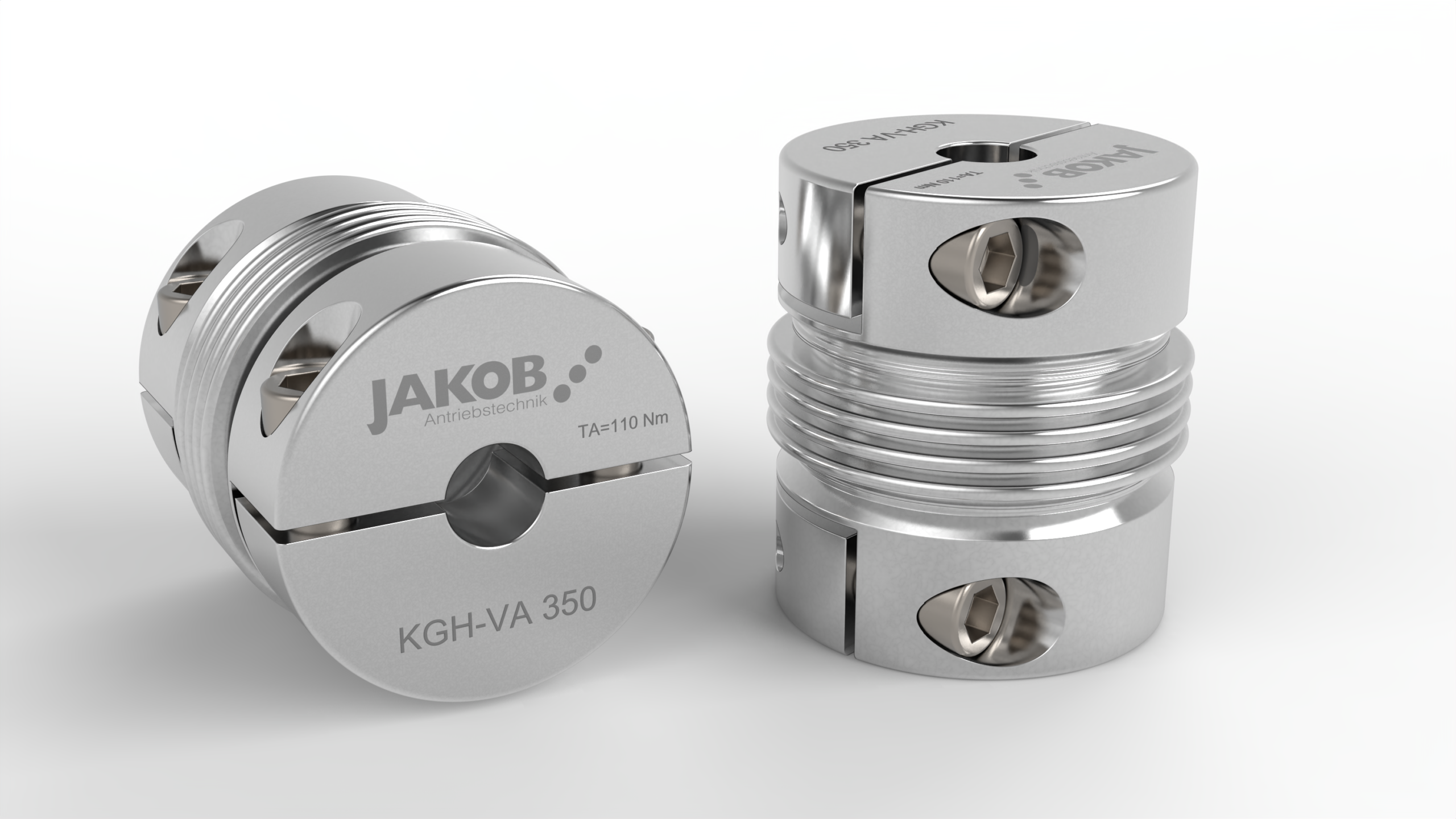
JAKOB said the KGH-VA metal bellows coupling and WD-VA spacer coupling feature split-hub designs intended to simplify installation. Fixed hub halves are placed onto the shaft and bolted to loose split-hub sections, reducing the need to disassemble drive or output units. That construction can be useful where space is limited or where fixed shaft ends make conventional installation more time-consuming.
The KG-VA series is suitable for temperatures up to 350°C and covers shaft diameters from 10 to 90mm, with torque ratings from 30 to 1000Nm. The KGH-VA series is wear-free and maintenance-free, also rated up to 350°C, and covers shaft diameters from 7 to 85mm with torque ratings from 10 to 1200Nm. It is available in variable overall lengths with two- or four-convolution bellows.
The MKG-VA miniature metal bellows coupling uses a clamping hub and can transmit up to 15Nm of torque while operating at temperatures up to 350°C. The EKM-VA elastomer coupling is a newer addition to the range, capable of transmitting torques up to 500Nm and operating at temperatures up to 90°C.
The WD-VA spacer coupling is available in variable lengths up to 3m and provides backlash-free torque transmission. It is suitable for temperatures up to 350°C, shaft diameters from 7 to 85mm, and torque capacities between 10 and 1200Nm.
The SKVA-N and SKVA-K safety couplings are designed for indirect drives, while the SKVA-EK and SKVA-KG versions are intended for direct drives. JAKOB said the non-elastomer series offer higher heat resistance, making them suitable for applications involving ovens or refrigeration systems.
Power transmission components can become weak points in hygienic production when they are difficult to clean, prone to corrosion, or awkward to inspect. A coupling that traps residue, requires excessive maintenance, or reacts poorly to washdown conditions can undermine production reliability and hygiene assurance. In regulated sectors, small mechanical details can affect uptime, cleaning validation, contamination risk, and maintenance access.
Pharmaceutical production is particularly sensitive to component design because equipment is shaped by GMP expectations, documentation, and contamination control. Components used near product zones, filling lines, mixers, pumps, packaging equipment, or cleanroom systems must be maintainable, inspectable, and compatible with cleaning regimes.
Food manufacturing faces similar operational pressure through allergen control, cleaning time, water use, chemical exposure, corrosion resistance, and line availability. Components that reduce dismantling time or simplify inspection can improve production efficiency as well as hygiene.
JAKOB’s split-hub design focus therefore goes beyond installation convenience. Maintenance access is a productivity issue in plants where equipment may need to be cleaned, inspected, adjusted, or replaced during tight production windows. Eliminating unnecessary disassembly reduces downtime and lowers the risk of disturbing adjacent equipment.
The expanded stainless range reflects a broader move towards specialised standard components for regulated sectors. Manufacturers want catalogue availability without giving up application suitability. A standard stainless coupling range gives designers a faster route to specify hygienic components while retaining options around torque, shaft size, temperature, installation style, and drive configuration.
Custom engineering remains part of JAKOB’s offer, with the company continuing to design and manufacture couplings to customer requirements. That remains important because hygienic and regulated applications often involve compact equipment, stainless assemblies, high cleaning temperatures, aggressive chemicals, variable shaft distances, or unusual torque and misalignment profiles.
Hygiene is not achieved only through major vessels, pipework, and product-contact surfaces. It is also shaped by smaller components that determine how reliably a machine can be cleaned, maintained, and kept running.