Inbolt has raised $12.5 million to expand its AI based robot guidance business in the United States and Asia-Pacific and move further into electronics manufacturing and data centre applications.
The €11 million funding round was led by new investor Shift4Good, with Bridges Climate Transition Partners participating alongside existing investors BNP Paribas Développement and Ora Global. The investment takes total funding in the Paris company to €30 million.
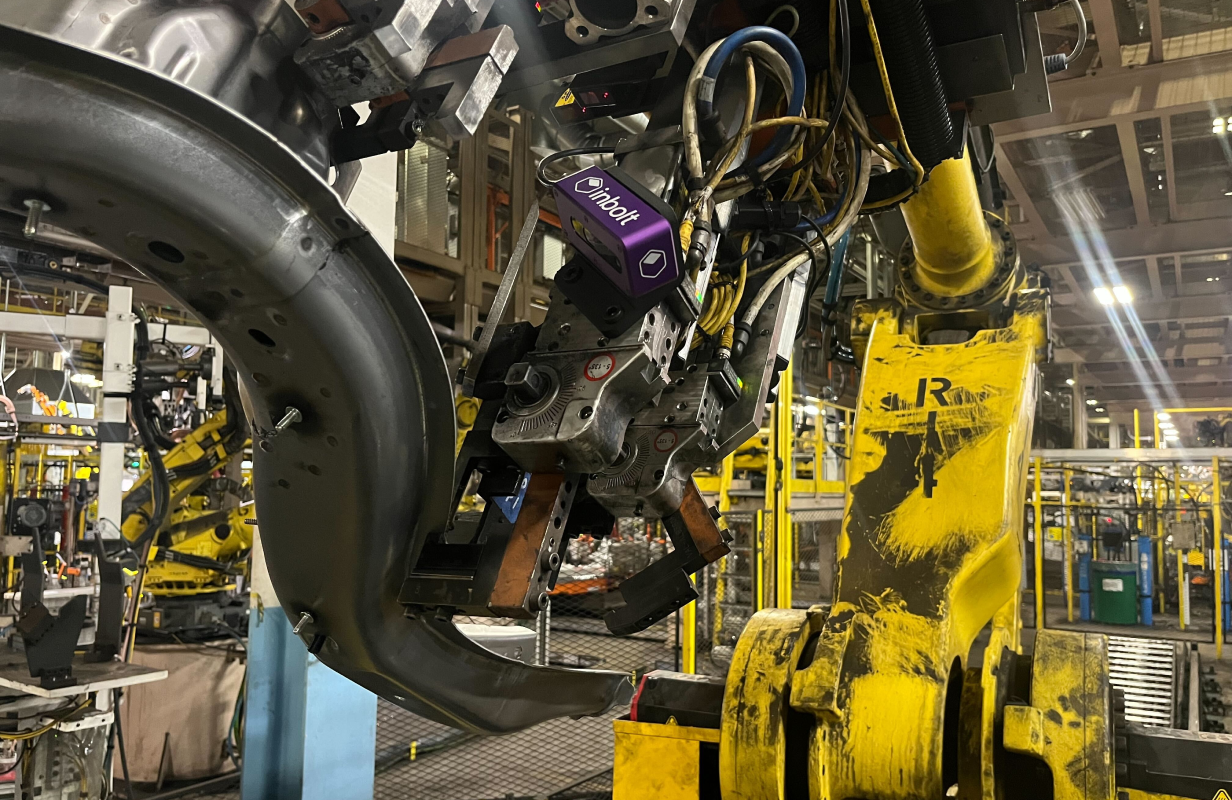
Inbolt develops 3D vision and control software intended to let industrial robots adjust their trajectories when components or fixtures are not exactly where a conventional programme expects them to be. Its platform combines robot-mounted 3D imaging with CAD trained perception and control software that corrects robot movement around the position detected in real time.
The practical target is one of the less visible costs in factory automation: creating a predictable environment for the robot. Conventional cells often use jigs, locating pins, guides, and tightly controlled presentation of parts so that every component arrives in the same position. Those methods are effective, but they add engineering and maintenance work and become cumbersome when product variants or tooling conditions change.
Inbolt instead identifies the position and orientation of the component and adjusts the robot’s path to match. The company supports major platforms including FANUC, ABB, KUKA, Yaskawa, Comau, and Universal Robots, giving the technology a route into installed automation as well as new cells.
The company says its platform is now deployed on more than 200 robots across more than 100 factories on three continents. Named users include Bosch, Beko, Flex, Ford, Stellantis, and Toyota. That installed base gives the current funding round a different character from financing built solely around prototype technology.
Rudy Cohen, co-founder and chief executive of Inbolt, said: “Robots have been running blind for fifty years. Fixing that isn’t about better hardware.”
The new capital will support further US growth following the opening of a Detroit operation during 2026, expansion across Asia-Pacific, and entry into electronics manufacturing and data centres. Those markets extend the business beyond the automotive applications that have provided much of its early production experience.
The technical requirement remains similar across sectors even where the physical processes differ. Robots are extremely repeatable when parts and tooling remain where expected, but variation in component location, fixture wear, manual loading, or moving production lines can force a cell to stop or require additional sensing and mechanical controls.
Adding perception changes that equation by allowing motion to respond to the actual position of the workpiece. It does not remove the rest of the automation stack. Vision still has to interact with robot control, PLC logic, tooling, functional safety, quality systems, and cycle-time requirements without introducing unreliable decisions into a process expected to run continuously.
Inbolt’s recent integration with Universal Robots’ Gen 7 platform illustrates the direction of travel. The company’s vision guidance can run through the newer UR controller and tool interface, reducing some of the external computing and cabling that would otherwise be required around a vision-guided cell.
The wider significance is less about one robot brand than about making adaptive guidance easier to install on existing machinery. Factories already operate millions of mechanically serviceable industrial robots, and replacing those assets merely to obtain better perception can be difficult to justify. A software and vision layer that can be retrofitted across several manufacturers offers a different upgrade path if integration remains manageable.
Electronics manufacturing will put that model under different pressures from automotive production. Components can be smaller, process tolerances tighter, and product variation higher, while cycle times leave little room for additional perception latency. Data centre applications will present another set of handling and assembly tasks rather than involving the computing workload itself.
Inbolt’s own production footprint suggests that the next stage is as much commercial as technical. More than 200 robot installations across more than 100 factories indicate broad site penetration but relatively few robots per location on average. Expanding individual deployments from a handful of cells towards larger portions of a plant would provide stronger evidence that adaptive guidance can move beyond targeted problem stations.
The funding therefore supports a scaling exercise rather than a basic proof of concept. Inbolt has working production deployments and integrations across several robot platforms; it now has to reproduce that performance across more plants, sectors, and regions while keeping commissioning, support, and maintenance simple enough for manufacturers to deploy the technology repeatedly.