
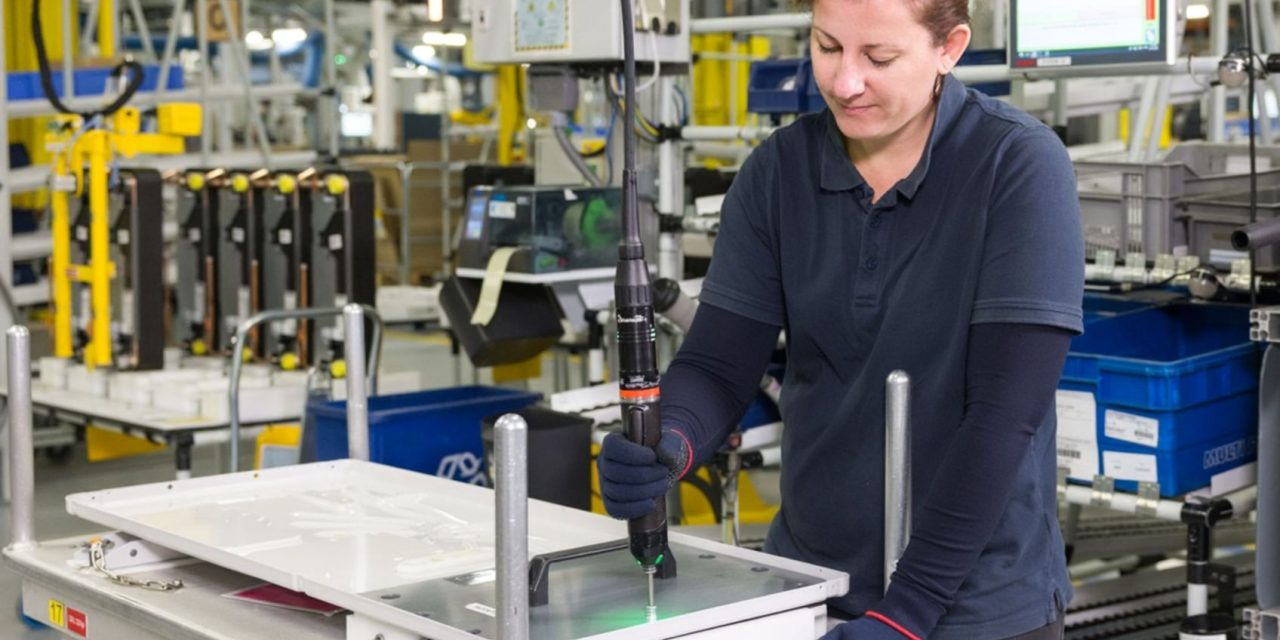
Desoutter has launched the EIDS Series, a new generation of low-torque transducerised screwdrivers designed for safety-critical and high-precision industrial assembly.
The tool range is aimed at manufacturers working in sectors such as electronics, medical technology, e-mobility, and smart mobility, where tightening quality has a direct effect on product safety, compliance, and long-term reliability. The EIDS Series covers inline tools from 0.2Nm to 16Nm and angle tools from 1.5Nm to 22Nm, with a stated torque scatter accuracy of ±2.5% 6s across the full torque range.
Designed for handheld, fixtured, and automated stations, the platform gives production teams a single tool family that can move across different assembly strategies. The range supports integration into Desoutter’s fastening ecosystem, including AXON controllers, and is intended to reduce tool complexity while maintaining tightening quality across multiple applications.
Low-torque fastening can appear simple because the components are small, but the tolerance window is often narrow. A joint that is slightly under-tightened may loosen or compromise electrical, sealing, or mechanical performance; a joint that is over-tightened may damage threads, deform components, crack housings, or create failures that appear only after test or field use.
The problem becomes sharper in products with dense assemblies and high part counts. Electronics housings, sensors, medical devices, battery modules, small actuators, and control units often require repeated fastening across materials that vary in stiffness, surface finish, and thread behaviour. Production lines have to deliver speed without allowing operator variation or tool drift to undermine repeatability.
Transducerised tools address that challenge by measuring torque directly at the tool level rather than relying only on indirect motor current or clutch behaviour. More accurate tightening data gives manufacturers a stronger basis for traceability, particularly in regulated or safety-critical sectors where the ability to prove how a joint was tightened can be as important as the tightening action itself.
The EIDS Series also reflects the uneven route from manual assembly to automation. Many factories are not moving into fully automated production in one step. They are running mixed-model lines, semi-automated stations, reconfigurable benches, and fixtured tools that still rely on operators. A tool that can be used by hand and then integrated into a fixed or automated station gives production engineers more room to adapt as volumes, variants, and labour availability change.
That flexibility is particularly valuable in electronics and medical manufacturing, where product lifecycles can be short and the cost of dedicated hard automation is not always justified. Automation is being applied where it stabilises quality and throughput, but equipment still has to be redeployed when product geometry, batch size, or customer specification changes. The most useful assembly technologies therefore support gradual automation rather than demanding full-line replacement.
Traceability is becoming a stronger operational requirement across automotive electronics, e-mobility systems, and medical devices. Tightening data can be linked to serial numbers, production records, quality investigations, and warranty analysis, turning a screwdriver from a standalone production tool into a data-generating node inside a wider manufacturing system.
The engineering challenge is to add that intelligence without making tools harder to use or maintain. Operators still need clear feedback, manageable cable handling, good ergonomics, and reliable visual indicators. Maintenance teams need tools that can be serviced without excessive downtime, while production engineers need compatibility with existing stations, accessories, and control architectures.
Desoutter’s EIDS Series sits between manual precision and automated process control. It does not remove the need for good joint design, fixturing, operator training, or quality planning, but it gives manufacturers a more controlled tightening platform for assemblies where small deviations can carry large consequences. As low-torque products become denser, more safety-critical, and more heavily documented, fastening is becoming a controlled manufacturing process rather than a routine shopfloor action.
