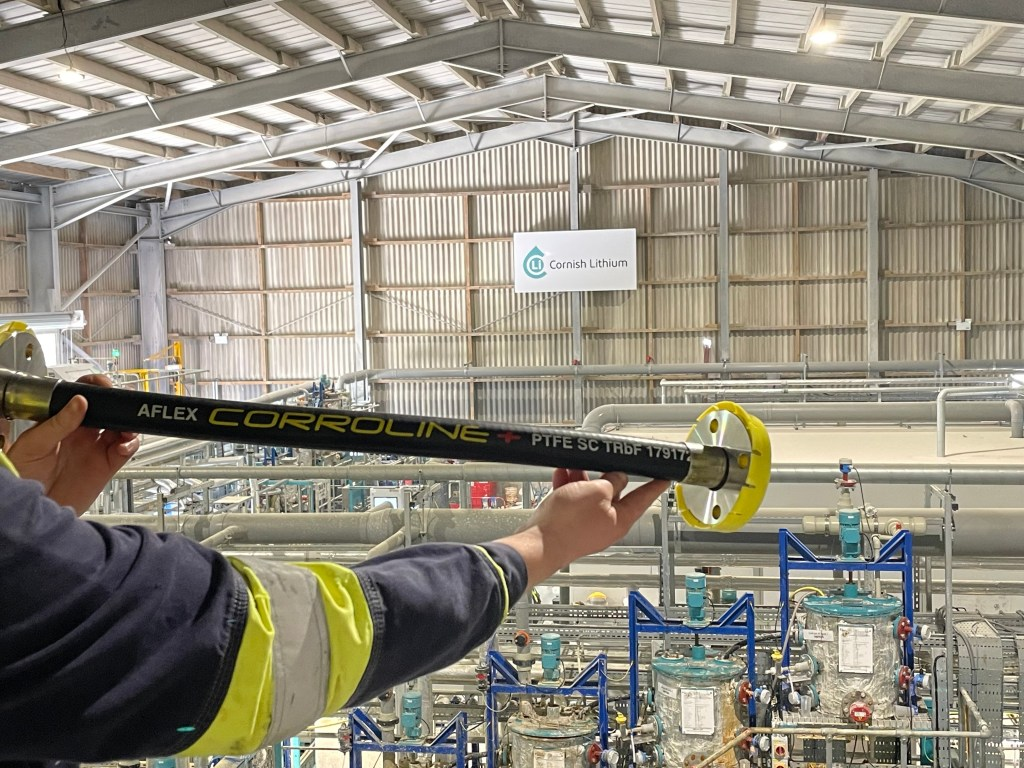
Cornish Lithium has improved slurry handling at its Trelavour hard-rock lithium demonstration plant by replacing sections of rigid pipework with Corroline+ hoses from Aflex Hose, part of Watson-Marlow Fluid Technology Solutions.
The change was made after blockages occurred in plastic pipework with 90-degree bends during transfer of mica concentrate slurry treated with sulphuric acid. The flexible hoses are now being used across parts of the hydrometallurgy stage, where they help maintain a more direct flow path between process tanks and reduce the risk of solids settling in bends.
The Trelavour Lithium Project near St Austell is based on extracting lithium from granite ore in a former china clay area. The first stage involves crushing, milling, and refining ore to produce a lithium-rich mica concentrate slurry. The material then moves into hydrometallurgical processing, where acid leaching is used to extract metals and support production of lithium hydroxide monohydrate.
Since late 2024, Cornish Lithium has installed 15 Corroline+ hoses to replace rigid pipework in parts of the process. The hoses support transfer of acid slurry during leaching and downstream stages including impurity removal and by-product recovery. The operating conditions are severe, with concentrated sulphuric acid, temperatures above 90°C, abrasive solids, and slow-moving slurry that must remain sufficiently mobile to prevent sedimentation.
The hose specification is central to the process improvement. Corroline+ uses a smooth PTFE lining for chemical and temperature resistance, with reinforcement intended to resist kinking and mechanical abuse. The smooth bore supports flow, while flexible routing allows engineers to remove sharp bends that had previously contributed to blockage risk.
In process engineering terms, the change shows how plant reliability can turn on relatively modest design details. A hydrometallurgical circuit may be defined by chemistry, residence time, leaching performance, temperature, and product recovery, yet the physical movement of slurry between tanks can still disrupt the whole process if pipework geometry encourages solids to settle.
That becomes more important in demonstration plants designed to mimic future commercial production. Trelavour is being developed as a scaled-down version of a planned full-scale facility, with Cornish Lithium targeting long-term production of battery-grade lithium hydroxide monohydrate. The UK has been trying to strengthen domestic capability in battery materials, and process reliability at demonstration scale will influence confidence in future commercial design.
Critical minerals supply chains are now being treated as part of industrial strategy rather than purely mining activity. Lithium extraction has to connect geology, mineral processing, chemical engineering, environmental regulation, energy use, water management, product qualification, and customer expectations from battery makers. Battery material developments, including UK aluminium foil supply activity for electrification markets, show how different parts of the value chain are being pulled into higher specification manufacturing routes.
The Trelavour process also has a by-product dimension. Cornish Lithium’s mineral processing route can generate materials including amorphous pozzolanic silica, alum, and gypsum, which may have uses in cement, water treatment, wastewater treatment, and construction materials. Efficient handling and separation therefore affect more than lithium yield; they influence whether the wider process can make productive use of associated material streams.
Slurry transfer is one of the less visible areas of process plant design, but it can dominate operating experience. Abrasive solids, acidic media, temperature, low velocity, and plant geometry create a difficult combination. Pumps, hoses, pipework, seals, flanges, valves, and cleaning access all have to work together. If one part of the system creates repeated blockages, the plant loses availability, operators spend time clearing faults, and process data becomes less representative of a stable future facility.
The move to flexible hoses also improves maintainability. Rigid pipework can be difficult to remove, inspect, and clean, particularly when installed around tanks and support structures. Hose assemblies that can be disconnected more easily give operators a faster route to inspection and cleaning if solids build up. That is useful in a demonstration environment where engineers are still learning how the process behaves over extended operation.
The change does not by itself prove commercial lithium production at Trelavour. It does, however, address a specific reliability issue in one of the harsher parts of the plant. Demonstration projects succeed by finding and correcting these weaknesses before scale-up locks them into expensive equipment and layouts.
Cornish Lithium’s Corroline+ installation strengthens the practical engineering base of the project. Battery-grade lithium may be the headline product, but the route to it still runs through hoses, pumps, pipework, tanks, and disciplined plant engineering.