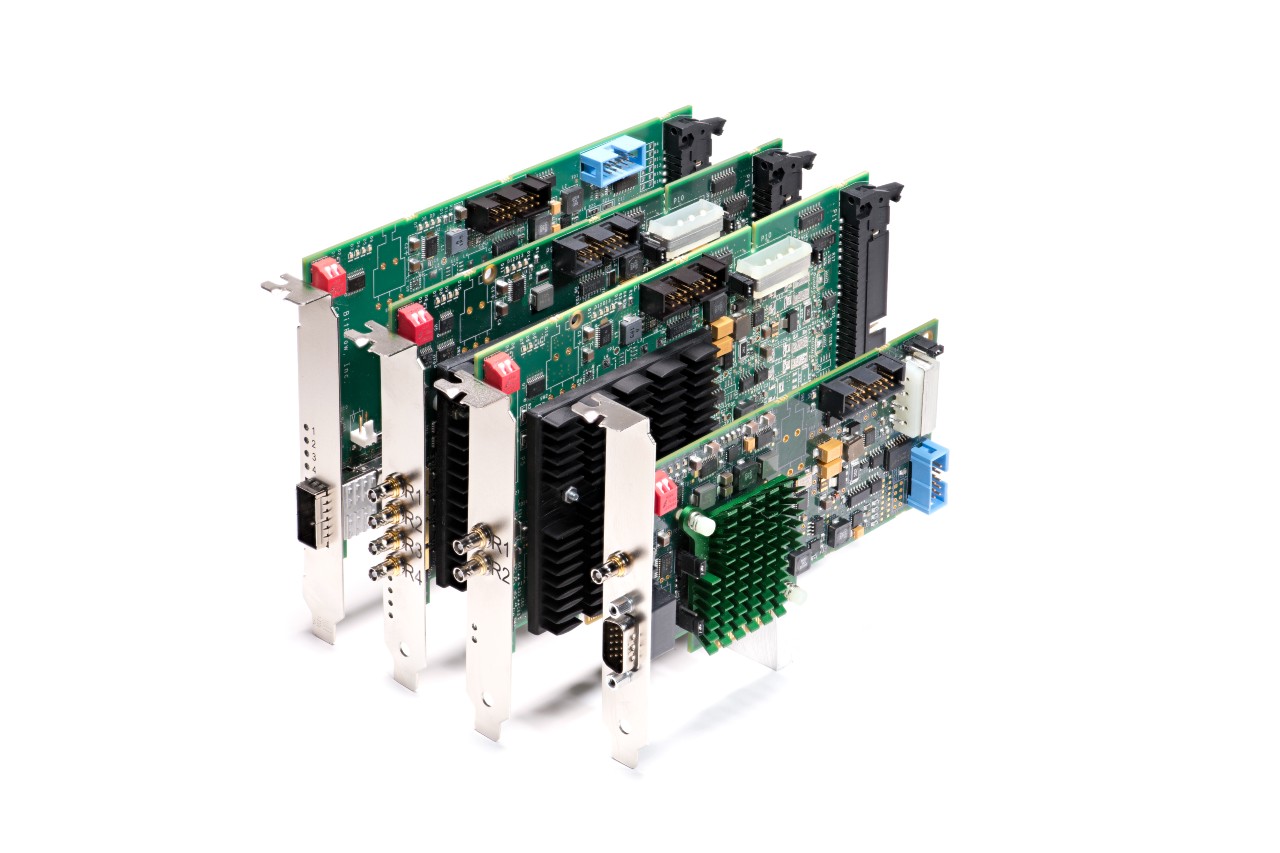
BitFlow has moved its Claxon CXP-12 frame grabber family into full production availability, with the range aimed at high-speed machine vision systems using NVIDIA GPU acceleration for real-time AI inference.
As inference engines have become faster, the acquisition path between camera and processor has become harder to ignore. A GPU can run demanding models at speed, but inspection performance still depends on whether raw image data can reach memory without avoidable latency, jitter, or bandwidth restriction.
Built around the CoaXPress 2.0 CXP-12 interface, the Claxon family supports 12.5 Gbps per link and can aggregate multiple links for higher-bandwidth camera configurations. The line-up includes single-, dual-, and quad-link boards, alongside a fibre model designed for long-distance installations and electrically noisy production environments.
Each board implements the full CoaXPress 2.0 specification, including simultaneous multi-camera capture, Power over CoaXPress, a low-speed uplink for camera control, and GenICam support for standardised configuration. That gives machine builders a deterministic acquisition route for applications where Ethernet-based image transfer can add packet-handling overhead and variable latency.
“A machine vision system designer can only experience the full potential of CXP 2.0 by having access to all its capabilities,” said Donal Waide, Director of Business Development – iService, BitFlow. “With the Claxon family paired to an NVIDIA GPU platform, the image data path finally matches the inference engine’s appetite. There is no artificial ceiling on throughput.”
The Claxon CXP1 supports single-link acquisition, while the CXP2 can handle two single-link cameras or one dual-link camera. The CXP4 supports up to four single-link cameras, two dual-link cameras, or one quad-link camera, with the ventilated CXP4-V variant designed for compact systems where airflow is limited.
Longer cable runs are addressed through Claxon Fiber, which extends CoaXPress over QSFP+ fibre assemblies. The approach is suited to factory floors, high-voltage areas, and other environments where electromagnetic interference or physical distance can make coaxial cabling less practical.
BitFlow has also positioned the range for integration with NVIDIA Jetson AGX Orin-based systems, workstation-class NVIDIA RTX platforms, and data centre GPU systems. Its SDK supports C, C++, C#, and Python, with Windows and Linux support and drivers for environments including HALCON, LabVIEW, VisionPro, and MATLAB.
Existing users of BitFlow’s Cyton CXP platform are being offered a migration path designed to preserve acquisition code and triggering logic. Technical documentation and SDK access are available from BitFlow.