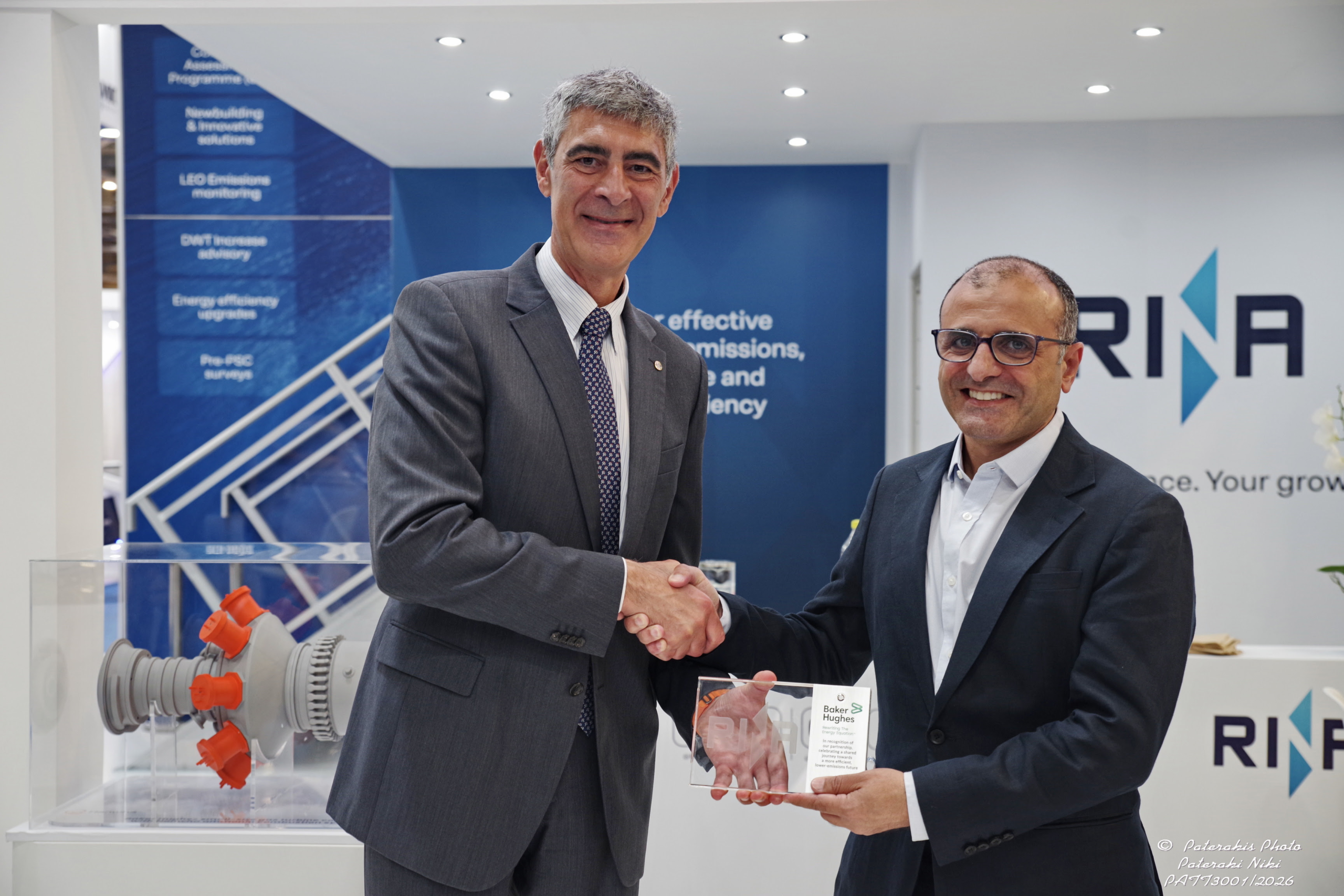
Baker Hughes has secured RINA Type Approval for its NovaLT™16 gas turbine for marine propulsion, certifying the technology to operate on natural gas and up to 100% hydrogen.
Announced at Posidonia 2026 in Athens, the approval extends the company’s industrial gas turbine platform into a marine market that is under growing pressure to align vessel design with lower-carbon fuel strategies. The certification follows work between Baker Hughes and RINA to assess how the turbine can be installed, operated, and integrated on board ships.
RINA’s approval covers the NovaLT™16 against marine requirements including safety, performance, and ship system integration. Although the NovaLT family was originally developed for industrial power generation, its compact design, high efficiency, and fuel flexibility make it relevant to vessel applications where machinery space, operational reliability, and future fuel optionality are all under scrutiny.
Giosuè Vezzuto, Marine Executive Vice President at RINA, said: “This certification highlights the value of early collaboration between technology developers and classification societies when introducing innovations to the maritime sector. By supporting the assessment of the NovaLT™ turbine, we contribute to ensuring that the solution is aligned with safety, performance and regulatory expectations.”
The NovaLT™16 operates in the 12–17 MW range in simple cycle configuration and up to 22 MW in combined cycle applications. Baker Hughes says the platform offers high availability and maintenance intervals of up to 35,000 hours, giving operators a turbine option designed around long-duration service as well as fuel flexibility.
Ahmed Eldemerdash, Vice President Climate Technology Solutions at Baker Hughes, said: “Decarbonizing maritime shipping requires solutions that deliver performance today and flexibility for tomorrow — without compromising reliability or safety. With RINA’s Type Approval of our NovaLT™16 turbine, we are advancing a proven, fuel-flexible platform ready for real-world marine applications.”
Marine propulsion is increasingly being shaped by the uneven pace of alternative fuel infrastructure. LNG, methanol, ammonia, biofuels, batteries, hybrid-electric systems, and hydrogen are all moving through different levels of maturity, while vessel owners still have to make decisions on assets that may remain in service for decades.
A turbine able to run on natural gas today and hydrogen in future gives designers another route between current fuel availability and longer-term decarbonisation targets. Gas turbines will not replace conventional marine engines across every vessel class, but their power density and compatibility with electric and hybrid propulsion layouts make them a credible option where space, weight, and operating flexibility carry a premium.
With RINA approval in place, NovaLT™16 moves beyond industrial power generation and into the engineering choices now facing marine propulsion: how to cut emissions without designing ships around fuels, infrastructure, or operating profiles that are still developing.