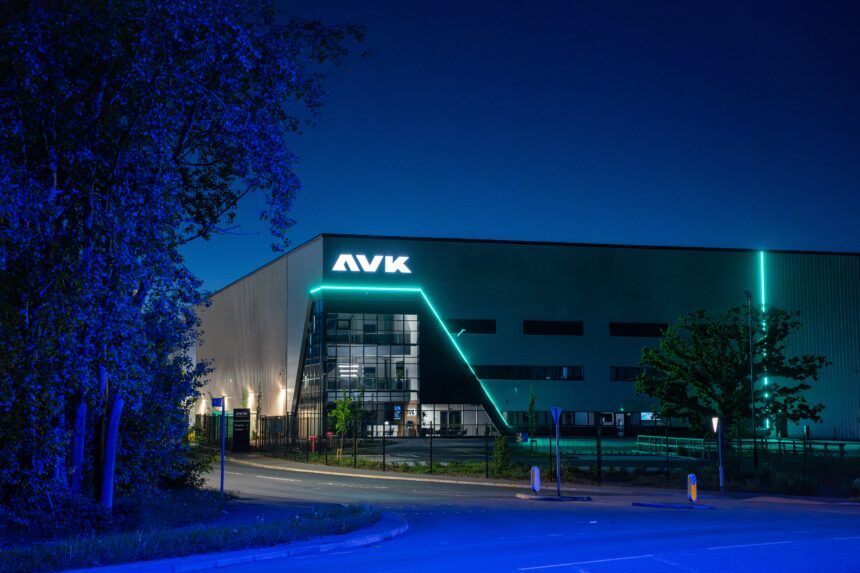
AVK is planning its first standalone manufacturing facility in the UK, with a £3m investment at Haydock in the Liverpool City Region to assemble modular low and medium-voltage PowerPods for data centres, AI infrastructure, and wider power applications.
The new site will manufacture pre-engineered, transportable electrical systems designed to support high-demand infrastructure projects where speed, repeatability, and power resilience are central to delivery. Haydock has been selected for its logistics position, access to Junction 23 of the M6, and proximity to an established engineering workforce.
As production ramps up, the facility is expected to create skilled technical, operational, graduate, and apprenticeship roles. Around three-quarters of the first phase of jobs will sit in technical and operational functions, including electrical installation, mechanical installation, plant movement, warehousing, and production support. Graduate roles are also planned across finance, facilities, production management, and lean manufacturing.
AVK is working with St Helens College to develop a local skills pipeline, including work experience placements, MOET Level 3 engineering apprenticeships, and curriculum input linked to real industrial requirements. Apprentices will be exposed to electrical and mechanical work across the product lifecycle, from design and assembly through to installation, with possible progression into higher technical qualifications such as HNC and HND routes.
The investment lands as data centre power demand increasingly dictates the pace of digital infrastructure development. AI workloads are lifting rack densities and accelerating demand for reliable electrical systems, while grid connection availability is already shaping the EMEA development pipeline. That pressure has become visible in data centre power access across Europe, the Middle East, and Africa, where developers are having to treat energisation as a strategic constraint rather than a late-stage utility connection.
Factory-built power infrastructure gives developers a route to remove some of the variability from site delivery. Modular systems can be engineered, assembled, tested, and transported under controlled conditions, while construction work continues elsewhere on the project. In sectors where programme delay is expensive, that ability to run workstreams in parallel can be as valuable as the equipment itself.
Electrical infrastructure is also becoming more productised. Instead of every project building a bespoke site-installed power architecture from loose components, modular LV and MV systems allow standardised design principles, repeatable quality checks, and clearer installation sequencing. The approach does not remove the need for careful site engineering, but it can reduce exposure to labour shortages, weather, access constraints, and late design change.
Data centre power systems now need to satisfy several industrial demands at once. They must handle dense electrical loads, protection coordination, maintainability, integration with backup generation or storage, and long-term availability. As AI infrastructure scales, the electrical system becomes a core production asset, not an auxiliary service hidden behind the building.
UK manufacturing capacity in this area also offers a resilience advantage. Developers, utilities, industrial users, and electrification projects are competing for many of the same inputs, including switchgear, transformers, cables, power electronics, protection systems, technicians, and commissioning engineers. A domestic assembly base gives AVK more control over scheduling, workforce development, and product integration, even where upstream component supply remains exposed to wider market pressure.
Haydock’s location gives the company a practical base for moving large, high-value modular systems across the UK and into European markets. Transport planning can affect both cost and programme certainty, particularly when completed electrical packages must arrive within tightly sequenced construction windows. Motorway access, local industrial infrastructure, and a nearby skills base all support that operating model.
The facility also shows how AI infrastructure is creating physical industrial demand. Behind every data centre deployment are switch rooms, substations, backup power systems, cable routes, cooling systems, controls, and factory-built electrical packages. Those assets must be engineered and manufactured before the software economy can consume the power it needs.
With the Haydock investment, AVK is building a dedicated UK manufacturing base for a product category tied directly to data growth, grid constraint, and industrial electrification. The capital spend is relatively modest, but the strategic direction is clear: power system assembly is moving closer to the front line of digital infrastructure delivery.