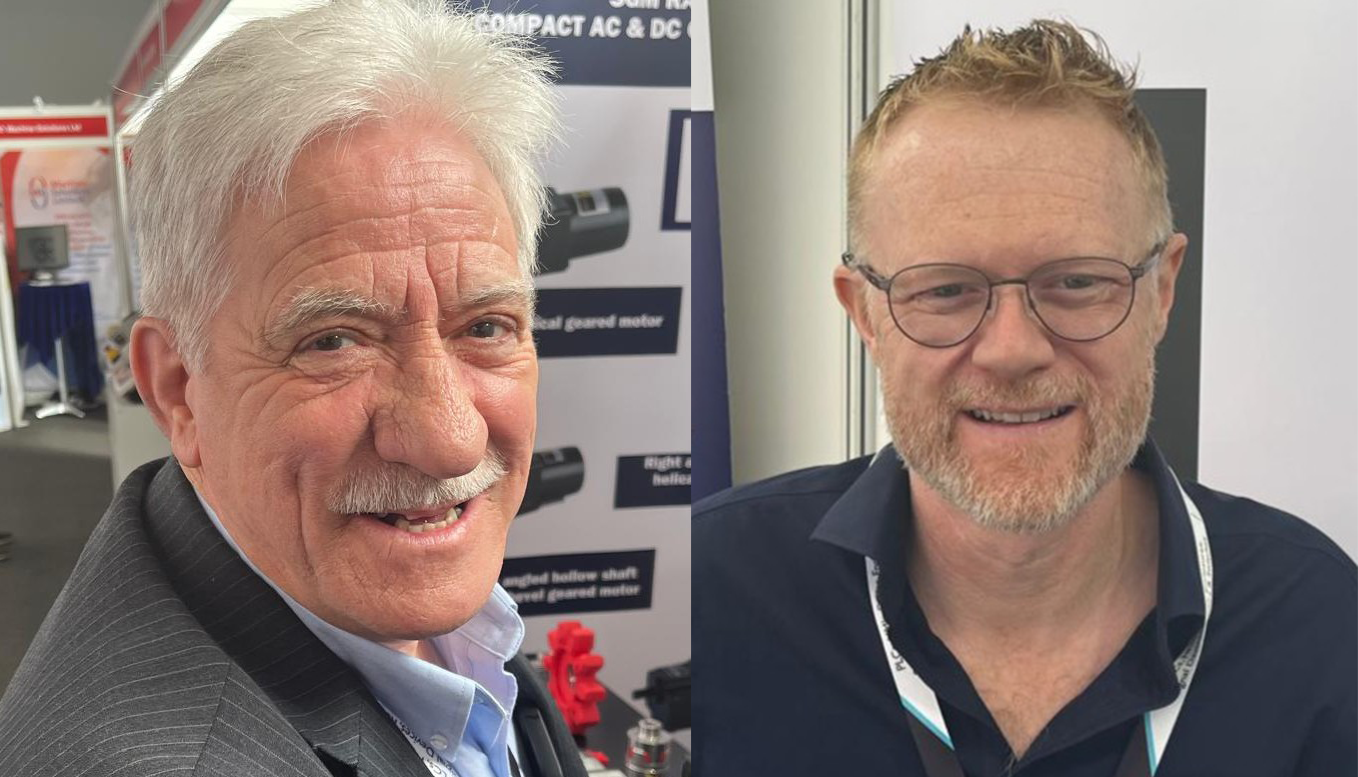
Apex Dynamics UK has expanded its regional technical sales capability with the appointment of James Coucher as technical sales engineer for the South and Wales and the return of Malcolm Hillary as Northern region sales manager.
The appointments strengthen support for customers specifying precision servo gearboxes, rack and pinion systems, and motion control components across manufacturing, automation, aerospace, and industrial machinery applications. Apex Dynamics positions its gearboxes around high performance, reliability, fast delivery, ATEX availability, and a five-year warranty.
Coucher joined the company in May, bringing more than 20 years of engineering and technical sales experience. His background includes engineering, installation, technical support, service engineering, and automation work involving servo systems, ball screws, gearboxes, and motors.
Hillary has returned to Apex Dynamics UK after previously spending six years with the company. He brings 35 years of industry experience across marine fitting, oil rig testing, linear motors, and technical sales, adding senior application knowledge to the company’s northern coverage.
The appointments add capacity in a field where component selection has a direct effect on machine accuracy, speed, durability, noise, vibration, maintenance, safety, and energy use. Gearboxes, servo motors, and mechanical transmission components are often selected late in the design process, even though they can determine whether a machine performs consistently once installed.
In automated equipment, the gearbox is not a passive component. It influences acceleration, positioning accuracy, backlash, torque transmission, load handling, and mechanical response. Poor selection can create oversizing, heat, premature wear, control instability, or unnecessary cost, particularly in robotic handling, packaging, machine tending, pick and place, test equipment, and special purpose machinery.
The UK machinery market is demanding more local support as equipment designs become more integrated. Machine builders are combining robotics, servo axes, safety systems, vision, sensors, digital control, and data capture in tighter spaces. A gearbox selection that appears suitable on paper may need to be revisited once duty cycles, washdown requirements, contamination risk, ATEX zones, shaft loads, mounting constraints, and maintenance access are fully understood.
Component developments across motion control point in the same direction. An encoder designed to reduce robotic joint complexity showed how suppliers are being pulled into tighter, more space-constrained, and more integrated machines. As automated systems become more compact, individual component choices carry more system-level consequences.
SMEs and specialist machine builders often face the sharpest selection burden because they may not have large in-house motion engineering teams. A production machine might be designed around a small number of axes, but each axis must be matched to load, inertia, torque, speed, precision, duty cycle, and control strategy. Local technical support can reduce the risk of both under-specification and over-specification.
Supply availability has also become part of the specification process. A technically suitable gearbox still has to be available when the machine builder needs it, and replacements must remain accessible during the equipment’s operating life. Fast delivery and support for drop-in replacement can affect new machine projects, retrofits, and maintenance planning.
ATEX availability gives the company a role in sectors where explosive atmospheres may be present, including chemical processing, food and beverage, pharmaceutical production, coatings, energy, and some materials handling environments. In those settings, motion components form part of the safety case as well as the performance specification. Certification, documentation, and correct application are integral to the selection.
The expansion also reflects the persistence of relationship-led technical sales in industrial components. Digital catalogues and online selectors are useful, but complex applications still benefit from engineers who understand the machine, the process, and the consequences of the selection. That is especially true where customers are upgrading older equipment, adding automation, or trying to reduce maintenance burden without redesigning the full system.
Motion control rarely dominates automation announcements, yet it often determines whether automated machines run smoothly, accurately, and reliably. As factories revisit automation to offset cost and labour pressures, the support wrapped around components such as gearboxes will remain a practical part of the productivity equation.