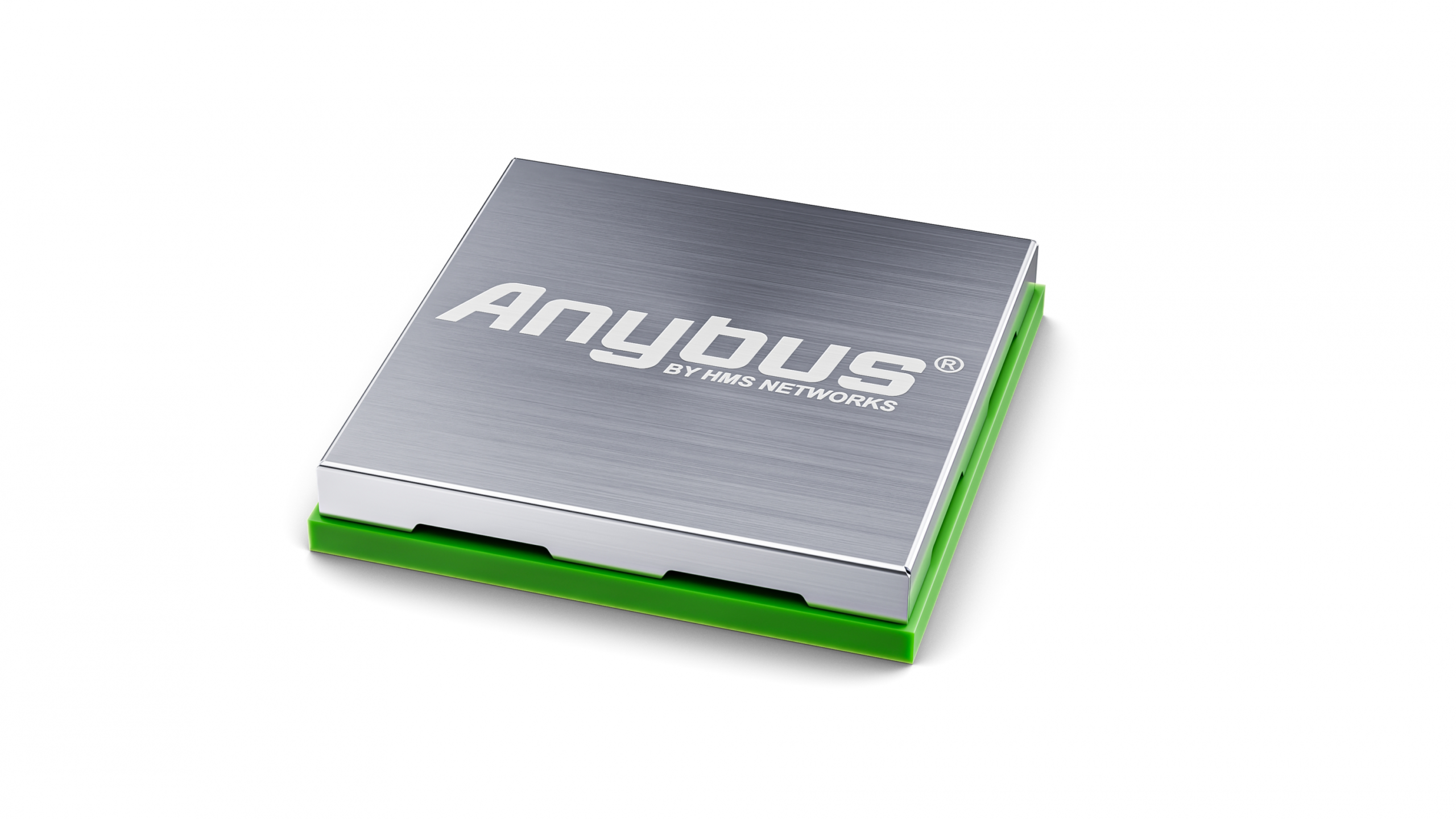
HMS Networks has presented its Anybus ONE industrial connectivity architecture at SPS 2026 in Nuremberg, alongside a demonstration of how embedded machine learning could be incorporated into the platform. The architecture is intended to let industrial equipment manufacturers reuse communications engineering across different products and successive generations of equipment.
The first commercial module, the Anybus ONE S100-31-10, became available on 23 November together with the Anybus Studio configuration application. The 26mm by 26mm system on module supports PROFINET, EtherNet/IP and EtherCAT, using the same hardware part number for the three industrial Ethernet networks.
Equipment manufacturers can connect the module to their host electronics through a Serial Peripheral Interface (SPI) or Modbus RTU. It handles the industrial network protocols and maps the exchanged data into a form that the host application can use, reducing the amount of network-specific code required within the equipment itself.
Although the three supported protocols share Ethernet foundations, their communication models and timing requirements differ. A device supplying process data to a PROFINET controller cannot simply be connected to an EtherCAT network and expected to operate without the appropriate protocol implementation and configuration. Equipment suppliers selling into multiple automation markets must accommodate those differences while preserving the intended behaviour of their products.
Consider a motor drive that receives speed and torque commands and supplies current measurements, operating state and diagnostic information. The host application processes these values according to the drive's electrical and mechanical characteristics. Each industrial network must expose the relevant data in the structure expected by the controlling equipment. Incorrect data mappings could cause a diagnostic value to be misinterpreted or a command to be associated with the wrong function.
Anybus Studio provides a graphical environment for defining these communication behaviours rather than requiring engineers to write each configuration in code. The software checks configurations during creation and can be used independently or incorporated into automated build processes. Teams can maintain versions of configurations and use the same application programming interface when developing subsequent products.
A common hardware part number can also simplify procurement and inventory management. Manufacturers may be able to hold a shared module stock for several product variants instead of purchasing and tracking a different connectivity board for each network. The completed equipment still requires suitable physical integration, configuration and testing against its intended industrial environment.
HMS has included secure boot, authenticated firmware updates and protected storage for cryptographic keys within the module. Secure boot provides a mechanism for establishing the authenticity of software before it runs, while signed update packages help prevent unauthorised firmware from being accepted by the device. Configuration authenticity is addressed separately through the use of signed configuration data.
The module was developed under an IEC 62443-4-1 certified development process and is designed to meet IEC 62443-4-2 security level 1 and the requirements of the EU Cyber Resilience Act. HMS also provides a software bill of materials and manages reported vulnerabilities through its product security incident response process. These provisions do not automatically establish compliance of the final industrial device, whose manufacturer remains responsible for the wider product and its integration.
At SPS, the company is showing a related Device Intelligence concept that incorporates machine learning technology from Ekkono, a Swedish edge AI company in which HMS invested in 2026. The concept places model training and execution on the module's application processing core while maintaining the industrial communications function separately.
This arrangement could allow a connected device to establish a model of its normal behaviour using information already available within the equipment. Deviations could then be identified locally and made available to other systems without requiring continuous transmission of raw operating data to a separate computing platform.
The reliability of such a model will depend on the range of operating conditions represented during training and on the quality of the underlying data. A machine running at different speeds, loads or temperatures may exhibit legitimate variations that should not be treated as faults. The demonstration does not establish detection accuracy or the suitability of the technology for safety functions in a particular application.
Device Intelligence is a developing technology concept, distinct from the commercially available S100 module. HMS plans further Anybus ONE products based on the same architecture, with the aim of preserving earlier engineering investment as processing capabilities and network requirements change. The extent of reuse will depend on the compatibility of future modules with the host interface, configuration environment and requirements of the equipment into which they are integrated.