The OPC Foundation and AutomationML e.V. have agreed to combine their industrial interoperability activities, with AutomationML transferring its technology assets to the foundation on 1 January 2027. The agreement brings together the communities responsible for exchanging engineering information between design applications and establishing common communication mechanisms for operational industrial systems.
Announced in Brussels on 25 November, the integration builds on more than a decade of cooperation between the organisations. Their existing joint work includes a companion specification that makes information represented in AutomationML available through the OPC Unified Architecture (OPC UA). Bringing the activities under one organisation creates a basis for coordinating the further development of the technologies without requiring users to abandon the existing specifications.
AutomationML is an open engineering data exchange format covered by the IEC 62714 series of international standards. It represents industrial plant structures, equipment and the relationships between their constituent elements so that engineering tools can exchange information without relying exclusively on individual suppliers' proprietary file formats.
At the top level, AutomationML uses Computer Aided Engineering Exchange (CAEX), an XML-based format that describes equipment structures and the relationships between objects. Additional information can be represented through associated formats, including COLLADA for geometry and kinematics and PLCopen XML for control logic. This arrangement allows engineers to associate different types of technical information with the same equipment structure without having to express every engineering discipline in a single data model.
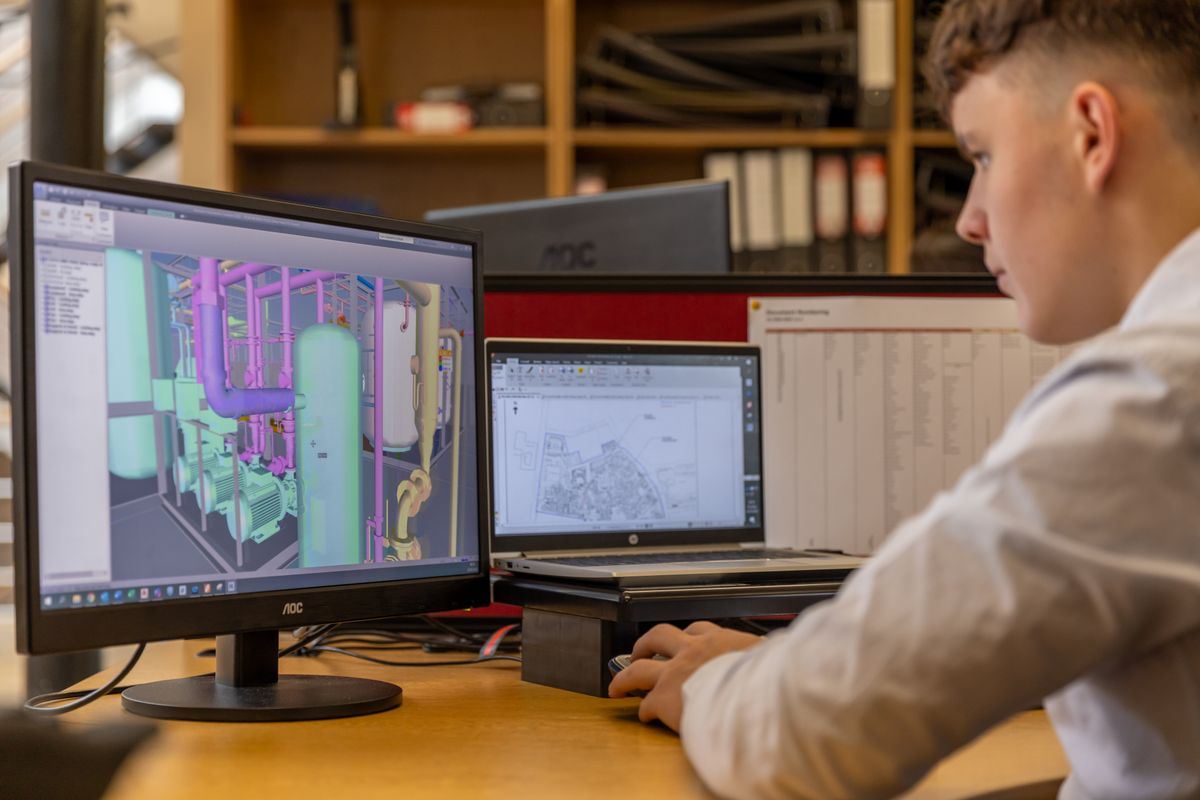
A robot cell may be developed using mechanical design software, electrical engineering tools, controller programming environments and production simulation applications. Each requires a different representation of the cell. The mechanical model describes the physical arrangement and movements of its equipment, while the controller project identifies the signals and functions required to coordinate those movements. Exchanging these models is complicated when the applications use different identifiers for the same equipment or store its relationships in incompatible forms.
OPC UA addresses a complementary requirement. Its information models allow software to represent equipment as objects with associated variables, properties and relationships, while its communication services allow compatible clients to access that information. Rather than interpreting a measurement solely through a numerical address, an application can browse its relationship to the equipment and the type of value it represents.
The existing OPC 30040 companion specification describes a mapping from AutomationML structures into OPC UA. It defines how engineering hierarchies, class libraries and links between objects can be represented in an OPC UA server's address space. An application can consequently access a structured description of an engineering model through the same general communications architecture used to exchange operational information.
One application is the transfer of engineering data between otherwise separate software environments. An equipment model can establish the relationships between assemblies and their interfaces, allowing subsequent engineering activities to work from that structure. The mapping does not itself establish that every application will understand every discipline-specific attribute; participating tools must still support the relevant models and preserve their meaning during transfers.
Engineering information can also provide context for commissioning and maintenance. Where a component identifier is shared between a design model and an operational information system, a technician examining an alarm may be able to establish which physical assembly is affected and identify its connections to other equipment. That association becomes less useful when changes made during commissioning are not incorporated into the engineering record.
The same problem arises when a production line is modified after entering service. Adding a sensor or replacing a drive can change electrical documentation, control logic and diagnostic information. Maintaining the links between these representations requires procedures for recording changes as well as compatible software. An exchange format can reduce the need to reproduce information manually, but it cannot determine whether a model still reflects the installed equipment.
Both technologies also provide foundations for developing applications that require machine-readable information about industrial assets. A diagnostic application interpreting a temperature measurement, for example, needs to distinguish a motor winding measurement from a cabinet air temperature and account for the conditions under which it was recorded. A structured model can establish those relationships, but the validity of any resulting diagnosis still depends on the completeness of the data and the application's engineering assumptions.
The January integration is an organisational change rather than the release of a new version of IEC 62714 or OPC UA. Its industrial significance will depend on how the combined community maintains the existing specifications, coordinates subsequent developments and supports consistent implementations across the engineering tools used to design and operate manufacturing systems.