
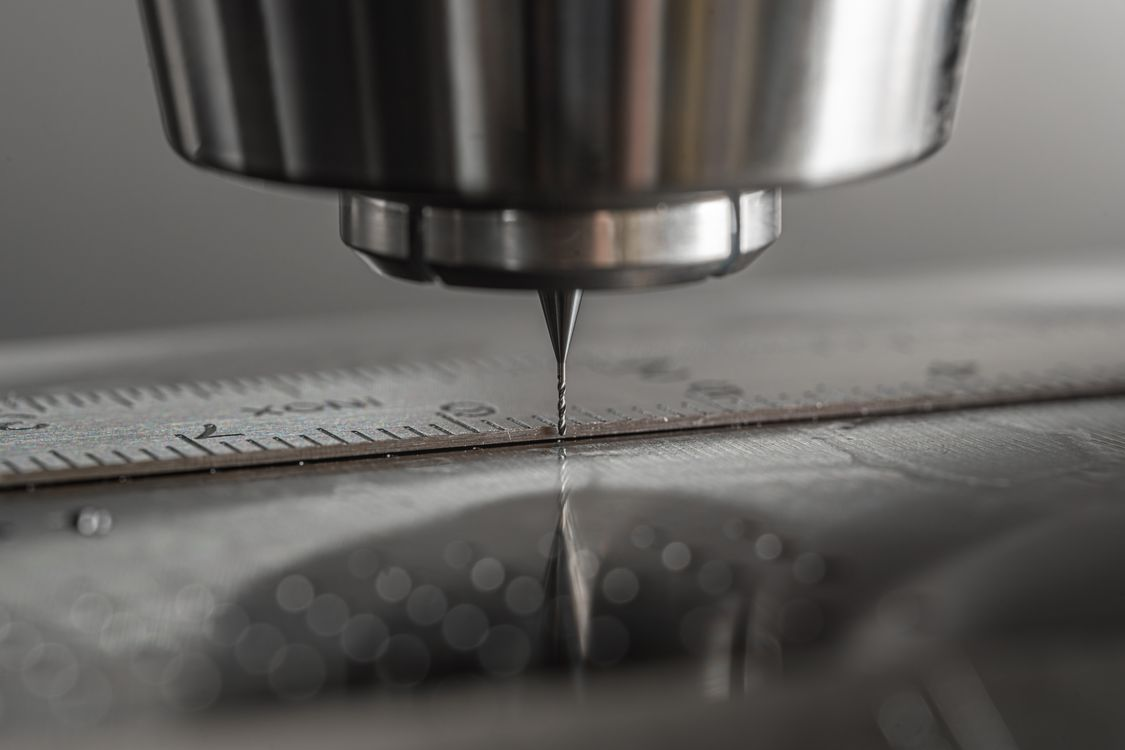
West Midlands aluminium foundry Alucast has expanded its precision machining operations with a new XYZ UMC-5X computer numerical control (CNC) machining centre, adding capacity to produce finished components alongside its casting activities.
The investment builds on the Wednesbury manufacturer’s established five-axis capabilities. Alucast commissioned six five-axis machining centres in 2020 and made further additions in 2024, supporting the development of an integrated manufacturing operation encompassing casting, machining and inspection.
The company operates from a 55,000 sq ft facility and employs more than 120 people. Its manufacturing services include sand casting, gravity die casting, low-pressure casting and high-pressure die casting. The different processes allow it to produce components across a range of geometries and production volumes, with subsequent machining used to achieve the required functional surfaces and dimensional tolerances.
XYZ Machine Tools’ UMC-5X is designed for simultaneous five-axis machining. Its standard configuration provides travel of 600mm in both horizontal linear axes and 500mm vertically, with a 600mm diameter rotary table rated for workpieces weighing up to 600kg. The table can tilt through 120 degrees in either direction, and the standard spindle operates at up to 15,000rpm.
Moving the workpiece around two rotary axes in addition to the three linear axes allows the cutting tool to approach surfaces from several directions. Components with angled bores, complex mounting faces or curved surfaces can consequently be machined without repeatedly transferring them between fixtures. Simultaneous movement of all five axes also supports the machining of contours where the tool’s orientation must change continuously as it follows the surface.
Minimising the number of setups can improve the relationship between features machined at different angles. Every time a component is removed and repositioned, the machine must establish a new reference position. Errors in those positions can accumulate, particularly when the completed component has several features whose dimensions must be maintained relative to one another.
The UMC-5X incorporates position measurement scales on its linear axes and encoders on its rotary axes. XYZ specifies positional accuracy of five micrometres in either direction over 300mm and repeatability of 2.5 micrometres in either direction under the relevant machine test conditions. Finished component accuracy will additionally depend on factors including fixture design, cutting tool condition, workpiece temperature and machining parameters.
Rotary axis calibration is particularly important during five-axis operations because the control system must know the location of the axes’ centres of rotation relative to the linear coordinate system. If those positions are incorrect, rotating or tilting the workpiece can introduce errors in the tool’s calculated position. XYZ offers a calibration function that uses measurements of a reference sphere at different table orientations to determine those relationships.
The machining requirements of cast aluminium components can differ from those of parts cut entirely from solid stock. A casting incorporates the near-final shape of a component, leaving material for removal at features that require more precise dimensions or surface finishes. Engineers must establish suitable machining allowances based on the expected variation in the cast geometry and the requirements of the finished part.
Thin walls and irregular geometries can also complicate workholding. Excessive clamping forces or unsupported cutting loads can deform a component during machining, with the resulting dimensions changing after it is removed from the fixture. Developing fixtures around the geometry and stiffness of the casting can help control these effects.
Alucast’s integrated inspection capabilities include coordinate measuring machine (CMM) verification, X-ray inspection and dye penetrant testing. These techniques address different characteristics of the component: dimensional measurement establishes geometrical conformity, while non-destructive testing can identify certain internal or surface discontinuities. Inspection results can also inform adjustments to casting and machining processes.
Alucast also uses casting simulation and prototype sand castings to examine component designs before committing to tooling for higher production volumes.
Earlier investment by the company included an 800-tonne high-pressure die casting machine and expanded machining and core production capabilities. Combining this range of processes on a single site gives Alucast the ability to coordinate design, casting, finishing and inspection around the same component specification.
The latest machine adds to that capacity rather than introducing five-axis machining for the first time. Its contribution will depend on the component geometries, batch sizes and operations assigned to it, with the additional flexibility allowing Alucast to undertake more complex finishing work within its existing production facility.

