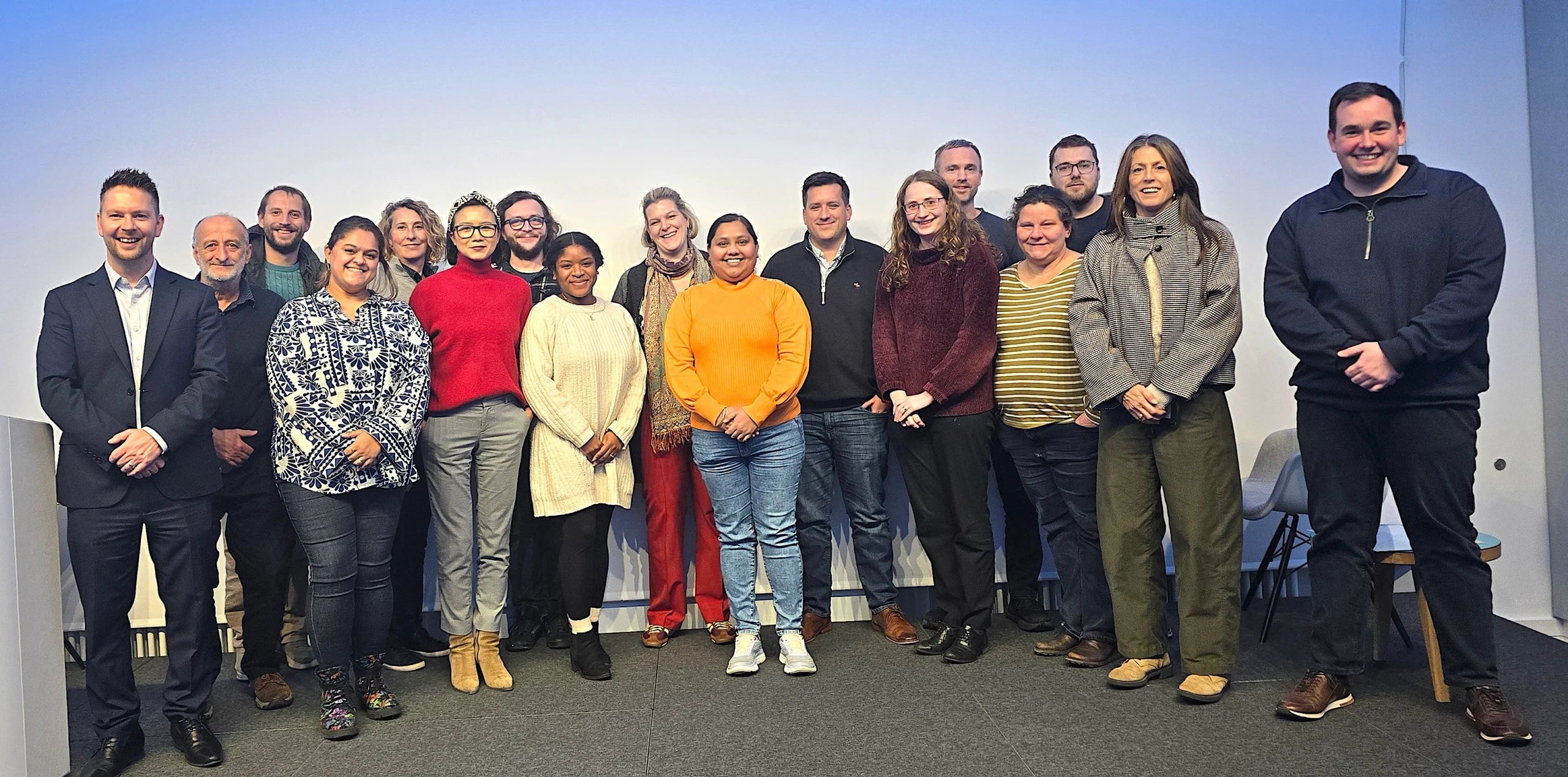
Made Smarter South East has partnered with the University of East Anglia (UEA) to deliver a fully funded digital leadership programme, extending the technical and organisational support available to manufacturing businesses investing in automation and digital technologies.
The eight-week Leading Digital Strategy Programme is directed towards owners, directors and senior managers responsible for identifying technology investment opportunities and implementing changes within their operations. Its first of three cohorts is already underway, involving leaders from 13 manufacturing businesses across the region.
Participating companies include Conttego Louvres, Christina May, Gemini Data Loggers, Aqua Broadcast, Built by Basil, The Blinds Company, PyCRobo, Porta Romana, FOX-VPS, Pop Cultures Kombucha, OSA Systems, Bandgap and The Elephant Boatyard. Their activities span sectors including electronics, specialist engineering, food and drink and consumer products.
Professor Tomás Harrington and Dr Ivan Mitchell from UEA’s Norwich Business School are leading the programme, which combines in-person workshops with online webinars, panel discussions and a planned visit to a university innovation facility. Participants will develop a digital strategy for implementation within their own businesses. Registration is open for further cohorts planned for January 2027.
Previous Made Smarter South East skills training has reached 89 people across 61 manufacturing companies. The regional initiative also runs Digital Champions, a separate two-day course for managers and employees responsible for identifying digital opportunities, engaging colleagues and implementing projects. Sessions are scheduled for 1 and 8 December in Canterbury and 9 and 16 December in Brighton, followed by further training in Buckinghamshire in January.
Bryan Vint, programme manager for Made Smarter South East, said: “We’re seeing manufacturers invest in increasingly sophisticated technology, but getting the full value from that investment depends on having people who can lead change and bring their colleagues with them.
“That’s why we’re refreshing our digital leadership offer. Our new partnership with UEA will give manufacturers practical support to build digital strategies, develop their teams and make technology work for their businesses.”
Made Smarter South East secured a further £3.1m to extend its activities until 31 March 2027. Its wider support includes diagnostic workshops, technical advice, funded internships and grants of up to £20,000, covering up to half of eligible technology investment costs.
At the time of the funding extension, the programme reported supporting 273 manufacturing businesses, developing 93 digital roadmaps and approving grants for 20 technology projects. Manufacturers had secured more than £307,000 in matched funding to support investment exceeding £1m, covering enterprise software, additive manufacturing, robotics and automation.
Identifying the underlying production problem is an important part of assessing such investments. A business seeking to reduce late deliveries, for instance, may find that inconsistent information about production progress prevents its planning system from reflecting actual factory conditions. Connecting equipment to monitoring software could improve access to production information, but the resulting data must correspond with the work orders and operating activities used in the planning system.
Introducing new technologies can therefore require changes to several departments rather than a single engineering installation. Managers need to determine which processes should be standardised, how performance will be measured and which employees will be responsible for maintaining the new arrangements.
West Sussex bicycle wheel manufacturer The Rider Firm has been developing its team’s digital skills alongside investment in advanced computing and additive manufacturing. Its chief technology officer, Daniel Gillborn, completed the earlier leadership programme and identified the opportunity to exchange experience with peers as one of its benefits.
The regional programme’s combination of management training, technical advice and investment support allows businesses to examine these requirements at different stages of development. A company considering additive manufacturing, for example, must assess suitable materials, component geometry and production volumes alongside the skills required to operate and maintain the equipment. Such an assessment can inform whether the technology is suitable for prototyping, tooling or finished component production.
The regional initiative has also partnered with the Toyota Lean Management Centre to deliver practical courses in Buckinghamshire and Kent, combining process improvement with preparation for digital investment.
Surrey County Council delivers Made Smarter South East in partnership with 11 regional organisations. Its funded support is scheduled to continue until the end of March, providing a limited period in which businesses can establish investment plans and access the available assistance. The UEA course complements that support by giving manufacturing leaders time to consider how technology projects can be integrated into their broader production and business strategies.