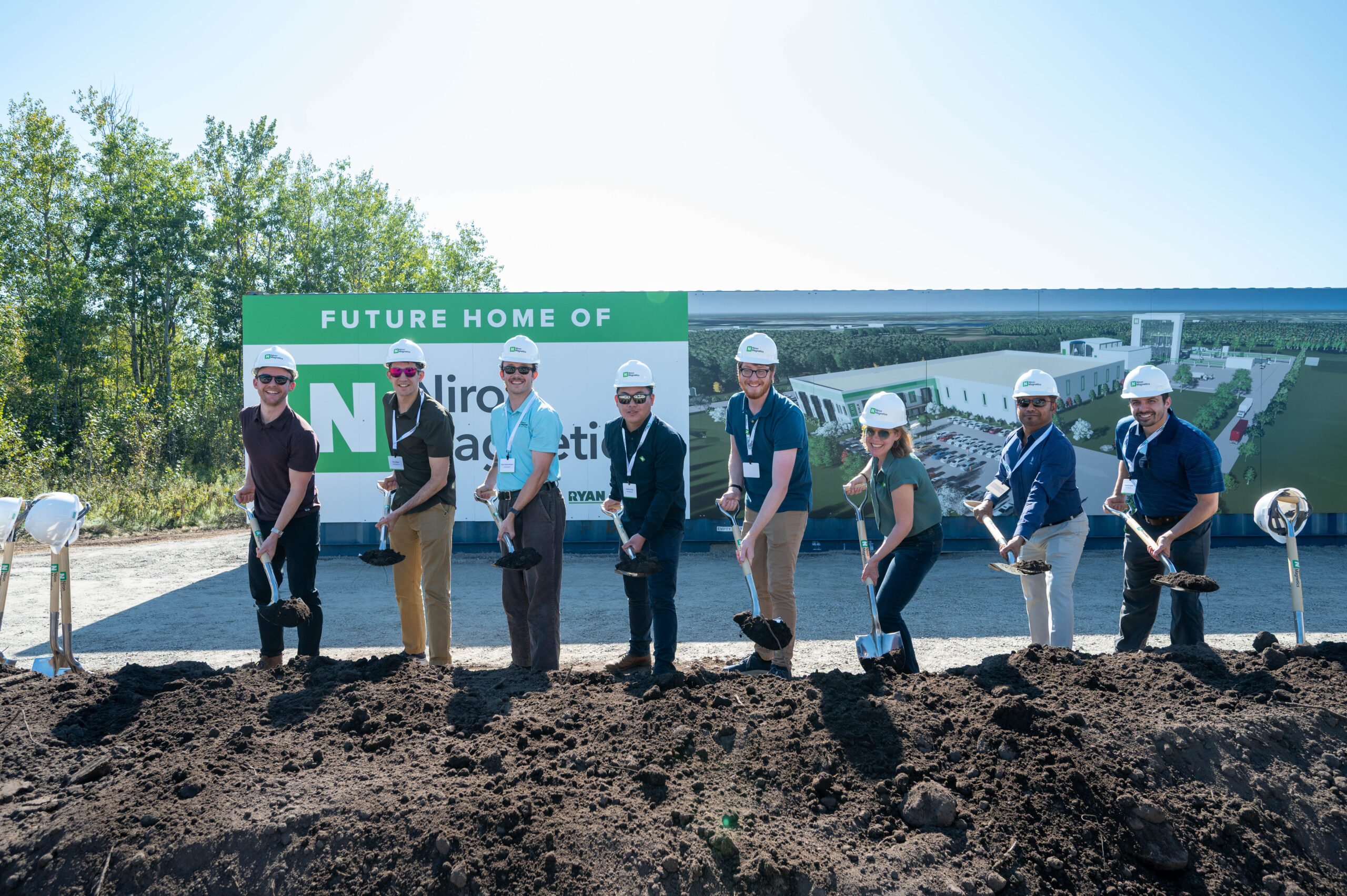
Niron Magnetics plans a $1.8 billion manufacturing campus for rare-earth-free iron-nitride permanent magnets at Dothan in Alabama. The company expects construction at the Westgate Super Site to begin in 2028 and production in 2029. The planned development covers about 1.6 million square feet and is described as a high-volume facility with a 10,000-ton scale; that stated scale should not be treated as capacity already commissioned.
The company and Alabama Governor Kay Ivey confirmed the site selection on 20 November 2026. Niron projects around 700 jobs within five years, but those posts and the investment remain forward-looking. The Dothan project is separate from Niron’s earlier Minnesota manufacturing expansion, which is due to establish larger-scale production before Alabama starts operating. Neither the 2029 start date nor the stated plant scale establishes the future annual output actually achieved.
Permanent magnets supply a magnetic field without a continuous electrical power input, making them important in motors, generators, actuators and other electromechanical assemblies. In a motor, the field interacts with electromagnetic forces in the stator or rotor to produce torque; temperature, demagnetisation resistance and field strength affect the design envelope. High-performance neodymium-iron-boron magnets contain rare-earth elements and depend on supply chains for processing, alloy production and finished magnet manufacture.
Niron’s technology substitutes an iron-nitride material platform for the rare-earth-containing compounds used in many established magnet grades. The company says the approach relies on more abundant raw materials and is designed to support competitive manufacturing at scale. Removing rare-earth constituents from the composition addresses one part of supply risk, but commercial adoption also depends on the finished magnet meeting the performance and consistency demands of each application.
Changing the magnet material is not a drop-in substitution in every motor. Designers must assess the magnetic flux available within the existing geometry, the behaviour under opposing fields, the operating temperature and the mechanical retention of the magnet. Rotor configuration, air-gap dimensions, winding design or thermal management may need adjustment if an alternative material differs in its magnetic characteristics. Qualification therefore involves component testing and machine-level performance, not only a comparison of raw-material availability.
The Alabama investment is part of a staged capacity expansion. Niron expects to open a full-scale plant in Sartell, Minnesota, during 2027, with stated capacity of up to 1,500 tonnes of magnets annually. Dothan would follow as the much larger manufacturing campus. Keeping those developments separate is important: the earlier Minnesota site is intended to establish industrial production before the company reaches the scale proposed for Alabama.
According to the company, the Dothan facility will occupy the 446-acre Westgate Super Site industrial park. The location has rail access through a CSX line and secured a CSX Select Site Platinum designation in 2025. Local and state authorities have previously invested in preparing the site through the SEEDS programme and the Growing Alabama Tax Credit initiative, which support the development of industrial properties ready for large manufacturing projects.
A campus of this proposed size would require significant processing, utilities, equipment installation and product testing capacity. Magnet manufacture must control chemistry and microstructure as well as dimensional consistency, because variations can affect the repeatability of electrical-machine performance. Niron has not published the complete equipment specification, commissioning timetable for individual production lines or audited yields for a Dothan plant that has not yet been built.
The expansion could diversify supply of permanent magnets used in industrial drives, transport systems, defence equipment and other engineered products. Rare-earth-free chemistry reduces exposure to one group of critical raw materials, but customers still need verified performance, reliable delivery and acceptable cost before substituting new products into established designs. The announcement does not demonstrate that Dothan magnets will match every existing rare-earth grade or meet all customer specifications without redesign.
The company dates its founding to 2013 and says its magnets already serve applications across industrial and consumer electronics, automotive, defence and AI-related infrastructure. It selected Alabama after considering sites in 22 states, with local support and industrial-site readiness among the factors highlighted in the investment announcement. These details describe the decision to locate the factory, not an undertaking that each target sector has committed to future Alabama production.
Niron’s next announced milestones are a 2027 ramp-up in Minnesota, the start of Alabama construction in 2028 and the opening of production at Dothan in 2029. The planned 700 jobs and 10,000-ton scale remain targets rather than completed capacity. Industrial qualification at the Minnesota facility should provide earlier evidence of manufacturing consistency, while the larger Alabama investment sets out the intended subsequent expansion.