Agile Robots has raised $500 million in a funding round led by SoftBank, valuing the German robotics manufacturer at $8.5 billion as it prepares to expand production capacity and accelerate the development of AI-enabled industrial automation systems.
NVIDIA and Hitachi participated in the financing, which will support the company's expansion in the United States and additional manufacturing capacity, including in Germany.
The Munich-based business develops industrial robotic arms, collaborative robots, mobile automation systems and humanoid platforms. Its portfolio combines mechanical equipment with sensing, motion control and artificial intelligence technologies intended to support tasks involving changing components or operating conditions.
The investment follows the opening of a humanoid manufacturing facility in Fürstenfeldbruck, near Munich, earlier in 2026. Agile Robots says the site has the potential to produce up to 10,000 legged and wheeled humanoid robots annually.
That figure represents stated annual manufacturing capacity rather than the number of robots already produced or delivered. The company has not disclosed a current production rate equivalent to the facility's maximum capacity.
Production began at Fürstenfeldbruck in January, with the manufacturing operation subsequently progressing into series production. The factory occupies approximately 10,000 sq m and manufactures humanoid systems using a combination of automated and manual assembly operations.
The facility was established to provide production capacity beyond Agile Robots' existing Kaufbeuren operation, which manufactures robotic arms and collaborative robots.
Humanoid robots introduce different manufacturing requirements from conventional industrial arms because their mechanical structures contain multiple interconnected assemblies, sensors and actuators.
The final product must coordinate movement across several joints while processing information from the surrounding environment. Components therefore require accurate mechanical assembly, suitable electrical connections and testing to establish that the integrated equipment operates as intended.
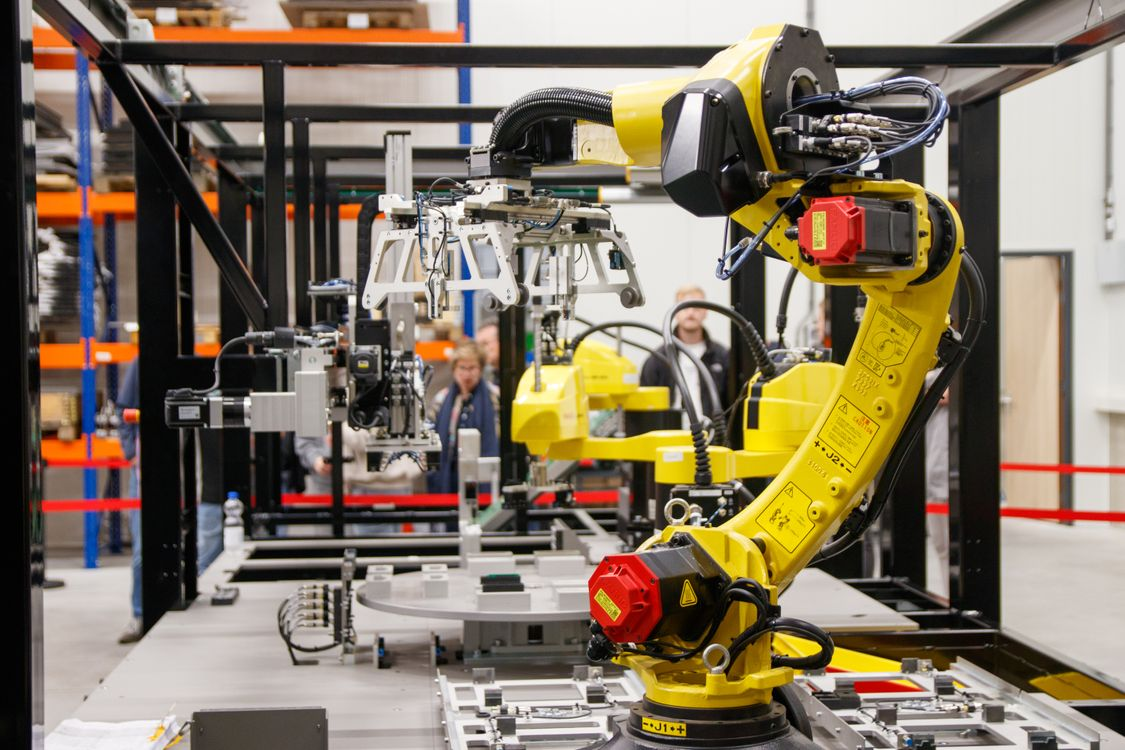
Agile Robots has automated selected manufacturing operations at Fürstenfeldbruck, including production of robot arms and torso assemblies. Its own mobile robots transport material between workstations, while other activities continue to involve direct work by technicians.
Assembly of the company's dexterous robotic hand is one such operation. The hand incorporates sensors within individual fingers, requiring careful installation and inspection of components that are relatively small compared with the rest of the humanoid structure.
Final assembly also involves human technicians. Agile Robots says a completed humanoid takes approximately three to four days to move through the factory's manufacturing sequence.
This processing time should not be interpreted as the output of a single workstation or the maximum production rate of the facility. Several robots can move through different assembly stages simultaneously, with overall throughput determined by the capacity and operating time of the complete production system.
Agile Robots has arranged the factory to allow workstations to be repositioned as products and manufacturing processes develop. That flexibility can assist when equipment configurations change during a production ramp-up, although modifications still require appropriate engineering assessment and validation.
The company manufactures both legged and wheeled humanoid platforms. According to its September account of factory operations, wheeled systems represented most of the units leaving the facility at that stage.
Agile Robots has identified certification and deployment requirements as considerations influencing the development of its humanoid products. The ability to operate a particular platform commercially depends on its application, the environment and the relevant safety requirements.
Alongside the new manufacturing operation, the company reports that more than 20,000 of its automation solutions are deployed worldwide. This figure covers its broader portfolio and must not be interpreted as an installed population of 20,000 humanoid robots.
Agile Robots was founded in 2018 as a spin-off from the German Aerospace Center. Its development activities combine robotics hardware, software and technologies intended to improve the ability of machines to operate under less predictable conditions.
Conventional industrial robots can achieve highly repeatable operation when components are presented consistently and the required movements have been established through programming.
Where parts arrive in different orientations or their positions change during operation, the robot may require additional sensing, programming or process-specific tooling to complete the task reliably.
Physical AI systems aim to provide greater adaptability by combining sensor information with learned models that assist in selecting appropriate movements and responses.
A robotic system must still carry out those decisions through physical actuators and mechanical structures. Its performance depends on available movement, gripping force, positioning accuracy and the operating limits of the equipment.
The reliability of perception is also important. Changes in lighting, component orientation, surface finish or the surrounding machinery can affect the information collected by sensors.
AI software may help interpret that information, but testing is necessary to determine whether the resulting behaviour is sufficiently reliable for the intended industrial operation.
Agile Robots is developing these capabilities through its AgileCore software environment, which supports simulation, control and coordination across its robotics portfolio.
Simulation provides a means of examining operating conditions and movement strategies before testing them on physical equipment. Results obtained in a digital environment must still be assessed against real components, machinery and production constraints.
In September, Agile Robots announced a partnership with Hitachi to develop physical AI applications for manufacturing. The collaboration combines Agile Robots' hardware and software with Hitachi's industrial systems expertise and edge AI technologies.
The companies intend to develop applications including material handling, machine loading and assembly, with an emphasis on operations that are difficult to automate through fixed movement sequences.
Edge processing is among the technologies being examined. By processing selected sensor information close to the robotic equipment, a system may reduce its dependence on transferring all data to a remote computing environment before responding.
The benefit depends on computing capability, communications arrangements and the timing requirements of the application. Local processing does not eliminate the need for reliable controls or appropriate safety measures.
Manufacturing more complex robotic systems at scale also places demands on component supply. Actuators, sensors, electronics and mechanical assemblies must be available in the required quantities and manufactured consistently enough for integration into the finished product.
Qualification of suppliers, inspection of incoming components and testing during assembly all influence production performance. Changes to an individual component can require additional engineering work before the revised design is introduced into manufacturing.
Agile Robots intends to use its latest financing to support further manufacturing expansion and international development. The company has not disclosed a detailed allocation of the $500 million between factories, research programmes and regional operations.
SoftBank's participation adds substantial financial backing, while NVIDIA and Hitachi have technological interests related to the development of intelligent robotic systems.
The planned expansion will build on Agile Robots' established industrial automation business and the new humanoid manufacturing operation near Munich. The rate at which production increases will depend on component availability, equipment performance, customer requirements and the qualification of completed systems.
The company has not published a timetable for reaching the Fürstenfeldbruck facility's stated annual capacity of 10,000 robots. Its immediate programme combines increased manufacturing capability with further development of adaptive robotic systems for industrial deployment.