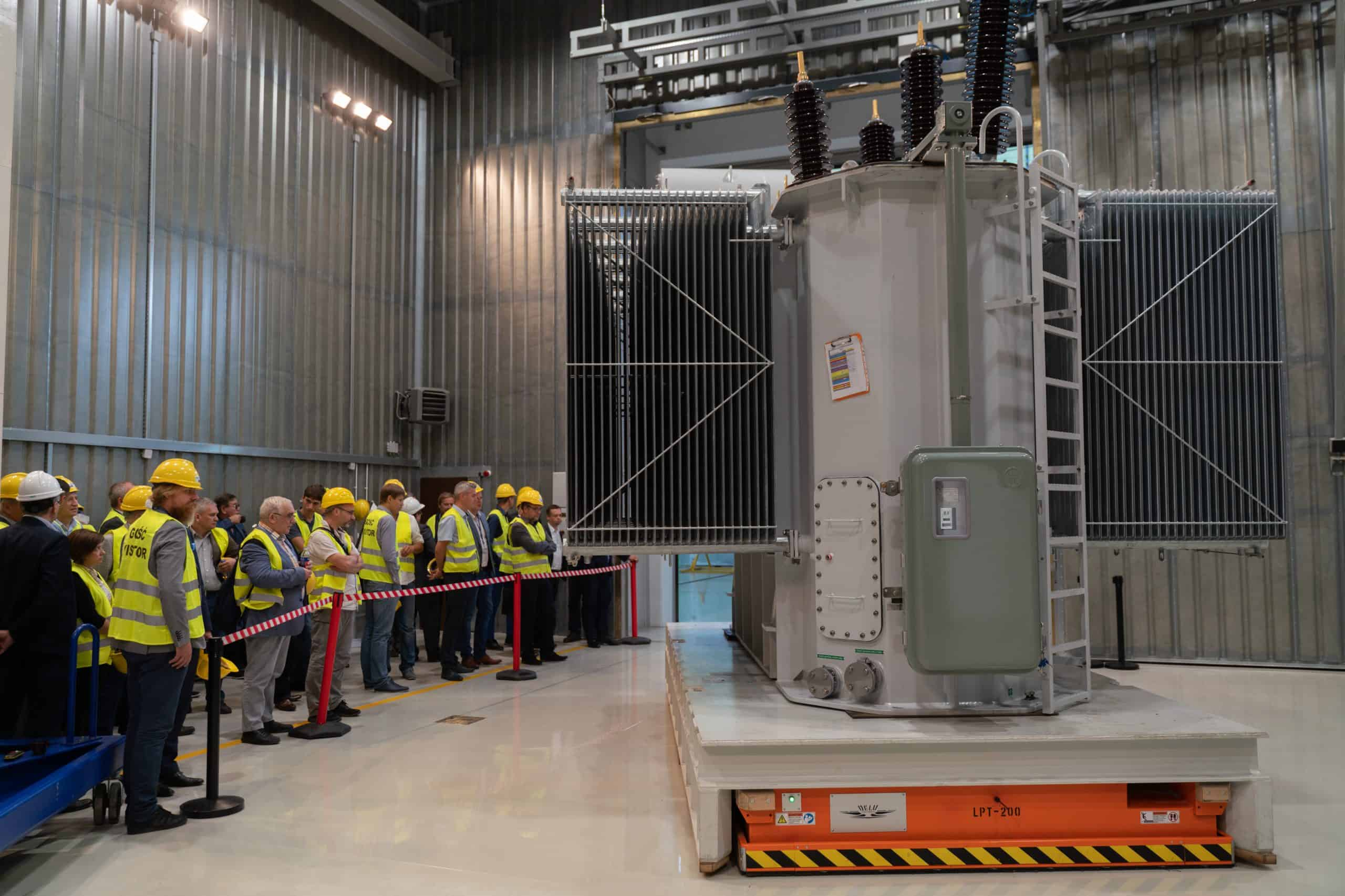
R&S Group has inaugurated its new power transformer manufacturing facility in Łódź, Poland, completing a CHF 29 million investment intended to expand production capacity and support the manufacture of larger electrical transformers.
The plant began operating in October and was formally inaugurated on 3 November, with more than 300 customers, suppliers and government representatives attending the opening.
R&S Group confirmed the development during its Capital Markets Day on 4 November, reporting that the investment had been completed on schedule and within its budget.
The new facility forms part of the expansion of the group’s ZREW transformer business, which manufactures oil-immersed power transformers for electricity networks, generating facilities and industrial applications.
R&S Group is directing more of its portfolio towards larger units, with manufacturing capabilities covering power ratings up to 160 MVA and voltage levels up to 220 kV.
The company also identifies battery energy storage systems, data centres and railway infrastructure among the applications supporting demand for its equipment.
The opening represents the completion of the principal factory investment and the beginning of production at the new facility. It does not establish that the plant has reached its eventual production volume or completed all elements of its manufacturing ramp-up.
R&S Group expects the CHF 29 million investment to achieve payback within 18 months of operations beginning. This is a management forecast rather than a financial result already achieved.
Matthias Weibel, interim chief executive and chief financial officer of R&S Group, said: “We have a new plant and a clear growth plan – now it is all about execution, step by step”.
Weibel said the investment would allow the group to increase its capacity for larger transformers and move towards higher-value applications within its existing markets.
Power transformers enable electrical energy to be transferred between circuits operating at different voltage levels. Their operation relies on electromagnetic induction between windings linked through a magnetic core.
The relationship between the windings determines the voltage transformation, while the design of the core, insulation and associated equipment influences electrical losses, temperature rise and operating performance.
Increasing voltage allows a given amount of power to be transmitted with lower current, reducing the resistive losses that would otherwise occur in conductors. Transformers are therefore used throughout electricity networks to establish suitable voltage levels for generation, transmission and distribution.
Large power transformers require substantial amounts of electrical steel, conductor material, insulation and supporting mechanical components. Their dimensions and mass influence the manufacturing equipment and handling arrangements needed within a factory.
Production involves a sequence of operations that can include core assembly, winding manufacture, installation of insulation, electrical connections, mechanical assembly and filling with insulating liquid.
Each operation must be completed against the design and quality requirements of the finished transformer. Dimensional control, insulation arrangements and the condition of the materials used can affect equipment performance during service.
Transformers must operate under substantial electrical and thermal stresses. The design must account for normal loading, changes in operating conditions and the mechanical forces associated with faults.
Heat is generated through electrical and magnetic losses. Oil-immersed transformers use insulating liquid to provide electrical insulation and support the transfer of heat away from active components.
The cooling arrangement depends on the transformer’s rating and operating requirements. Larger units may require additional heat exchange equipment or other measures to maintain suitable temperatures during operation.
The equipment must also meet the specifications established for its intended installation. Customers can require particular winding configurations, insulation levels, cooling methods, monitoring systems and electrical interfaces.
Manufacturing larger transformers therefore requires more than additional assembly space. The factory must accommodate component handling, specialised production equipment and testing arrangements suitable for the electrical ratings of the units being manufactured.
Verification before delivery is an important part of transformer production. Testing is used to establish whether the finished equipment meets its specified electrical characteristics and other relevant requirements.
Depending on the transformer and applicable standards, testing can address winding characteristics, insulation performance, losses and other parameters associated with operation.
The completed equipment may then require specialist transport arrangements because of its size and weight. Delivery planning must consider access to the installation site and the handling requirements associated with moving large electrical assets.
The Łódź investment was developed to increase ZREW’s manufacturing capability and support a shift towards higher-rated units. In September 2025, R&S Group said the programme was intended to double its power transformer production capacity.
The October 2026 start of operations confirms that the new factory is available for manufacturing. The earlier doubling ambition remains a target to be assessed against actual production as the operation develops.
The company has previously indicated that the expansion could create up to 200 additional local jobs. The November inauguration announcement does not establish that all those positions have been filled.
ZREW has manufactured transformers in Poland since 1957 and became part of R&S Group in 2015. Its activities include the production of equipment for power stations, combined heat and power plants, wind farms, distribution networks and industrial installations.
The business also provides transformer maintenance, repair and diagnostic services. These activities require technical knowledge of transformer condition and performance, including the interpretation of electrical measurements and the condition of insulating materials.
Condition monitoring can help identify changes associated with equipment ageing or developing faults. Relevant methods include insulating oil analysis, thermal inspection and electrical tests examining the condition of transformer components.
Such services complement new equipment manufacturing, although the requirements and operating arrangements differ between an established transformer in service and a new unit undergoing factory qualification.
Demand for transformers is being supported by investment in electricity networks and the connection of new generating, industrial and storage facilities.
Battery energy storage projects require electrical equipment to connect their power conversion systems to the network. Transformer selection depends on the installation’s electrical configuration, operating characteristics and the voltage levels involved.
Data centres can also impose substantial requirements on electrical infrastructure. Their connections and internal distribution arrangements require equipment capable of providing the necessary voltage transformation and supply capacity.
Rail infrastructure introduces different load patterns and installation requirements, depending on the traction power system and the configuration of the associated electrical network.
R&S Group’s expansion programme is intended to position its transformer operations to serve these markets while continuing to supply established utility and industrial customers.
The group also plans to modernise its Irish manufacturing facility during 2027 and 2028, improving flexibility and preparing it to produce equipment with higher power ratings for additional applications.
Those upgrades remain planned investments rather than completed manufacturing capacity. Their scope and operational benefits will depend on the equipment installed and the subsequent development of production activity.
R&S Group reported a record order backlog of CHF 380 million at the end of October, providing visibility over work contracted across its operations.
It reaffirmed its full-year 2026 net sales guidance of CHF 410 million to CHF 420 million, subject to the delivery of large power transformers. The company also maintained its medium-term objectives of annual organic sales growth between 8% and 12% and an EBITDA margin between 19% and 21% over a rolling three-year period.
Order backlog represents business that has been secured but not necessarily completed or recognised as revenue. Manufacturing and delivery schedules remain dependent on production progress, equipment testing and customer project requirements.
For the new Łódź plant, those requirements will determine how quickly the additional capacity contributes to deliveries. Increasing the number of transformers manufactured also depends on the availability of components, skilled employees and the equipment needed for successive production stages.
The factory is now operating, establishing the main physical manufacturing milestone in the expansion programme. R&S Group’s subsequent reporting will show how output, deliveries and financial performance develop as the new production capacity is brought into regular use.