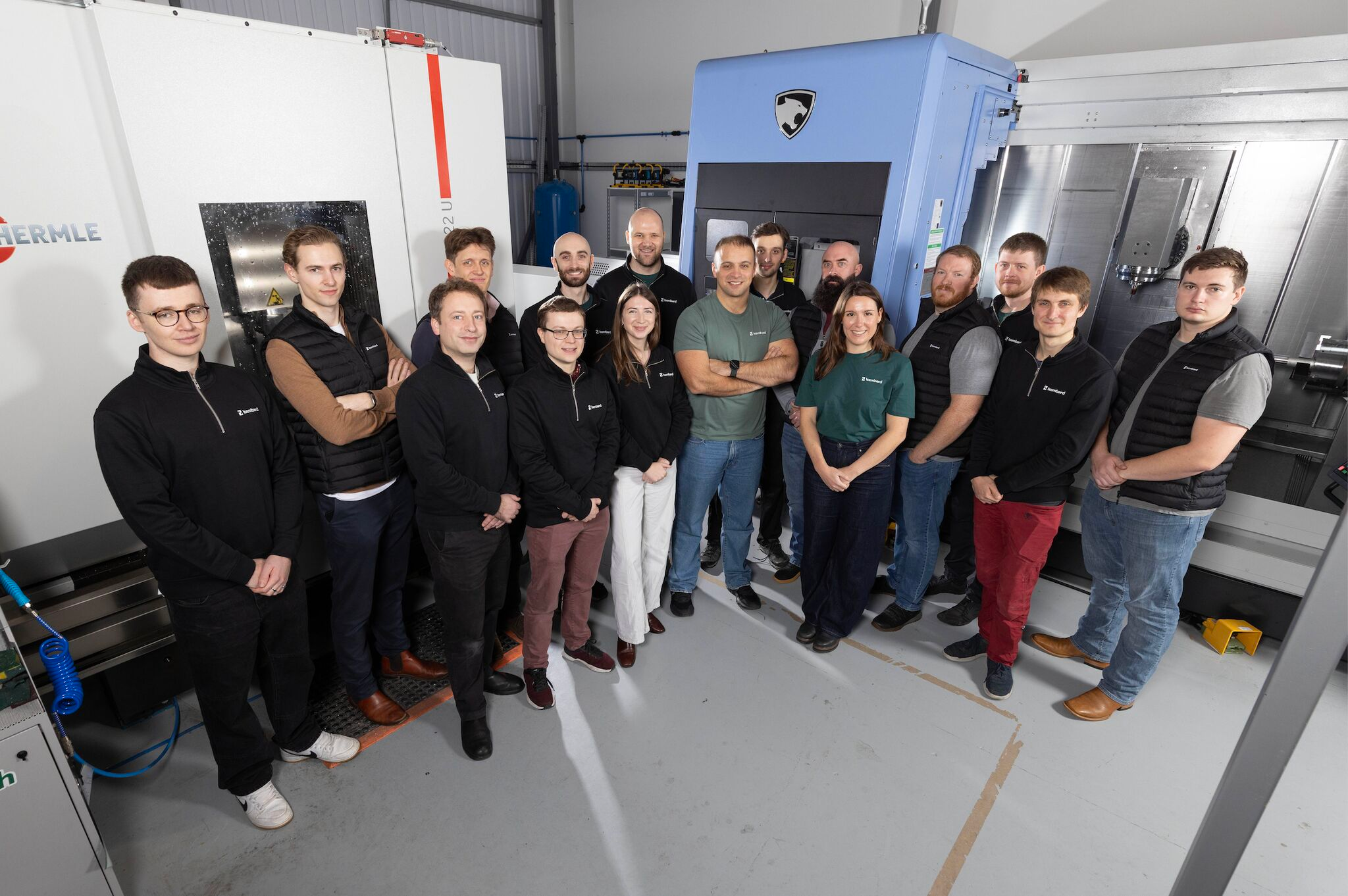
Isembard has opened a precision engineering factory in Swindon, adding a 5,050 sq ft manufacturing facility to its expanding network of locally operated sites serving aerospace, defence and robotics customers.
The factory, located on Paddington Drive, was established in 87 days and has already begun shipping manufactured components. It is owned and operated by Jonathon Griffiths, a former British Army engineering officer who subsequently worked in senior operational roles at Amazon.
Griffiths runs the facility through Isembard’s franchise model, which combines local factory ownership with centrally provided customer orders, manufacturing software, training and quality accreditation.
The site is recruiting three machinists and programmers as production activity develops. Its opening adds another engineering business to Swindon’s industrial base, with an initial focus on components used in technically demanding equipment.
Isembard was founded in 2024 and has been building a network of manufacturing facilities across the UK, Europe and the United States. Its expansion programme includes both company-operated and franchise facilities, with local operators responsible for managing individual production sites.
The company currently identifies 17 factories within its network, comprising 11 live sites and six that are being onboarded. Swindon is listed among the operating factories, rather than those still undergoing preparation.
That distinction is important when considering the network’s production capacity. A site being onboarded does not necessarily provide the same manufacturing capability as a facility already operating equipment and fulfilling customer orders.
The Swindon opening follows earlier investments elsewhere in the network, including a £750,000 manufacturing facility in Milton Keynes announced in October. The developments concern separate sites and represent successive additions to Isembard’s UK operations.
The new factory will concentrate on precision machining, using computer numerical control (CNC) equipment to manufacture components to defined geometrical requirements.
CNC machining involves translating engineering designs into programmed movements of cutting tools and workpieces. The equipment removes material under controlled conditions to produce specified shapes, dimensions and surface characteristics.
The manufacturing process depends on the material being processed, the equipment configuration, cutting tools, workholding arrangements and the requirements of the finished component.
Dimensional accuracy must be established through suitable measurement and inspection. Factors including machine condition, tool wear, thermal effects and the stability of the workpiece can influence the dimensions achieved during machining.
Isembard describes its equipment as capable of producing components to very close tolerances, using a fraction of a sheet of paper’s thickness as an illustration of the precision involved.
Actual tolerances vary between components and processes. The company’s general description should not be interpreted as a guarantee that every manufactured feature can be produced to the same dimensional limit.
Aerospace and defence components can require controlled manufacturing processes, material traceability and detailed inspection records. The requirements depend on the intended application and the technical specifications supplied by the customer.
Robotics manufacturers may need precision components for mechanical assemblies, equipment housings, brackets and interfaces connecting actuators or sensing equipment to other parts of a system.
Producing such components can involve a combination of machining, inspection and additional processing. Some parts may require heat treatment, surface finishing or other operations before they are suitable for incorporation into finished equipment.
The ability to manufacture parts consistently is particularly important when a customer moves from prototype development towards repeated production. A component may initially be manufactured in small numbers for testing, with subsequent orders requiring a reliable process and predictable delivery arrangements.
Isembard’s franchise model is designed to connect these customer requirements with manufacturing facilities distributed across different locations.
The company provides common software and operational support, while individual factory owners manage their employees, equipment and local production activity. Customer work can then be coordinated through the wider network.
This arrangement differs from a conventional independent machine shop developing all its own commercial, technical and operating systems. It allows factory owners to use shared infrastructure while retaining direct responsibility for managing their businesses.
Manufacturing software can support the planning and allocation of production work, although the quality and delivery of finished components still depend on the capabilities of the machines, employees and inspection systems at the selected factory.
Different facilities may possess different equipment and available capacity. Assigning an order therefore requires a match between the customer’s specification and the production resources capable of meeting it.
Griffiths’s background includes service in the Royal Electrical and Mechanical Engineers, the British Army corps responsible for maintaining and supporting military vehicles and equipment.
He trained at the Royal Military Academy Sandhurst and was commissioned in 2015. His military work included responsibility for equipment maintenance and supporting operational readiness.
After leaving the Army in 2018, Griffiths joined Amazon, where he held roles in delivery operations across London and southern England. He later moved into a senior management position in Swindon.
His experience managing equipment and operational teams provides a different route into manufacturing ownership from the conventional progression through an engineering apprenticeship or established machine shop business.
Griffiths said: “I want this to be a factory where people in Swindon can learn a trade and stay for the long term.”
The recruitment programme will be important to establishing the site’s local manufacturing capability. CNC equipment depends on employees who can prepare operations, select suitable tooling, manage machining programmes and verify that finished products meet the required specifications.
Programming and machining skills also influence the efficient use of equipment. Appropriate cutting strategies, machine setup and inspection procedures can affect production time, material consumption and the number of components requiring rework.
Swindon’s manufacturing history played a part in the decision to establish the facility. The town has longstanding connections to railway engineering, aircraft manufacture and vehicle production, including the former Honda plant that closed in 2021.
The wider area also contains businesses involved in defence technology and uncrewed systems. Their development can create demand for prototype manufacturing, specialist engineering and low-volume component production.
The new factory provides one additional source of local capacity, although its contribution will depend on the types of equipment installed, the available workforce and the volume of orders it can fulfil.
Will Stone, MP for Swindon North and chair of the Cross-Party Group to Strengthen the UK Defence Supply Chain, assisted the search for suitable premises after visiting Isembard’s London headquarters.
Stone helped connect Griffiths and Isembard with the property opportunity on Paddington Drive. The factory has since been established and begun production, rather than remaining at the site-selection or planning stage.
Alexander Fitzgerald, founder and chief executive of Isembard, said: “With generations of engineering skill and a growing defence and drone industry on its doorstep, Swindon was the obvious choice for our next factory.”
He identified Griffiths’s operational experience and familiarity with the local workforce as factors supporting the decision.
Isembard wants to reach 100 company-operated and franchise factories across the UK by the end of 2028, with the programme potentially creating 2,200 skilled jobs.
These figures represent the company’s expansion ambitions. They do not establish that all the planned facilities have secured premises, installed machinery or begun recruiting.
Scaling a distributed manufacturing network requires a continuing supply of suitable customer work, operators capable of running factories and employees with the technical skills needed to maintain consistent production.
Shared operating systems may support coordination, but each new facility must establish its machinery, workforce, quality controls and production processes before it can contribute effectively to the network.
The Swindon factory has passed that initial stage and is already supplying customers. Recruitment and the development of further manufacturing capacity will determine how the operation expands as additional work is allocated to the site.