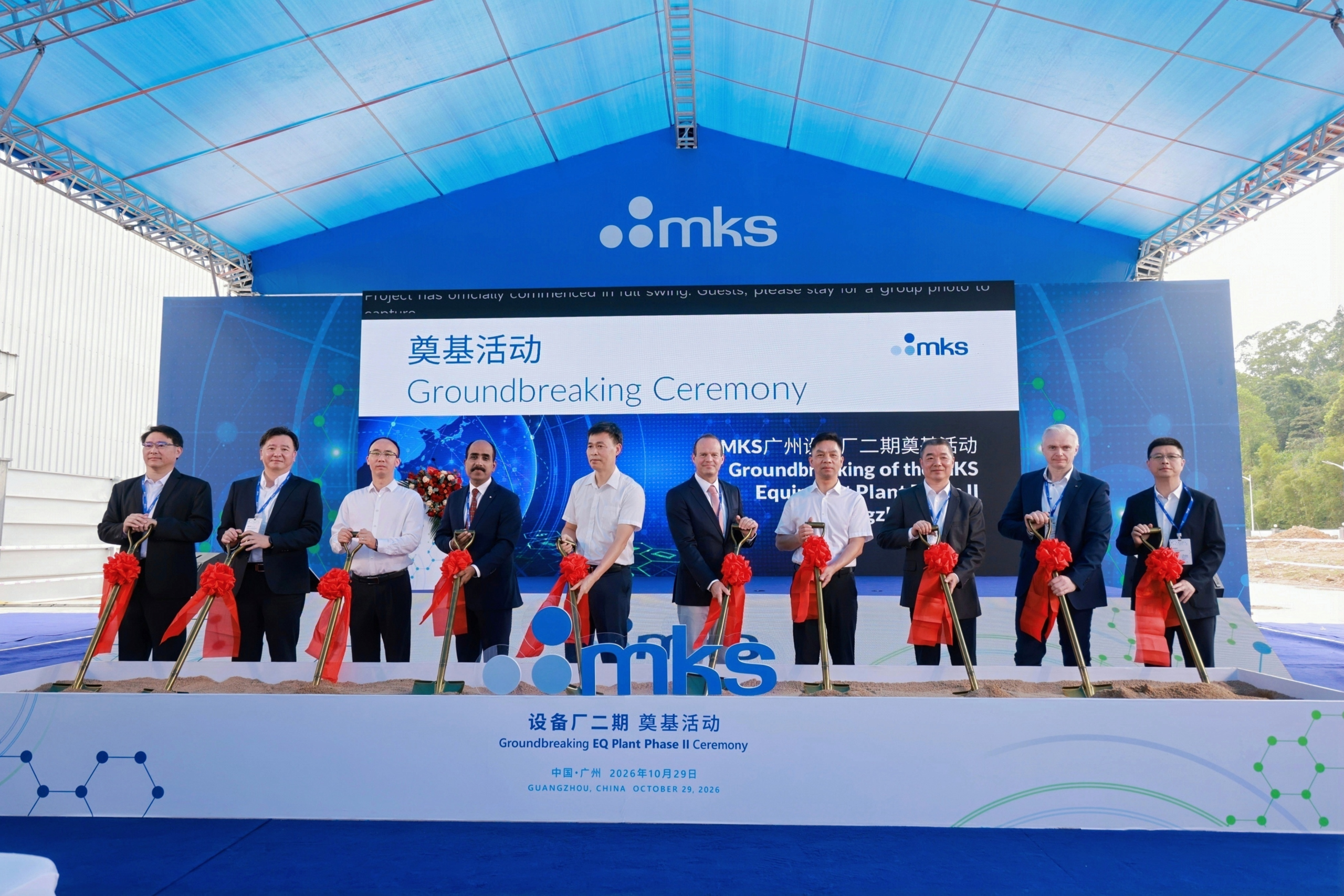
MKS has begun expanding its Atotech equipment manufacturing facility in Guangzhou, China, through a $25m investment programme responding to demand for plating equipment used in advanced electronics production. The project will enlarge the site from 20,000m² to 50,000m², add 30 machining and fabrication systems and create more than 300 potential employment opportunities. MKS now targets completion in the third quarter of 2027.
The project was announced in June 2026 with an initial fourth-quarter 2027 target and a projected doubling of production capacity. MKS confirmed the commencement of the expansion on 2 November and brought its completion forecast forward to the third quarter. Its latest update describes a substantial increase in sustainable annual production capacity but does not provide a revised numerical production target or a confirmed future equipment shipment rate.
MKS operates the Atotech business within its Materials Solutions division, supplying process chemicals, manufacturing equipment and associated services for printed circuit boards, semiconductor applications and advanced electronic packaging. The Guangzhou site manufactures equipment used in plating operations. Growth in these markets can increase requirements for production systems able to deposit controlled metal layers on increasingly complex substrates while maintaining repeatability across multiple processing stages.
Industrial plating equipment combines process tanks with controlled movement of workpieces, chemical management, electrical systems and rinsing stages. Components must be exposed to specified treatment conditions as they pass through successive operations, with fixtures, transfers and process controls arranged to preserve consistent results. Different applications place different demands on the equipment, and MKS has not identified individual Guangzhou machine models or process-line designs within the latest expansion update.
The new machining and fabrication systems will increase Guangzhou’s capacity to make parts and assemblies for its equipment. That investment could also change the balance between externally sourced components and manufacturing performed on site. The effect on production lead times will depend on which fabrication and assembly bottlenecks the added equipment addresses and whether customer demand, component supply and testing capacity keep pace.
Manufacturing capacity is being expanded alongside the site’s project-execution and local installation teams. Plating lines frequently require integration with a customer’s site utilities, handling arrangements and production controls after factory work is complete. Engineers must therefore coordinate assembly, testing, shipment and commissioning. MKS says its development programme will also include training, knowledge sharing and projects undertaken with teams elsewhere in the group.
Research and development operations will remain at Guangzhou, with dedicated areas planned for new-product testing and validation. MKS also intends to expand engineering capability through training, knowledge sharing and projects with its global teams. Testing facilities can help engineers check function and process compatibility before new equipment enters customer production, although the company has not disclosed a new laboratory throughput target or the number of development programmes to be handled at the enlarged site.
The business links the capacity increase to customers in Greater China and Southeast Asia, particularly Thailand and Vietnam. Electronics manufacturing investment in these locations creates demand for process equipment close enough to customer plants to support specification changes, service and production ramp-up. The company characterises the regional demand as significant but has not published a customer-order total attributable solely to Guangzhou or a breakdown of equipment deliveries by country.
The additional floor area will have to accommodate material movement, fabricated parts, equipment assembly and inspection as the plant’s output rises. Machined components need to meet design tolerances before assemblies can be built, and control systems require functional checks before equipment is released for installation. The company has confirmed the overall expansion and additional systems but has not disclosed a detailed production layout plan.
The facility sits in Guangzhou’s Huangpu district, where MKS reached an expansion agreement with local authorities earlier in 2026. The company has now formally commenced the next phase, while the timetable for individual fabrication cells remains unspecified. Machinery installation and production qualification will have to be coordinated with ongoing customer equipment deliveries as construction proceeds.
Construction, machinery installation and process qualification will determine how quickly the additional fabrication systems contribute to productive capacity. MKS intends to extend Guangzhou’s technical support alongside the factory enlargement, with completion targeted for the third quarter of 2027. Sustained equipment output and installation activity will show how the enlarged manufacturing and engineering operation performs.